
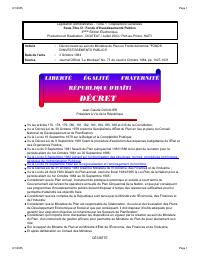
Decree Creating the Public Investment Fund
Summary: The decree of 3 October 1984 creating the Public Investment Fund (Fonds d'Investissements Publics) within the Ministry of Plan, published in Le Moniteur No. 71 of 4 October 1984 at pages 1027 to 1031. It separates development financing from general state revenue, lists the fund's four resource types, splits allocation (Ministry of Plan) from control of use (Ministry of Economy, Finance and Industry), and creates the special Treasury account through which public investment has been financed since. This is the founding instrument of Haiti's PIP machinery.
Key Findings
- The decree's core act is a separation: resources devoted to financing public-sector development operations are separated from the mass of state revenue and constitute the ways and means of the Public Investment Fund (article 4). Ring-fencing investment money from the general budget is the design choice everything else follows from.
- The fund's resources are defined broadly enough to cover the whole development budget: Treasury funds, the own funds of autonomous bodies and public enterprises, all other national funds, and loans and grants from external agencies (article 5).
- Allocation and control are deliberately split between two ministries. Allocating the resources is the competence of the Ministry of Plan; controlling their use falls to the Ministry of Economy, Finance and Industry (article 6). Financial execution of the Public Investment Program is MEFI's, which opens a special Treasury account for the purpose (article 7).
- That account is the instrument that survives in current practice: the special Treasury account centralizes all resources allocated to development listed in article 5, and is named in the 1985 implementing order as the Compte Spécial du Trésor pour le Développement.
- The Ministry of Plan is given a gatekeeping function over project quality, not only over money. It must satisfy itself that project objectives are defined qualitatively and quantitatively and serve the Plan's objectives, that operation plans are properly formulated as to activities, spatial distribution, phasing, logical order and cost, and that financial plans are coherent with the activities (article 9).
- Cash management is calendared rather than ad hoc: the Ministry of Plan draws up a forecast calendar of financing needs at the start of the fiscal year and periodic disbursement programs during it, and MEFI feeds the special account on the first and keeps project accounts regularly and sufficiently supplied on the second (articles 10 and 11).
- Project management sits with the executing agency, which may be a ministerial department or an autonomous body (article 12), so the fund finances and monitors but does not implement.
- The legal lineage is worth recording because it dates the architecture: the decree cites the 1978 decree-law creating the Secretariat of State for Plan in place of the National Development and Planning Council, the law of 16 September 1979 on the budget and public accounting, the decree-law of 9 September 1981 on the procedure for executing state budget expenditure, the law of 9 September 1981 making the 1981-1986 five-year plan the nation's plan-law, the law of 6 September 1982 on uniform administrative structures, the law of 19 September 1982 on regionalization and territorial development, the decree-law of 31 October 1983 creating MEFI, and the law of 24 August 1984 making the annual plan for fiscal 1984-1985 the plan-law.
- The reasoning given for the fund is a timing problem: the annual plan is the operational tranche of the five-year plan, so its public investment programs must have sufficient resources in time to reach the objectives set. The instrument was created to solve late money, not missing money.
How to cite
Ministry of Planning and External Cooperation (MPCE), 1984, Decree Creating the Public Investment Fund, https://www.mpce.gouv.ht/wp-content/uploads/2025/10/Decret-1984-creant-le-Fonds-d_Investissement-Public-FIP.pdf