
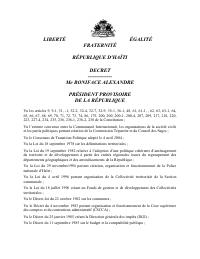
Decree on the Organization and Functioning of the Communal Section
- Signed at the National Palace in Port-au-Prince on February 1, 2006, the decree revises the law of April 4, 1996 on the communal section.
- Casec and Asec members are elected for four years and may be re-elected without limit (Article 6).
- The Asec elects one member per habitation of under 500 residents and two per large habitation, quartier or village (Article 17).
- Sections are subject to audit by the CSCCA, legality review by the Ministry of the Interior, and a Finance Ministry paying cashier assigned to the Casec (Articles 112 and 113).
- Each section's budget covers one fiscal year, based on its own and external expected revenue (Article 124).
Issued on the report of the Minister of the Interior, the decree defines the communal section as the smallest administrative entity of the Republic, with administrative and financial autonomy. Its territory is organized into quartiers, habitations and a village, which is its chief town. Ten titles cover general provisions, the two organs (the executive Conseil d'administration de la Section communale, or Casec, and the deliberative Assemblée de Section communale, or Asec), conflict resolution, installation of the organs, administrative services and staff, oversight and relations with other bodies, financing and the annual budget, and the section's land holdings. Members of both organs serve four-year terms and may be re-elected without limit. Asec members are elected by direct universal suffrage on lists put forward by registered local associations. The decree also creates a Conseil de développement de la Section communale (CDSC).
How to cite
Ministry of the Interior and Local Government (MICT), 2006, Decree on the Organization and Functioning of the Communal Section, https://www.mict.gouv.ht/wp-content/uploads/2016/04/Decret-Portant-Organisation-et-Fonctionnement-de-la-Section-Communale.pdf