
Mango Value Chain and Opportunities for Secured Credit
- Records mango exports averaging more than 7 million US dollars a year between 2001 and 2010, reaching 9 million in 2006, 9.6 million in 2008 and 10.51 million in 2009.
- Finds the export market far from saturated, with the American market able to absorb more than double the 2 million cases currently shipped and absorbing about 67 percent of total export volume.
- Identifies rejection rates as the value leak: about 50 percent of fruit volume is commonly rejected, rejects lose value and resell at 20 to 50 percent of the price, and one buyer's stated aim was to improve quality by reducing the rejection rate.
- Traces the price chain from producer to exporter: rural market producers receive 2.00 gourdes a kilogram for common varieties and 5.00 for quality varieties, madan sara buy and resell to exporters at 35.00 to 55.00 gourdes, and export firms pay from USD 4.00 to 8.50 depending on exporter and period.
- Prices the certification economies of scale precisely: FENAPCOM pays about USD 18,000 a year for organic and fair trade certifications, where separate certification for every organization would exceed USD 50,000 a year.
- Records a working credit operation at the scale that actually exists: KFSE manages a portfolio of 1,331,000 gourdes across 340 clients, lending 1,200 to 25,000 gourdes at 3 percent.
- Notes that about 75 percent of production is sold on the local market against about 6 percent exported and 10 to 20 percent self-consumed, so the export debate concerns a small share of the crop.
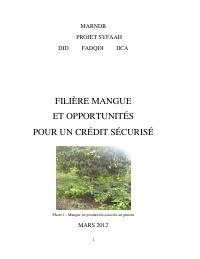
Produced under the SYFAAH project by MARNDR with Développement International Desjardins, FADQDI and IICA, this 84-page study examines the mango chain specifically through the lens of secured credit: not simply how the chain works, but where in it a lender could advance money against collateral or a contracted crop. It sets out general and specific objectives, methodology, and the chain from production - including mango grown in association with other crops such as chili peppers, as its cover photograph shows - through to export. It belongs with the other SYFAAH value-chain diagnostics on rice, banana and priority chains. Note the file is named for April 2013 while the cover is dated March 2012; the earlier date is used here.
How to cite
Ministry of Agriculture, Natural Resources and Rural Development (MARNDR); SYFAAH; Développement International Desjardins (DID); FADQDI; Inter-American Institute for Cooperation on Agriculture (IICA), 2012, Mango Value Chain and Opportunities for Secured Credit, https://agripubhaiti.org/wp-content/uploads/2025/03/Marndr-Syfaah-Etude-filiere-mangue-version-finale-avril-2013.pdf