
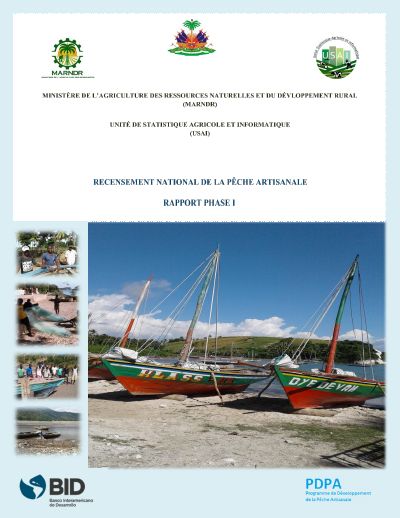
National Artisanal Fisheries Census: Phase I Report
- 590 landing sites were identified nationwide, 132 of them in Ouest, 107 in Sud and 98 in Nord-Ouest, together more than 57% of the total.
- An estimated 72,253 fishers work from these sites, about 122 per site; Ouest, Sud and Nippes hold more than half.
- 26,641 fishing boats were counted, an average of 45 per site, ranging from 18 per site in Nord-Ouest to 102 in Nippes.
- Dugout canoes (bois fouillé) make up 54.6% of the fleet (14,543 units) and fiberglass boats only 2.5% (663 units).
- A fishers' association was present at 44% of landing sites, from 75% in Grand'Anse to 14.3% in Nord-Ouest.
Phase I of the census had one purpose: to find and size every fish landing site on Haiti's coast so that phases II and III could be planned. The USAI recruited 35 enumerators and 9 supervisors from 92 applicants, grouped coastal communes into survey axes and collected data on tablets with GPS points and photos between 17 December 2017 and the end of January 2018, with support from the ministry's departmental offices. The report stresses that the results are approximate.
The census counted 590 landing sites, led by Ouest (132), Sud (107) and Nord-Ouest (98), with Nord-Est lowest at 11. It estimates 72,253 fishers, about 122 per site, and 26,641 boats, about 45 per site. Dugout canoes (bois fouillé) make up 54.6% of the fleet, wooden canoes 30.7%, corallins 12% and fiberglass boats 2.5%. A fishers' association, formal or informal, was present at 44% of sites. Annexes give department and commune tables and maps of sites and boat types.
How to cite
Ministry of Agriculture, Natural Resources and Rural Development (MARNDR), 2018, National Artisanal Fisheries Census: Phase I Report, https://haitistatagri.com/rapportPhase1.pdf
- Rights holder
- Ministère de l'Agriculture, des Ressources Naturelles et du Développement Rural (MARNDR)