
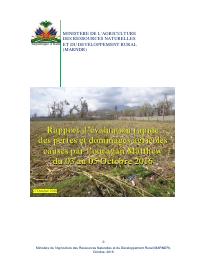
Rapid Assessment of Agricultural Losses and Damage from Hurricane Matthew
- The bill falls almost entirely on private holders. Of 37,910.22 million gourdes in total losses and damage, only 935.40 million is public, about 2.5 percent. Losses of 23,933.34 million are recorded as wholly private, and of 13,976.88 million in damage, 13,041.48 million is private.
- The headline total is 38 billion gourdes, about 583 million US dollars at the report's own rate of 65 gourdes to the dollar, which MARNDR sets against national accounts as 7 percent of GDP or 31 percent of agricultural GDP on a 2015 reference.
- The largest single line is not annual crops but perennials: 7,390.19 million gourdes, against 2,252.06 million for annual crops. Adding forestry losses of 8,747.27 million and reforestation damage of 4,436.12 million, the tree stock accounts for more of the bill than the season's harvest does, which is why recovery is measured in years rather than in one campaign.
- Timing made the loss worse in two ways at once. Matthew struck during the full summer campaign, about 20 percent of national agricultural output, while spring-campaign annual crops were still standing; and because the spring campaign, about 60 percent of national output, had only just ended, much of its harvest was still in store and was destroyed with the storage.
- Livestock deaths are counted in the millions for poultry and the hundreds of thousands for small ruminants: about 2,000,000 poultry, 374,000 goats, 163,000 pigs, 102,000 cattle, 74,000 sheep and 23,000 equines, with associated product losses of 48 million eggs, 700,000 liters of milk and 260 tonnes of honey.
- Crop loss volumes are concentrated in roots and tubers rather than cereals: 29,200 tonnes of roots and tubers, 18,000 tonnes of pulses and 7,900 tonnes of cereals, with Grand'Anse taking 54 percent of root and tuber losses and 35 percent of pulse losses.
- Destroyed stocks are reported separately and are substantial in their own right: 7,595 tonnes of pulses, 6,387 tonnes of roots and tubers and 2,609 tonnes of bananas, lost with the granaries, silos and warehouses that held them.
- Productive infrastructure damage extends past farms. About 16,000 hectares of irrigated perimeters were affected through silted canals and damaged intakes; some 472,500 square meters of salt pans at Aquin, Grande Saline and Anse-Rouge were damaged; and MARNDR's own departmental and communal offices, four research centers and a range of processing plants were hit.
- The exposed population is a third of the country. MARNDR puts 3.3 million people, 30.6 percent of the population, in the impact zones, of whom 2.7 million are rural, and estimates that 427,936 farm holdings, equivalent to more than 2 million people, were decapitalized across seven departments. Five were severely hit: Sud, Sud-Est, Nippes, Grand'Anse and the western part of Nord-Ouest.
- Two gaps are stated rather than papered over. Environmental and ecosystem damage could not be valued and is flagged as needing a dedicated impact study by MARNDR and the Ministry of the Environment; and for salt production only damage was counted, with losses and stocks omitted. The report also notes that the sector was already contracting, with agricultural performance down 3.3 percent on the previous year.
Issued by MARNDR on 27 October 2016, three weeks after the storm, this report is the ministry's rapid assessment of agricultural losses and damage caused by Hurricane Matthew between 3 and 5 October 2016. It sets out antecedents, then the strength of the hurricane and its impact zones, before the loss and damage figures. As the agriculture ministry's own first-pass numbers it is the sectoral counterpart to the government's full post-disaster needs assessment of January 2017, and it precedes the more detailed crop-specific work such as the CRS cacao assessment for the Grand'Anse. For anyone reconstructing what Matthew did to Haitian agriculture, this is the earliest official quantification.
How to cite
Government of Haiti; Ministry of Agriculture, Natural Resources and Rural Development (MARNDR), 2016, Rapid Assessment of Agricultural Losses and Damage from Hurricane Matthew, https://agripubhaiti.org/wp-content/uploads/2025/03/E-valuation-rapide-Matthew-dommages-et-pertes-final.pdf