
Contribution of the Egg Industry to the Haitian Economy
- Sizes the market the domestic egg industry is competing for: local demand of 495.6 million eggs a year, worth 2,612 million gourdes at consumer prices, including imports estimated at 35 million eggs a month.
- Records what poultry entrepreneurs will actually borrow, which is the operative constraint: farms of 70 to 1,000 pullets, more used to credit unions and savings and loan cooperatives, are ready to accept loans of 50,000 gourdes to 1 million over 18 to 36 months at 18 to 24 percent a year.
- Proposes two specific instruments rather than general support, a partial guarantee fund on the model of the Salvadoran FSG, and co-financing programmes at very low rates to pull down the average rate poultry entrepreneurs pay and raise loan sizes.
- Traces the exchange rate rather than inflation as the transmission channel, because maize, soya, vitamins and egg trays are imported and enter feed costs directly, and states that the real effect of inflation and interest rates is otherwise hard to isolate.
- Records BRH 90-day bill rates as the historical reference for local lending rates, reaching up to 28 percent in 2003, and notes monetary policy performance has not had the expected effect on the gourde-dollar rate.
- Sets the nutritional case with SMART February 2012 data, chronic malnutrition at 23.4 percent nationally with the Nord-Est at 32.9 percent, Grand'Anse at 27.6 percent and Nord at 27 percent, and severe chronic malnutrition at 7.1 percent.
- Notes a hatching yield of about 86 percent for broiler chick production, which is the technical benchmark the investment case rests on.
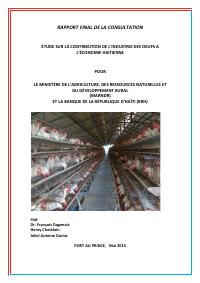
Prepared by Dr François Dagenais, Henry Chatelain and Jeliel Antoine Darius for MARNDR and the Bank of the Republic of Haiti, and issued in Port-au-Prince in May 2015. Its central finding is a rare instance of rapid measured growth in Haitian agriculture: between 2010 and 2015 intensive egg production quintupled, from a flock of 50,000 laying hens to 250,000, with domestic output of a quality that allowed producers to compete against imported eggs which the report characterizes as being in most cases the product of dumping and contraband. The study argues that expansion can continue under MARNDR's leadership provided specified constraints are resolved. It is the analytical basis for the laying-hen recovery plan of December 2016 and one of the few documents here that quantifies a growing sub-sector rather than a declining one.
How to cite
Ministry of Agriculture, Natural Resources and Rural Development (MARNDR); Bank of the Republic of Haiti (BRH), 2015, Contribution of the Egg Industry to the Haitian Economy, https://agripubhaiti.org/wp-content/uploads/2025/03/Oeufs-Rapport_final_haiti_oeufs_fd_4_juil_2015-b.pdf