
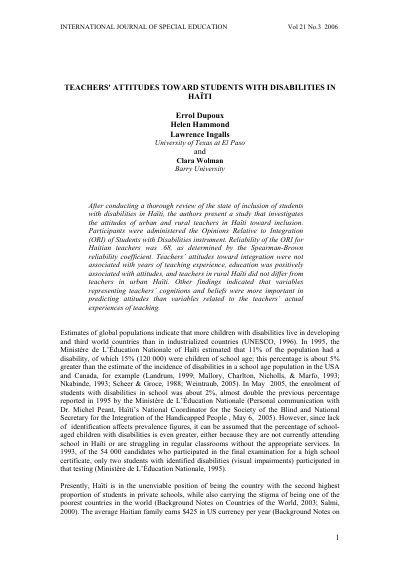
Teachers' Attitudes Toward Students with Disabilities in Haïti
- Rural and urban teachers in Haiti did not differ in their attitudes toward integrating students with disabilities, and both groups showed moderate acceptance.
- Attitudes were uncorrelated with years of teaching experience.
- Teachers with Master's degrees held more positive attitudes than teachers with less education.
- Variables for teachers' cognitions and beliefs explained almost twice as much variance in attitude as the actual experience of teaching.
- Teachers were most likely to say they could accommodate learning disabilities and least likely to say so for emotional disorders.
The article, published in the International Journal of Special Education in 2006, first reviews the state of inclusion of students with disabilities in Haiti. It cites a 1995 Ministry of Education estimate that 11% of the population had a disability, and a May 2005 enrollment of students with disabilities of about 2%. It then reports a survey of 183 elementary and secondary teachers drawn from three public schools, five Catholic schools and six nondenominational private schools, with a return rate of 72%.
Teachers answered the Opinions Relative to Integration of Students with Disabilities questionnaire, which had a reliability of 0.68 for this sample. Rural and urban teachers did not differ in attitudes, and attitudes were uncorrelated with years of teaching experience. Teachers with Master's degrees had more positive attitudes than other teachers. Variables for teachers' cognitions and beliefs explained almost twice as much of the variance in attitude as the experience of teaching, although almost 90% of the variance remained unexplained.
How to cite
International Journal of Special Education, 2006, Teachers' Attitudes Toward Students with Disabilities in Haïti, accessed via HaitiDocs, https://www.haitidocs.org/doc/ijse-2006-teachers-attitudes-students-disabilities-haiti
- Rights holder
- International Journal of Special Education