
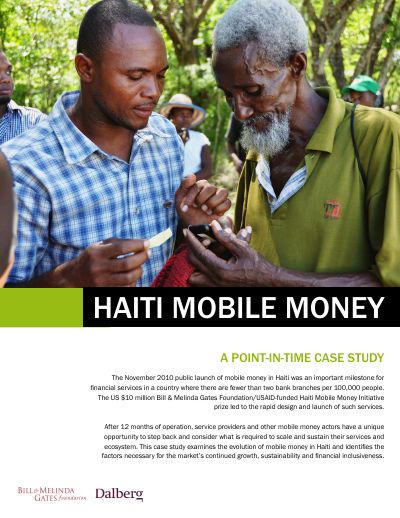
Haiti Mobile Money: A Point-in-Time Case Study
- Two services launched within weeks of each other after the earthquake: TchoTcho Mobile in late November 2010 and T-Cash in early December 2010.
- Growth in transactions was quick, but the services remained limited to cash in, cash out and person-to-person transfers, with bank integration, bill payment and merchant payments still to come.
- A University of California, Irvine survey six months after launch found that only 10 percent of respondents had signed up, although more than 80 percent were aware of the services.
- Early adopters were better educated than the population: more than 60 percent had at least a secondary education, compared with 37 percent of the population.
- The transaction limit of US $250 in Haiti is conservative compared with other markets such as Kenya, where wallets can hold up to US $590.
- The study names three areas where grant funds could ease constraints: keeping HIFIVE as an independent convener and broker, consumer research, and selective subsidies for new products and technology.
The study describes the mobile money ecosystem of service providers, technology providers, agents, vendors, consumers and regulators, and the two services launched after the earthquake: TchoTcho Mobile (Digicel and Scotiabank) in late November 2010 and T-Cash (Voila and Unibank) in early December 2010. It organizes the market's development into launch and grow, sustain, and evolve stages, and reports early survey evidence from the University of California, Irvine on who signs up and why others do not. The Haiti Mobile Money Initiative included a US $10 million prize and a USAID-funded team, HIFIVE, that acts as a broker between consumers, regulators and service providers.
The study finds that growth in transactions was quick but that services remained limited to cash in, cash out and person-to-person transfers, with bank integration, bill payment and merchant payments still being developed. It points to a transaction limit of US $250 in Haiti, conservative compared with other markets, and to the weight of non-governmental organizations, which account for a large share of the world's cash deployment programs on a mobile money platform. It also discusses how the prize money, estimated at 30 to 50 percent of typical launch costs in other markets, should shape further donor support.
How to cite
Dalberg Global Development Advisors; GSMA, 2012, Haiti Mobile Money: A Point-in-Time Case Study, https://gsma.com/solutions-and-impact/connectivity-for-good/mobile-for-development/wp-content/uploads/2012/05/Haiti-Mobile-Money.pdf
- Rights holder
- Dalberg Global Development Advisors|GSMA