Republic of Haiti
Document Library
4,925 documents 215,848 pages
Haiti Seasonal Monitor: Vegetation health affected by dry conditions, 2 September 2026

Haiti Seasonal Monitor: Vegetation health affected by dry conditions, 2 September 2026

Summary — FEWS NET's seasonal monitor for Haiti of 2 September 2026. Below-average rainfall and above-average temperatures are reducing soil moisture and holding back normal crop development, and vegetation health has declined steadily over the preceding thirty days, with the sharpest deficits in parts of the Sud and Sud-Est. Insufficient rain has delayed fall planting in some areas, and forecast deficits through early September may further limit the establishment of newly planted crops.
Key Findings
Full Description

FEWS NET's Haiti seasonal monitor of 2 September 2026, reporting on rainfall, temperature and vegetation health.

The key messages are three. Below-average rainfall and above-average temperatures are affecting normal crop development and reducing soil moisture. Vegetation conditions continue to degrade, with pronounced deficits in parts of the Sud and Sud-Est departments. And insufficient rainfall has delayed planting for the fall season in some areas, while rainfall deficits forecast through early September may further limit the establishment of newly planted crops.

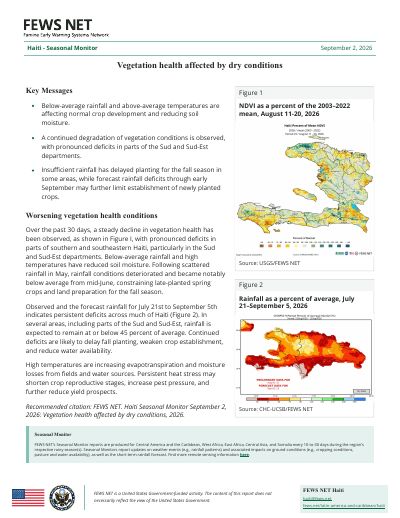
On vegetation, the monitor records a steady decline over the preceding thirty days, measured as NDVI against the 2003-2022 mean for 11 to 20 August 2026, with the deficits concentrated in southern and southeastern Haiti. Below-average rainfall and high temperatures have reduced soil moisture. Rainfall was scattered in May, then deteriorated and fell below average from mid-June, which constrained late-planted spring crops and land preparation for the fall season.

On rainfall, observed and forecast totals for 21 July to 5 September 2026 indicate persistent deficits across much of Haiti.

Sectors
Geography
Time Coverage
2026-08 — 2026-09
Full Document Text

Extracted text from the original document for search indexing.

Haiti - Seasonal Monitor September 2, 2026 Vegetation health affected by dry conditions Key Messages Figure 1 Below-average rainfall and above-average temperatures are affecting normal crop development and reducing soil moisture. NDVI as a percent of the 2003–2022 mean, August 11-20, 2026 A continued degradation of vegetation conditions is observed, with pronounced deficits in parts of the Sud and Sud-Est departments. Insufficient rainfall has delayed planting for the fall season in some areas, while forecast rainfall deficits through early September may further limit establishment of newly planted crops. Worsening vegetation health conditions Over the past 30 days, a steady decline in vegetation health has been observed, as shown in Figure I, with pronounced deficits in parts of southern and southeastern Haiti, particularly in the Sud and Sud-Est departments. Below-average rainfall and high temperatures have reduced soil moisture. Following scattered rainfall in May, rainfall conditions deteriorated and became notably below average from mid-June, constraining late-planted spring crops and land preparation for the fall season. Observed and the forecast rainfall for July 21st to September 5th indicates persistent deficits across much of Haiti (Figure 2). In several areas, including parts of the Sud and Sud-Est, rainfall is expected to remain at or below 45 percent of average. Continued deficits are likely to delay fall planting, weaken crop establishment, and reduce water availability. Source: USGS/FEWS NET Figure 2 Rainfall as a percent of average, July 21–September 5, 2026 High temperatures are increasing evapotranspiration and moisture losses from fields and water sources. Persistent heat stress may shorten crop reproductive stages, increase pest pressure, and further reduce yield prospects. Recommended citation: FEWS NET. Haiti Seasonal Monitor September 2, 2026: Vegetation health affected by dry conditions, 2026. Source: CHC-UCSB/FEWS NET Seasonal Monitor FEWS NET’s Seasonal Monitor reports are produced for Central America and the Caribbean, West Africa, East Africa, Central Asia, and Somalia every 10-to-30 days during the region’s respective rainy season(s). Seasonal Monitors report updates on weather events (e.g., rainfall patterns) and associated impacts on ground conditions (e.g., cropping conditions, pasture and water availability), as well as the short-term rainfall forecast. Find more remote sensing information here. FEWS NET is a United States Government-funded activity. The content of this report does not necessarily reflect the view of the United States Government. FEWS NET Haiti haiti@fews.net fews.net/latin-america-and-caribbean/haiti

How to cite

Famine Early Warning Systems Network (FEWS NET), Haiti Seasonal Monitor: Vegetation health affected by dry conditions, 2 September 2026, https://fews.net/latin-america-and-caribbean/haiti

Rights holder
Famine Early Warning Systems Network (FEWS NET)