
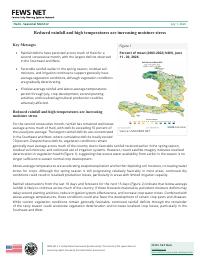
Seasonal Monitor: Reduced rainfall and high temperatures are increasing moisture stress, 1 July 2026
Summary — Rainfall deficits persisted across much of Haiti for a second consecutive month to the end of June 2026, exceeding 55 per cent of the usual June average and locally more than 70 per cent in the Southeast and West. Favourable rainfall earlier in the spring season, residual soil moisture and irrigation still supported broadly near-average vegetation conditions, though those conditions were gradually deteriorating. FEWS NET warns that if below-average rainfall and above-average temperatures persist through July, crop development, second planting and localised agricultural production could be adversely affected.
Key Findings
- Rainfall deficits persisted for a second consecutive month across much of Haiti to the end of June 2026.
- Deficits exceeded 55 per cent of the usual June average, and locally more than 70 per cent in the Southeast and West.
- Vegetation conditions remained near average but were gradually deteriorating.
- Residual soil moisture and irrigation were still supporting crops at the time of writing.
- Continued below-average rainfall and above-average temperatures through July would affect crop development and second planting.
Full Document Text
Extracted text from the original document for search indexing.
Haiti - Seasonal Monitor
July 1, 2026
Reduced rainfall and high temperatures are increasing moisture stress
Key Messages
Figure 1
Rainfall deficits have persisted across much of Haiti for a
second consecutive month, with the largest deficits observed
in the Southeast and West.
Percent of mean (2003-2022) NDVI, June
11 - 20, 2026.
Favorable rainfall earlier in the spring season, residual soil
moisture, and irrigation continue to support generally nearaverage vegetation conditions, although vegetation conditions
are gradually deteriorating.
If below-average rainfall and above-average temperatures
persist through July, crop development, second planting
activities, and localized agricultural production could be
adversely affected.
Reduced rainfall and high temperatures are increasing
moisture stress
For the second consecutive month, rainfall has remained well below
average across much of Haiti, with deficits exceeding 55 percent of
Source: USGS/FEWS NET
the usual June average. The largest rainfall deficits are concentrated
in the Southeast and West, where cumulative deficits locally exceed
70 percent. Despite these deficits, vegetation conditions remain
generally near average across much of the country due to favorable rainfall received earlier in the spring season,
residual soil moisture, and continued use of irrigation systems. However, recent satellite imagery indicates localized
deterioration in vegetation health (Figure 1), suggesting that excess water availability from earlier in the season is no
longer sufficient to sustain normal crop development.
Above-average temperatures are accelerating evapotranspiration and further depleting soil moisture, increasing water
stress for crops. Although the spring season is still progressing relatively favorably in most areas, continued dry
conditions could result in localized production losses, particularly in areas with limited irrigation capacity.
Rainfall observations from the last 10 days and forecasts for the next 15 days (Figure 2) indicate that below-average
rainfall is likely to continue across much of the country. If these forecasts materialize, persistent moisture deficits may
delay second planting activities, reduce irrigation system effectiveness, and increase crop water stress. Combined with
above-average temperatures, these conditions could also favor the development of certain crop pests and diseases.
While current vegetation conditions remain generally favorable, continued rainfall deficits through the remainder
of the rainy season could accelerate vegetation deterioration and increase localized crop losses, particularly in the
Southeast and West.
FEWS NET is a United States Government-funded activity. The content of this report does not
necessarily reflect the view of the United States Government.
FEWS NET Haiti
haiti@fews.net
fews.net/latin-america-and-caribbean/haiti
Seasonal Monitor
July 1, 2026
Figure 2
Percent of rainfall, June 16 – July 10, 2026, based on CHIRPS observations and CHIRPS-GEFS forecast
Source: UCSB/FEWS NET
Recommended citation: FEWS NET. Haiti Seasonal Monitor July 1, 2026: Reduced rainfall and high temperatures are
increasing moisture stress, 2026.
Seasonal Monitor
FEWS NET’s Seasonal Monitor reports are produced for Central America and the Caribbean, West Africa, East Africa, Central Asia, and Somalia every 10-to-30 days during the region’s
respective rainy season(s). Seasonal Monitors report updates on weather events (e.g., rainfall patterns) and associated impacts on ground conditions (e.g., cropping conditions,
pasture and water availability), as well as the short-term rainfall forecast. Find more remote sensing information here.
Famine Early Warning Systems Network
2
How to cite
Famine Early Warning Systems Network (FEWS NET), Seasonal Monitor: Reduced rainfall and high temperatures are increasing moisture stress, 1 July 2026, https://reliefweb.int/node/4219375
- Rights holder
- Famine Early Warning Systems Network (FEWS NET)