Republic of Haiti
Document Library
4,677 documents 213,367 pages
Haiti Seasonal Monitor, January 2026

Haiti Seasonal Monitor, January 2026

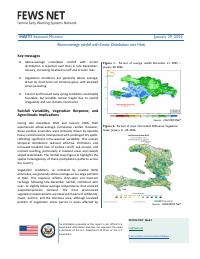
Summary — FEWS NET's Haiti Seasonal Monitor for January 2026, dated January 29, 2026. Above-average cumulative rainfall with erratic distribution was reported over Haiti in late December and January, increasing localized runoff and erosion risks. Vegetation conditions were generally above average on short-term soil moisture gains, with localized stress persisting. Early spring conditions were broadly favorable, and the report notes that the benefits remained fragile because of rainfall irregularity and non-climatic constraints.
Key Findings
Full Description

FEWS NET's Haiti Seasonal Monitor for January 2026, dated January 29, 2026. Above-average cumulative rainfall with erratic distribution was reported over Haiti in late December and January, increasing localized runoff and erosion risks. Vegetation conditions were generally above average on short-term soil moisture gains, with localized stress persisting. Early spring conditions were broadly favorable, and the report notes that the benefits remained fragile because of rainfall irregularity and non-climatic constraints. The report names non-climatic constraints alongside the rainfall, which is unusual for this series. The monitor reads the season under way: cumulative rainfall against the long-term mean, vegetation condition from satellite NDVI, and what both imply for planting, crop development and harvest. Its cover date closes the 30-day window it reports on.

Full Document Text

Extracted text from the original document for search indexing.

HAITÍ Seasonal Monitor January 29, 2026 Above-average rainfall with Erratic Distribution over Haiti Key messages ● Above-average cumulative rainfall with erratic distribution is reported over Haiti in late December– January, increasing localized runoff and erosion risks. ● Vegetation conditions are generally above average, driven by short-term soil moisture gains, with localized stress persisting. ● Current and forecast early spring conditions are broadly favorable, but benefits remain fragile due to rainfall irregularity and non-climatic constraints. Figure 1. Percent of average rainfall December 21, 2025 – January 20, 2026. Rainfall Variability, Vegetation Response, and Agroclimatic Implications Source: CHC/FEWSNET During late December 2025 and January 2026, Haiti experienced above-average cumulative rainfall. However, these positive anomalies were primarily driven by episodic heavy rainfall events interspersed with prolonged dry spells, reflecting significant intra-seasonal variability. This uneven temporal distribution reduced effective infiltration and increased localized risks of surface runoff, soil erosion, and nutrient leaching, particularly in lowland areas and steeply sloped watersheds. The rainfall map (Figure 1) highlights the spatial heterogeneity of these precipitation patterns across the country. Figure 2. Percent of mean Normalized Difference Vegetation Index, January 11 -20, 2026. Vegetation conditions, as indicated by positive NDVI anomalies, are generally above average across large portions of Haiti. This response reflects short-term soil moisture recharge following late-December rainfall, combined with near- to slightly below-average temperatures that reduced evapotranspiration demand. The most pronounced vegetation improvements are observed in parts of Artibonite, Ouest, Sud-Est, and the Gonaïves area, although localized pockets of vegetation stress persist in areas affected by Source: USGS/FEWS NET FEWS NET Haiti The information provided in this report is not official U.S. Government information and does not represent the views or positions of the U.S. Department of State or the U.S. Government. lac@fews.net fews.net/latin-america-and-caribbean rainfall intermittency. These contrasts are illustrated in the NDVI anomaly map (Figure 2). From an agroclimatic perspective, current conditions are broadly conducive to the preparation and early initiation of the Spring agricultural season. However, the sustainability of these conditions remains highly dependent on improved rainfall regularity in the coming weeks. February forecasts indicate near-average rainfall and temperature conditions, which could support crop establishment if precipitation becomes more evenly distributed. Nevertheless, anticipated impacts on food security are expected to remain limited and uneven, as the translation of favorable climatic conditions into durable food security gains continues to be constrained by non-climatic factors, including access to agricultural inputs, security conditions, and market functioning. 2

How to cite

Famine Early Warning Systems Network (FEWS NET), Haiti Seasonal Monitor, January 2026, https://fews.net/latin-america-and-caribbean/haiti

Rights holder
Famine Early Warning Systems Network (FEWS NET)