EN FR HT
Republic of Haiti
Document Library
Search & download AI summaries Free & open
(2024-11) Key Message Update: Crisis (IPC Phase 3) and Emergency (IPC Phase 4) persist as gang violence intensifies

(2024-11) Key Message Update: Crisis (IPC Phase 3) and Emergency (IPC Phase 4) persist as gang violence intensifies

FEWS NET 2024 2 pages
Summary — Gang attacks intensified in the Port-au-Prince metropolitan area and Artibonite. Nearly 40,965 people were displaced after the 11 November attacks in Port-au-Prince, Tabarre and Bas Delmas (IOM), and security incidents rose 107 percent in the first two weeks of November against the same period in October (ACLED). The prime minister was replaced on 11 November, and gangs exploited the instability. Attacks on commercial aircraft forced a temporary closure of the international airport through 25 November. Widespread Crisis (IPC Phase 3) persists, with Emergency (IPC Phase 4) in Cité Soleil and among displaced people in metropolitan sites.
Key Findings
Full Description
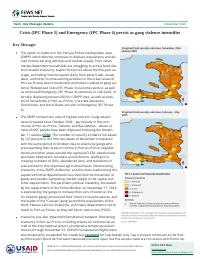
This Key Message Update covers November 2024. The uptick in violence in the Port-au-Prince metropolitan area (ZMPP) and Artibonite continues to displace people and disrupt income-earning activities and market supply. Poor urban market-dependent households struggle to access food because of increased insecurity, staple prices above the five-year average and falling incomes, particularly from petty trade and casual labour in urban Port-au-Prince, as gang violence restricts movement. Widespread Crisis (IPC Phase 3) outcomes persist alongside continued Emergency (IPC Phase 4) in Cité Soleil, and internally displaced people in ZMPP sites, together with pockets of households in Port-au-Prince, Croix-des-Bouquets, Grand'Anse and Nord-Ouest, are also in Emergency (IPC Phase 4). The ZMPP remains the area of highest concern. Gang attacks increased from October 2024, particularly in the communes of Port-au-Prince, Tabarre and Bas Delmas, where almost 40,965 people were displaced following the 11 November attacks according to IOM. ACLED data show security incidents up 107 percent in the first two weeks of November compared with the same period in October, as gangs expanded their areas of control inside Port-au-Prince and beyond the capital. Attacks were also recorded in Arcahaie and Artibonite, increasing displacement, land abandonment and reductions in area planted in that important agricultural basin. Deteriorating insecurity in the ZMPP, in Artibonite and along the main roads linking the capital to other departments restricts the movement of goods and people and hampers market supply. Persistent political instability, illustrated by the replacement of the prime minister on 11 November 2024, is exploited by gangs to increase violence: the Viv Ansanm coalition announced its intent to resume attacks, and the leader of the Canaan gang warned people in Nord, Plateau Central, Artibonite and Ouest not to travel to Port-au-Prince because road access would be blocked (PLSO). Insecurity also hit international transport: attacks on commercial aircraft at the international airport prompted a temporary closure through 25 November, and UNHAS humanitarian flights were suspended for a week before resuming for Cap-Haïtien only. Sea transport continues, as the Port-au-Prince port operated by the Autorité Portuaire Nationale remains open, but insecure access roads limit operations.
Geography
NationalOuest DepartmentArtibonite DepartmentGrand'Anse DepartmentNord-Ouest DepartmentNord DepartmentCentre Department
Time Coverage
2024-11 — 2024-11
Keywords
series:fewsnet-hti-foodsec|key message update|IPC|acute food insecurity|internal displacement|airport closure|political instability|market supply
Entities
FEWS NET|IPC|ACLED|IOM|PLSO|UNHAS|Autorité Portuaire Nationale
Full Document Text

Extracted text from the original document for search indexing.

Haiti - Key Message Update November 2024 Crisis (IPC Phase 3) and Emergency (IPC Phase 4) persist as gang violence intensifies Key Messages The uptick in violence in the Port-au-Prince metropolitan area (ZMPP) and Artibonite continues to displace populations and disrupt income-earning activities and market supply. Poor urban market-dependent households are struggling to access food due to increased insecurity, staple food prices above the five-year average, and falling incomes (particularly from petty trade, casual labor, and other income-earning activities in the urban areas of Port-au-Prince) due to movement restrictions related to gang violence. Widespread Crisis (IPC Phase 3) outcomes persist, as well as continued Emergency (IPC Phase 4) outcomes in Cité Soleil. Internally displaced persons (IDPs) in ZMPP sites, as well as pockets of households in Port-au-Prince, Croix-des-Bouquets, Grand'Anse, and Nord-Ouest are also in Emergency (IPC Phase 4). The ZMPP remains the area of highest concern. Gang attacks have increased since October 2024 – particularly in the communes of Port-au-Prince, Tabarre, and Bas Delmas – where almost 40,965 people have been displaced following the November 11 attacks (IOM). The number of security incidents increased by 107 percent in the first two weeks of November (compared with the same period in October) due to attacks by gangs who are expanding their areas of control in Port-au-Prince neighborhoods and other areas outside the capital (ACLED). Attacks have also been observed in Arcahaie and Artibonite, leading to increasing numbers of IDPs, abandoned land, and reductions in area planted in this important agricultural basin. Deteriorating insecurity in the ZMPP, Artibonite, and the main roads linking the capital with other departments has restricted the movement of goods and people, hampering market supply in the capital and other departments. The persistent political instability, illustrated by the replacement of the Prime Minister on November 11, 2024, is exploited by the gangs to increase their acts of violence: the Viv Ansanm gangs announced their intent to resume attacks, and the leader of the “Canaan” gang warned the populations of the Nord, Plateau Central, Artibonite, and Ouest departments not to travel to Port-au-Prince, as they will block road access (PLSO). Insecurity has also impacted international transport. Worsening insecurity in Port-au-Prince, including attacks on commercial aircraft at the international airport, prompted a temporary airport closure through November 25. UNHAS humanitarian flights were also temporarily suspended for a week but resumed for Cap-Haitien only. Sea transport continues as the Portau-Prince port (Autorité Portuaire Nationale) remains open, but the access roads are not secure which limit opFEWS NET is a USAID-funded activity. The content of this report does not necessarily reflect the view of the United States Agency for International Development or the United States Government. FEWS NET Haiti haiti@fews.net fews.net/latin-america-and-caribbean/haiti Key Message Update November 2024 eration. Despite these rampant insecurity-related disruptions, food prices remain stable but above the five-year average. Since July 2024 the exchange rate has also remained stable, at around 131 gourdes (HTG)/USD (BRH). Insecurity continues to hamper and limit humanitarian access, affecting food assistance distribution activities. However, food assistance distribution continues in the ZMPP and other departments – including populations returning from the Dominican Republic – at low levels. The WFP plans to distribute hot meals to 135,000 IDPs before the end of November. On a single day (November 17, 2024) the WFP distributed hot meals to over 38,000 IDPs in 26 sites in Port-au-Prince and Arcahaie. While this food assistance helps beneficiaries to reduce some food consumption gaps, the limited and irregular distribution is insufficient to fully mitigate the effects of food insecurity for the affected populations. Recommended citation: FEWS NET. Haiti Key Message Update November 2024: Crisis (IPC Phase 3) and Emergency (IPC Phase 4) persist as gang violence intensifies, 2024. * FEWS NET's classifications are IPC-compatible. IPC-compatible analysis follows key IPC protocols but does not necessarily reflect the consensus of national food security partners. As of IPC 3.0, the IPC no longer assesses the impact of food assistance on classification and thus no longer maps the (!). However, FEWS NET continues to produce food security maps inclusive of the (!) as well as maps compatible with IPC 3.0/3.1, which include the mapping of food security assistance bags. FEWS NET and the IPC use different methods to estimate the total Population in Need of humanitarian food assistance and assess the risk of Famine. Learn more at www.fews.net/about. Key Message Update This Key Message Update provides a high-level analysis of current acute food insecurity conditions and any changes to FEWS NET's latest projection of acute food insecurity outcomes in the specified geography. Learn more here. Famine Early Warning Systems Network 2