
Key Message Update: Persistent insecurity continues to exacerbate displacement and food insecurity in Haiti
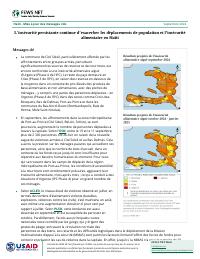
- Cité Soleil remains in Emergency (IPC Phase 4); the rest of the country is in Crisis (IPC Phase 3) with Emergency pockets in Croix-des-Bouquets, Bas Delmas, Port-au-Prince and the lower Nord-Ouest.
- IOM recorded more than 2,300 people fleeing Cité Soleil and Bas Delmas between 10 and 11 September 2024.
- Food access in metropolitan displacement sites is extremely precarious, producing Emergency outcomes for many displaced households.
- Violent events held at July's high level in August, rising a further 6 percent (ACLED), with the trend continuing into September (PLSO).
- The Multinational Security Support Mission had received fewer than 20 percent of planned personnel, 426 of 2,500.
This Key Message Update covers September 2024. Cité Soleil, particularly affected by clashes between armed groups that significantly disrupt income and food sources, still faces Emergency (IPC Phase 4) acute food insecurity. The rest of the country remains in Crisis (IPC Phase 3) on the back of below-average incomes in a context of high food and non-food prices, with pockets of households, including a share of displaced people, in Emergency (IPC Phase 4) in areas such as Croix-des-Bouquets, Bas Delmas, Port-au-Prince and the communes of the lower Nord-Ouest, namely Bombardopolis, Baie de Henne and Môle Saint Nicolas.
Clashes in the Port-au-Prince metropolitan area, in Cité Soleil, Bel-Air and Solino, continued through September and increased the number of displaced people across the capital: IOM reported that more than 2,300 people had to flee between 10 and 11 September because of the new wave of armed violence in Cité Soleil and Bas Delmas. That raised pressure on the poor households hosting them and on the number of reception sites, in a context where funding received so far is insufficient to meet current humanitarian needs.
For those in displacement camps in the metropolitan region, conditions of access to food are extremely precarious and worsen their food insecurity month after month, which has produced Emergency (IPC Phase 4) outcomes for a large number of these households. According to ACLED, the high level of violence recorded in July, measured by the number of violent events including battles, explosions and violence against civilians, was sustained in August with an increase of around 6 percent on July; PLSO observed the same trend in September and expected it to persist into October.
Access to the main national roads remains controlled by gangs, which erect toll posts and impede the normal movement of people and goods. Delays and logistical difficulties in deploying the Multinational Security Support Mission are among the factors limiting law enforcement efforts to contain and prevent violence in the capital: the mission had received fewer than 20 percent of its planned personnel, 426 out of 2,500.
How to cite
Famine Early Warning Systems Network (FEWS NET), 2024, Key Message Update: Persistent insecurity continues to exacerbate displacement and food insecurity in Haiti, https://reliefweb.int/node/4097568