Full Description
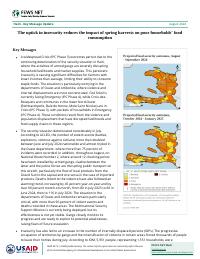
This Key Message Update covers August 2024. Widespread Crisis (IPC Phase 3) outcomes persist as the security situation continues to deteriorate, with armed gang activity severely disrupting household livelihoods and market supplies. Farmers with below-average incomes struggle to consume staple foods, and the situation is particularly worrying in Ouest and Artibonite, where violence and internal displacement are most concentrated. Cité Soleil faces Emergency (IPC Phase 4), while Croix-des-Bouquets and the communes of the lower Nord-Ouest, namely Bombardopolis, Baie de Henne and Môle Saint Nicolas, are in Crisis (IPC Phase 3) with pockets of households in Emergency (IPC Phase 4).
July marked a sharp deterioration: according to ACLED, violent events including battles, explosions and violence against civilians more than doubled nationwide between June and July 2024 and almost tripled in the Ouest department, where more than 75 percent of incidents were recorded. Deaths linked to violence increased by 45 percent year-on-year and by more than 90 percent month-on-month, from 80 in July 2023 and 60 in June 2024 to 116 in July 2024. Throughout August, around 12 checkpoints installed by armed gangs on National Route 2 and the resulting clashes with police disrupted public transport on that corridor, particularly the flow of local produce from the Grand Sud to the capital and of imported goods in the opposite direction.
Ouest and Artibonite together account for more than 90 percent of violent events and deaths. The Multinational Security Support Mission is deploying but its effectiveness is not yet visible, and gangs are monitoring its progress and ready to exploit weaknesses, raising fears of escalation. Insecurity has also driven displacement: IOM reported 5,951 people, or 1,551 households, displaced in mid-July following attacks in Ganthier in Ouest, taking refuge with relatives or host families in the same commune and placing considerable pressure on those hosts.
Full Document Text
Extracted text from the original document for search indexing.
Haiti - Key Message Update
August 2024
The uptick in insecurity reduces the impact of spring harvests on poor households’ food
consumption
Key Messages
A widespread Crisis (IPC Phase 3) outcomes persist due to the
continuing deterioration of the security situation in Haiti,
where the activities of armed gangs are severely disrupting
household livelihoods and market supplies. This persistent
insecurity is causing significant difficulties for farmers with
lower incomes than average, limiting their ability to consume
staple foods. The situation is particularly worrying in the
departments of Ouest and Artibonite, where violence and
internal displacement are most concentrated. Cité Soleil is
currently facing Emergency (IPC Phase 4), while Croix-desBouquets and communes in the lower Nord-Ouest
(Bombardopolis, Baie de Henne, Mole Saint Nicolas) are in
Crisis (IPC Phase 3), with pockets of households in Emergency
(IPC Phase 4). These conditions result from the violence and
population displacement that have disrupted livelihoods and
food supply chains in these regions.
The security situation deteriorated considerably in July.
According to ACLED, the number of violent events (battles,
explosions, violence against civilians) more than doubled
between June and July 2024 nationwide and almost tripled in
the Ouest department, where more than 75 percent of
incidents were recorded. In addition, throughout August, on
National Route Number 2, where around 12 checking points
have been installed by armed gangs, clashes between the
latter and the police forces are disrupting public transport on
this stretch, particularly the flow of local products from the
Grand Sud to the capital and vice versa in the case of imported
products. Deaths linked to the violence have also followed an
alarming trend, increasing by 45 percent year-on-year and by
over 90 percent month-on-month, from 80 in July 2023 to 60 in
June 2024, then to 116 in July 2024. The situation in the
departments of Ouest and Artibonite remains particularly
critical, with more than 90 percent of violent events and
deaths recorded in these areas. The Multinational Security
Support Mission is currently being deployed, but its
effectiveness is not yet visible. Gangs closely monitor its
progress and are ready to exploit its potential weaknesses,
raising fears of future escalation.
Insecurity has also led to an increase in the number of internally displaced persons (IDPs). The progressive
occupation of territories by gangs and the intensification of violence in certain areas forced thousands of people
to leave their homes during July. According to IOM, 5,951 people, representing 1,551 households, were
FEWS NET is a USAID-funded activity. The content of this report does not necessarily reflect the view
of the United States Agency for International Development or the United States Government.
FEWS NET Haiti
haiti@fews.net
fews.net/latin-america-and-caribbean/haiti
�Key Message Update
August 2024
displaced in mid-July (the most recent data available) following attacks in the commune of Ganthier in the Ouest
department. The displaced have taken refuge with relatives or host families in the same commune. This massive
displacement is putting considerable pressure on the limited resources of host households, exacerbating
existing vulnerabilities.
At the same time, spring harvests failed to significantly improve household food consumption. Despite a slight
improvement in the availability of local food products, agricultural production remains below the seasonal
average due to various factors, including erratic rainfall, scarcity of seeds, decreasing in cultivated land, and high
labor costs, exacerbated by widespread insecurity. The marginal improvement in food availability from the
spring harvests of maize and beans has not been able to influence high commodity prices downwards and
decreasing sources of income for poor households, as well as the continuing pressure exerted by displaced
people on the resources of host households.
The food market also showed scattered price variations from one market to another between June and July
2024. The price of imported rice (4% broken) remained stable in some markets such as Cap-Haïtien, Gonaïves,
Hinche, and Ouanaminthe, while other markets recorded significant declines, notably in Port-de-Paix (-20%),
Jacmel (-12%), and Les Cayes (-9.4%). On average, rice prices fell by around 5 percent month-on-month but rose
by 15 percent year-on-year and by 68 percent compared with the three-year average. On the other hand, corn
fell by 7 percent month-on-month and 15 percent year-on-year, although its price remains 57.6 percent higher
than the five-year average. These fluctuations reveal seasonal and short-term price declines but significant
increases over the longer term, underlining ongoing pressure on agricultural markets due to insecurity,
logistical disruptions, and climatic impacts. These elements highlight the complexity of the current situation in
Haiti, where deep and persistent crises rapidly cancel out temporary improvements.
Recommended citation: FEWS NET. Haiti Key Message Update August 2024: The uptick in insecurity reduces the impact of
spring harvests on poor households’ food consumption, 2024.
*
FEWS NET's classifications are IPC-compatible. IPC-compatible analysis follows key IPC protocols but does not necessarily reflect the consensus of national food security partners. As of IPC
3.0, the IPC no longer assesses the impact of food assistance on classification and thus no longer maps the (!). However, FEWS NET continues to produce food security maps inclusive of the
(!) as well as maps compatible with IPC 3.0/3.1, which include the mapping of food security assistance bags. FEWS NET and the IPC use different methods to estimate the total Population in
Need of humanitarian food assistance and assess the risk of Famine. Learn more at www.fews.net/about.
About Key Message Update
This Key Message Update provides a high-level analysis of current acute food insecurity conditions and any changes to FEWS NET's latest projection of acute food insecurity outcomes
in the specified geography. Learn more here.
Famine Early Warning Systems Network
2
�