EN FR HT
Republic of Haiti
Document Library
Search & download AI summaries Free & open
(2024-01) Key Message Update: Widespread acute food insecurity Crisis (IPC Phase 3) persists due to high commodity prices and worsening insecurity at the beginning of the year

(2024-01) Key Message Update: Widespread acute food insecurity Crisis (IPC Phase 3) persists due to high commodity prices and worsening insecurity at the beginning of the year

FEWS NET 2024 2 pages
Summary — In January 2024 widespread Crisis (IPC Phase 3) food insecurity persists, with Emergency (IPC Phase 4) in Cité Soleil, amid intensifying protests calling for the prime minister's resignation. The gourde appreciated by more than 10 percent year-on-year against the dollar and was stable month-on-month, yet food prices stayed close to 100 percent above five-year averages because insecurity has broken the market supply chain. SHODECOSA, the capital's main private warehouse, closed after repeated looting. Below-average and irregular December-January rainfall delayed winter planting.
Key Findings
Full Description
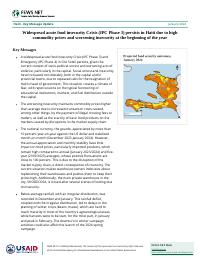
This Key Message Update covers January 2024. Widespread Crisis (IPC Phase 3) acute food insecurity persists nationally, with Emergency (IPC Phase 4) in Cité Soleil, against a background of socio-political unrest and worsening violence. Social unrest and insecurity rose considerably in both the capital and provincial towns amid repeated calls for the head of government's resignation, creating a climate of fear with consequences for schools, markets and fuel distribution outside the capital. Worsening insecurity keeps commodity prices above average through higher transaction costs, including illegal crossing fees paid by traders, and through the scarcity of staples caused by supply-chain disruption. The report is explicit that macroeconomic improvement is not reaching food access: the gourde appreciated by more than 10 percent year-on-year against the US dollar and was stable month-on-month between December 2023 and January 2024, yet prices, particularly of imported products, remained high against both annual and five-year comparisons, with positive fluctuations close to 100 percent. Warehouse owners are hesitant to restock and hold prices high, and SHODECOSA, the city's main private warehouse, is closed after repeated looting. Below-average rainfall with irregular distribution in December and January delayed the planting of winter crops (beans, maize), which struggled to reach maturity across most agroecological zones when harvests should have begun in January and peaked in February; the weak winter campaign may also affect the launch of the 2024 spring season.
Geography
NationalOuest DepartmentArtibonite DepartmentCentre DepartmentNord DepartmentNord-Ouest Department
Time Coverage
2024-01 — 2024-01
Keywords
series:fewsnet-hti-foodsec|key message update|IPC|acute food insecurity|social unrest|food prices|exchange rate|winter crops|SHODECOSA
Entities
FEWS NET|IPC|SHODECOSA
Full Document Text

Extracted text from the original document for search indexing.

Haiti - Key Message Update January 2024 Widespread acute food insecurity Crisis (IPC Phase 3) persists in Haiti due to high commodity prices and worsening insecurity at the beginning of the year Key Messages A widespread acute food insecurity Crisis (IPC Phase 3) and Emergency (IPC Phase 4) in Cité Soleil persists, given the current context of socio-political unrest and worsening acts of violence, particularly in the capital. Social unrest and insecurity have increased considerably, both in the capital and in provincial towns, due to repeated calls for the resignation of Haiti's head of government. This situation creates a climate of fear, with repercussions on the typical functioning of educational institutions, markets, and fuel distribution outside the capital. The worsening insecurity maintains commodity prices higher than average due to increased transaction costs caused, among other things, by the payment of illegal crossing fees to traders, as well as the scarcity of basic food products on the markets caused by disruptions in the market supply chain. The national currency, the gourde, appreciated by more than 10 percent year-on-year against the US dollar and stabilized month-on-month (December 2023-January 2024). However, the annual appreciation and monthly stability have little impact on food prices, particularly imported products, which remain high compared to annual (January 2023/2024) and fiveyear (2019/2023) averages, whose positive fluctuations are close to 100 percent. This is due to the disruption of the market supply chain, a direct consequence of insecurity. The current situation makes warehouse owners indecisive about replenishing their warehouses and pushes them to keep their prices high. Additionally, the main private warehouse in the city, SHODECOSA, is closed after several scenes of looting due to insecurity. Below-average rainfall, with an irregular distribution, was recorded in December and January. This rainfall deficit, coupled with the irregular distribution, led to delays in the planting of winter crops (beans, maize), which are hard to reach maturity in most of the country's agroecological areas, while harvests were to be start, for the most part, in January and peak in February. The downturn in winter campaign activities could also affect the launch of the 2024 spring campaign. FEWS NET is a USAID-funded activity. The content of this report does not necessarily reflect the view of the United States Agency for International Development or the United States Government. FEWS NET Haiti haiti@fews.net fews.net/latin-america-and-caribbean/haiti Key Message Update January 2024 Recommended citation: FEWS NET. Haiti Key Message Update January 2024: Widespread acute food insecurity Crisis (IPC Phase 3) persists in Haiti due to high commodity prices and worsening insecurity at the beginning of the year, 2024. About Key Message Update This Key Message Update provides a high-level analysis of current acute food insecurity conditions and any changes to FEWS NET's latest projection of acute food insecurity outcomes in the specified geography. Learn more here. Famine Early Warning Systems Network 2