Republic of Haiti
Document Library
4,677 documents 213,367 pages
Haiti Monthly Climate and Weather, July 2025

Haiti Monthly Climate and Weather, July 2025

Summary — FEWS NET's monthly climate and weather report for Haiti, covering July 2025. ENSO-neutral conditions persisted, with near-average sea-surface temperatures across most of the equatorial Pacific and neutral most likely to continue. Artibonite, southern Nord-Est, Centre, northern and southwestern Ouest, Nippes, Sud and Grand'Anse received 10 to 25 mm against a climatological 25 to 300 mm, and the country was drier than average. Maximum temperatures ran 30 to 35 degrees Celsius, with the southern departments 1 to 2 degrees above average.
Key Findings
Full Description

FEWS NET's monthly climate and weather report for Haiti, covering July 2025. ENSO-neutral conditions persisted, with near-average sea-surface temperatures across most of the equatorial Pacific and neutral most likely to continue. Artibonite, southern Nord-Est, Centre, northern and southwestern Ouest, Nippes, Sud and Grand'Anse received 10 to 25 mm against a climatological 25 to 300 mm, and the country was drier than average. Maximum temperatures ran 30 to 35 degrees Celsius, with the southern departments 1 to 2 degrees above average. The NMME forecast for August to October 2025 gave only weak probabilities, 36 to 40 percent, for above-average rainfall. The report is published by FEWS NET and served from NOAA's Climate Prediction Center. Its cover carries the publication date, which falls in the month after the one it reports on.

Full Document Text

Extracted text from the original document for search indexing.

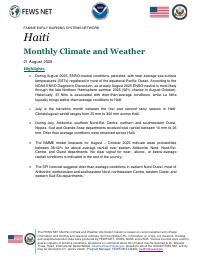
FAMINE EARLY WARNING SYSTEMS NETWORK Haiti Monthly Climate and Weather 21 August 2025 Highlights  During August 2025, ENSO-neutral conditions persisted, with near average sea surface temperatures (SSTs) registered in most of the equatorial Pacific Ocean. According to the NOAA ENSO Diagnostic Discussion, as of early August 2025 ENSO-neutral is most likely through the late Northern Hemisphere summer 2025 (56% chance in August-October). Historically, El Niño is associated with drier-than-average conditions, while La Niña typically brings wetter-than-average conditions to Haiti.  July is the transition month between the first and second rainy season in Haiti. Climatological rainfall ranges from 25 mm to 300 mm across Haiti.  During July, Artibonite, southern Nord-Est, Centre, northern and southwestern Ouest, Nippes, Sud and Grande-Anse departments received total rainfall between 10 mm to 25 mm. Drier than average conditions were observed across Haiti.  The NMME model forecasts for August – October 2025 indicate weak probabilities between 36-40% for above average rainfall over eastern Artibonite, Nord, Nord-Est, Centre, and Ouest departments. No clear signal for near-, above-, or below-average rainfall conditions is indicated in the rest of the country.  The SPI forecast suggests drier-than-average conditions in eastern Nord-Ouest, most of Artibonite, northwestern and southeastern Nord, northwestern Centre, western Ouest, and western Sud-Est departments. The FEWS NET Monthly Climate and Weather information bulletin is based on current weather and climate information and monthly and seasonal outlooks from the NOAA CPC. Information on crops, soil moisture, flooding, and evapotranspiration data were produced by FEWS NET, USGS, NASA and USDA. Various sources were used to assess impacts of extreme conditions. Questions or comments about this product may be directed to Dr. Wassila Thiaw, Head, International Desks/NOAA, wassila.thiaw@noaa.gov. Questions about the USAID FEWS NET activity may be directed to Dr. James Verdin, Program Manager, FEWS NET/USAID, jverdin@usaid.gov. Haiti Seasonal Calendar Current Climate Modes and Teleconnections  During August 2025, ENSO-neutral conditions persisted, with near average sea surface temperatures (SSTs) registered in most of the equatorial Pacific Ocean. According to the NOAA ENSO Diagnostic Discussion, as of early August 2025 ENSO-neutral is most likely through the late Northern Hemisphere summer 2025 (56% chance in August-October). Thereafter, a brief period of La Niña conditions is favored in the fall and early winter 202526 before reverting to ENSO-neutral (Fig. 1). For the latest update from the NOAA Climate Prediction Center (CPC) on ENSO, check here.  Much of the Caribbean Sea experienced near average conditions, except the northern and southern Caribbean Sea that showed positive SST anomalies of 0.5 – 1°C. Figure 1. Official ENSO probabilities for the Niño 3.4 SST index (5oN5oS, 120oW170oW). Figure updated 14 August 2025. Source: NOAA/CPC 2  Implications of ENSO conditions: Based on historical records, La Niña conditions are associated with above average precipitation throughout Haiti from August to October (Fig. A1, left panels). Meanwhile, La Niña conditions are related to near average mean temperatures in Haiti (Fig. A1, right panels). The ENSO-precipitation teleconnection pattern can be found here, and the pattern for temperature can be found here Extreme Events  Abnormal dryness continued across northern and western-central Haiti due to the lack of rainfall, soil moisture deficits, and stressed vegetation conditions.  There have been no reports of fire activity in Haiti during July 2025. Rainfall/Precipitation  July is a transition month between the first and second rainy season in Haiti. Climatological rainfall ranges from 25 mm to 300 mm across Haiti. The highest rainfall totals are observed in central Haiti (100-300 mm); lower rainfall amounts (25-50 mm) are climatologically expected in northwestern and southwestern Haiti. Past 3 months (May– July 2025):  Totals: Over the last three months, most of the northern states of Haiti received the lowest rainfall totals with values ranging from 10 mm to 25 mm. On the other hand, the largest total rainfall amounts were registered in eastern Centre department where rainfall reached 150 mm. The rest of the country received rainfall totals of 15 mm – 75 mm.  Anomalies: During May – July season, Haiti experienced below average conditions across the country. Central Haiti’s departments registered the highest rainfall deficits ranging from 200 mm to more than 500 mm, while the rest of Haiti registered below average amounts from 25 mm to 100 mm. Past 1 Month (July 2025):  Totals: During the past month, Haiti observed 5 mm to 25 mm rainfall . Areas of Artibonite, southern Nord-Est, Centre, northern and southwestern Ouest, Nippes, Sud and GrandeAnse departments received total rainfall amounts ranging from 10 mm to 25 mm, while the rest of the country observed rainfall between 2 mm and 10 mm (Fig. 2a).  Anomalies: During July, drier than average conditions were observed across Haiti. Central Haiti’s departments registered the highest rainfall deficits ranging from 100 mm to 300 mm, while the rest of Haiti registered below average amounts from 25 mm to 100 mm (Fig. 2b). 3 b) a) c) Figure 2. Satellite estimates of precipitation (CMORPH) for July 2025: (a) 1-month total accumulation and (b) 1-month anomaly. (c) NMME seasonal rainfall probabilistic forecast for September - November 2025. Source: NOAA/NCEP Monthly and Seasonal Forecasts (September 2025 and September - November 2025):  Monthly: The North American Multi-Model Ensemble (NMME) models indicate no clear signal for near-, above-, or below-average rainfall tercile categories for the country.  Seasonal: The NMME seasonal forecast for September - November 2025 suggests weak probabilities between 36-40% for above average rainfall over eastern Artibonite, Nord, Nord-Est, Centre, and Ouest departments. The rest of the country shows no clear signal for near-, above-, or below-average rainfall tercile categories (Fig. 2c). Temperature Past 3 months (May – July 2025):  Maximums: Haiti experienced maximum temperatures ranging from 30°C to 35°C. Southern departments experienced slightly above average anomalies between 1°C and 2°C, while the rest of Haiti observed near average temperature anomalies.  Minimums: Minimum temperatures ranged from 15°C to 25°C in Haiti. Most of Haiti recorded minimums between 20°C and 25°C. Meanwhile, southeastern Ouest and eastern Sud-Est observed temperatures of 15°C – 20°C. Near average minimum temperature anomalies prevailed in Haiti during August. Past 1 Month (July 2025):  Maximums: Similar to the seasonal average conditions, monthly maximum temperatures ranged from 30°C to 35°C in Haiti. Above average anomalies between 1°C and 2°C were observed in southwestern departments, while the rest of country registered near average temperature anomalies (Fig. 3a).  Minimums: Most of Haiti recorded minimum temperatures between 20°C and 25°C, while southeastern Haiti observed values ranging from 15°C to 20°C. Near average minimum 4 temperatures were observed across Haiti, with anomalies ranging from -1°C to 1°C (Fig. 3b). a) b) c) Figure 3. Spatial structure of temperature for July 2025. (a) Maximum temperature anomaly and (b) minimum temperature anomaly. (c) NMME probabilistic forecast of seasonal 2-m temperature anomaly for September – November 2025. Source: NOAA/NCEP Monthly and Seasonal Forecasts (September 2025 and September – November 2025):  Monthly: The NMME forecast indicates no clear dominant signal for either below or above average temperatures in Haiti.  Seasonal: For the September - November 2025 season, there is an increased likelihood (over 70%) of above average temperatures in northern, western and southern regions of Haiti. In contrast, there is no clear signal for near-, above-, or below-average temperatures in the central-east regions of the country (Fig. 3c). Drought and Dryness The Standardized Precipitation Index (SPI) is used to characterize meteorological drought. SPI compares the precipitation over a specific period of time with the climatology from that same period. Therefore, the SPI values can be thought of as the number of standard deviations the observed anomaly deviates from the climatology. The 1-month SPI values are a good representation of the monthly precipitation anomaly as well as the soil moisture and vegetation health. The 3-month SPI values are a good representation of seasonal precipitation anomalies. The Standardized Precipitation Evapotranspiration Index (SPEI) is similar to the SPI, but it also takes evapotranspiration into account (and therefore the impact of temperatures on water demand). Past 3 Months (May – July 2025):  The SPI analysis for the past 3 months indicated drier than average conditions (SPI values of -0.8 to -2 standard deviations below the mean) dominated over Haiti. The highest deficits (more than -1.6 standard deviations below the mean) were experienced in NordOuest, Artibonite, western and southeastern Nord, and northwestern Centre departments. 5 Past 1 Month (July 2025):  The SPI analysis for July 2025 indicated that Haiti experienced drier than average conditions (SPI values of -0.8 to more -2 standard deviations below the mean) across the country. The highest deficits (more than -2 standard deviations below the mean) were experienced in eastern Nord-Ouest, western Artibonite, northern Nord departments. Current/Forecast (01 August 2025 to 28 August 2025):  The SPI forecast suggests drier-than-average conditions (SPI values ranging from -0.5 to -1.6 standard deviations below the mean) in eastern Nord-Ouest, most of Artibonite, northwestern and southeastern Nord, northwestern Centre, western Ouest, western SudEst departments. Meanwhile, the forecast suggests near average SPI conditions for the rest of the country. Water Requirement Satisfaction Index (WRSI)  USGS/EROS crop WRSI: Current conditions during the 1st Dekad of August 2025 depicted ‘Average’ to ‘Good’ crop conditions in most of Haiti. Meanwhile, areas in Nord-Ouest, northern Nord-Est, and northern Ouest departments depicted ‘Failure’ to ‘Mediocre’ crops conditions. GEOGLAM Crop Monitor  GEOGLAM Crop Monitor synthesis indicated that ‘favorable’ conditions in Haiti for maize and rice during July 2025. Additional Resources - https://protectioncivile.gouv.ht/ - https://www.meteo-haiti.gouv.ht/ 6 Annex Figure A1. ENSO teleconnection for the August-September-October (ASO) season. The upperlevel panel shows the precipitation and temperature anomalies regressed onto the standardized Niño-3.4 index. The bottom panel shows the correlation between Nino-3.4 and the anomalies. Source : https://www.cpc.ncep.noaa.gov/products/precip/CWlink/ENSO/regressions/ 7

How to cite

Famine Early Warning Systems Network (FEWS NET), Haiti Monthly Climate and Weather, July 2025, https://fews.net/latin-america-and-caribbean/haiti

Rights holder
Famine Early Warning Systems Network (FEWS NET)