
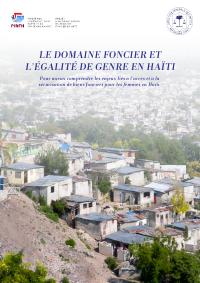
Land Tenure and Gender Equality in Haiti
- Women face barriers to land access and control through inheritance practices, informal unions, administrative procedures and limited credit access.
- The study focuses field analysis on Camp-Perrin and Bas Peu-de-Chose, linking rural and urban land-security issues.
- Land-registry modernization should include gender-sensitive procedures, information access and women's participation.
- Recommendations combine legal/systemic reform, procedural change, public information, participation and socio-economic support.
The report studies whether Haitian women can effectively access, secure and retain land and built property under the country's legal, customary and administrative systems. It frames the issue inside the PIRFH land-registry modernization project and examines how inheritance practices, informal unions, professional land services, disaster-related loss, registration procedures, conflicts and credit constraints shape women's ability to control land.
Its field focus on Camp-Perrin and Bas Peu-de-Chose makes it especially useful alongside CIAT land materials. The study ties gender equality to the mechanics of land administration: legal reform is not enough if procedures, information access, community participation, institutional practices and women's economic resources do not let women use the rights formally available to them.
How to cite
Fédération canadienne des municipalités (FCM); Global Affairs Canada; Projet d'informatisation du registre foncier en Haïti (PIRFH), 2019, Land Tenure and Gender Equality in Haiti, https://www.foncier-developpement.fr/wp-content/uploads/VERSION-FINALE-Étude-Genre-et-Foncier-190621-002.pdf