
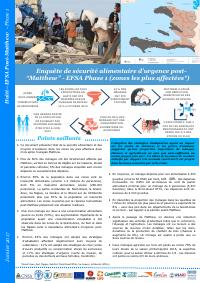
Haiti: Emergency Food Security Assessment (EFSA) Phase 1 Post-Hurricane Matthew (Most Affected Areas), January 2017
Summary: Emergency Food Security Assessment (EFSA) Phase 1 led by Haiti's National Coordination for Food Security (CNSA) with FAO, WFP and partners, covering the areas most affected by Hurricane Matthew after two consecutive years of drought. It reports 61 percent of surveyed households directly affected by the hurricane, over half with unacceptable or borderline food consumption, and two in three farmers with damaged plots who lost three-quarters or more of their stocks.
Key Findings
- The first-phase post-Matthew EFSA found severe food-security and livelihood damage in the most affected zones two months after the hurricane.
- More than 60 percent of surveyed households were directly affected, mainly through damage to homes, stocks and cultivated plots.
- About 38 percent of people in the assessed zones were food insecure, with the most severe geographic concentrations in western Nord-Ouest, Grand'Anse, Nippes, La Gonave and the dry Artibonite coast.
- Household food spending was below the minimum food basket for a five-person household, and over half of households had poor or borderline food consumption.
- Livelihood stress was widespread, with households consuming seed stocks, selling reproductive animals, begging, borrowing and losing income sources.
- The report recommends cash transfers where markets function, food assistance, seed and input distributions, recapitalization for affected households, and synchronization of recovery support with the 2017 agricultural seasons.
How to cite
National Food Security Coordination (CNSA); Food and Agriculture Organization (FAO); World Food Programme (WFP), Haiti: Emergency Food Security Assessment (EFSA) Phase 1 Post-Hurricane Matthew (Most Affected Areas), January 2017, https://reliefweb.int/attachments/08e81179-8c0b-378f-aa6d-6f7979692f46/Haiti_report_factsheet_FR_20%2001_HQ_cnsa.pdf