
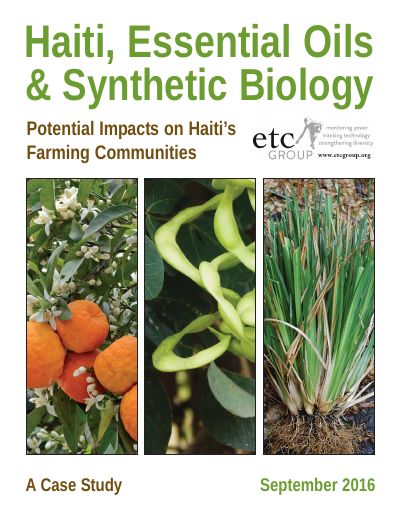
Haiti, Essential Oils and Synthetic Biology: Potential Impacts on Haiti's Farming Communities, A Case Study
- Essential oils are Haiti's most valuable agricultural export, accounting for US$16 million in 2012.
- Haiti is the world's single most important source of high-quality vetiver oil, accounting for 50% of the estimated 120-150 tons produced worldwide per annum.
- Some 30,000 farmers in Haiti's southwest region cultivate vetiver grass on small plots of land.
- Only one company, Evolva, holds patents on compounds structurally related to vetiver, and it says it is not currently conducting research to commercialize them.
- The authors conclude that the synthetic biology manufacturing platform is expanding rapidly and is a serious economic threat to producers of high-value natural plant products.
The report asks whether current research on synthetic biology threatens the market for Haiti's essential oils and the livelihoods of its farming communities. It examines vetiver, bitter orange and amyris (West Indian sandalwood). It states that essential oils were Haiti's most valuable agricultural export, at US$16 million in 2012, and that Haiti is the world's single most important source of high-quality vetiver oil.
It reports that only one company, Evolva, holds patents on compounds structurally related to vetiver and that Evolva says it is not conducting research to commercialize them. The authors conclude that the synthetic biology platform is expanding rapidly and is a serious economic threat to producers of high-value natural plant products, and the report closes with potential next steps.
How to cite
ETC Group, 2016, Haiti, Essential Oils and Synthetic Biology: Potential Impacts on Haiti's Farming Communities, A Case Study, accessed via HaitiDocs, https://www.haitidocs.org/doc/etc-group-2016-haiti-essential-oils-synthetic-biology
- Rights holder
- ETC Group