
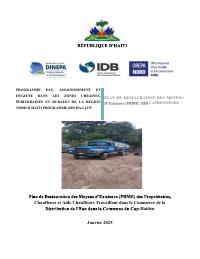
Livelihood Restoration Plan for Water-Trucking Drivers and Drivers' Assistants, Cap-Haitien (HA-L1135), Redacted Version
- A socio-economic survey of affected persons in May 2024 counted 14 drivers working in the Cap-Haitien water-trucking trade.
- Revenue is valued at 15,000 gourdes per trip, about 45,000 gourdes a day per truck, and 1,125,000 gourdes a month over 25 working days.
- The network extension reaches about 50,000 beneficiary households over 256 km of pipe.
- Drivers and drivers' assistants are treated as separate affected categories, each with partial income loss and an advisory support measure.
- IDB operational policy OP-710 on involuntary resettlement governs the plan alongside Haitian law.
Extending the Cap-Haitien network to a total of about 50,000 beneficiary households over 256 km of pipe reduces demand for trucked water, and this plan sets out how the drivers and drivers' assistants who make their living from that trade are to be compensated and supported. A socio-economic survey of affected persons in May 2024 counted 14 drivers in the trade. The plan values the loss using a revenue chain: 15,000 gourdes per trip, an estimated 45,000 gourdes of daily revenue per truck, and 1,125,000 gourdes of monthly revenue over 25 working days. It applies the Haitian legal framework, the project environmental and social management framework, and IDB operational policy OP-710 on involuntary resettlement, and it closes with a consolidated compensation table and a budget.
How to cite
National Directorate for Drinking Water and Sanitation (DINEPA); Inter-American Development Bank (IDB), 2025, Livelihood Restoration Plan for Water-Trucking Drivers and Drivers' Assistants, Cap-Haitien (HA-L1135), Redacted Version, https://www.dinepa.gouv.ht/wp-content/uploads/2025/03/PRME-OREPA-Nord-HA-1135-2025-redacted-version.pdf