
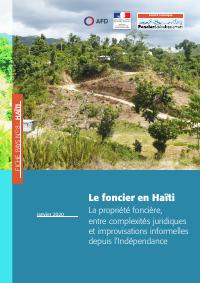
Country Brief No. 8: Land Tenure in Haiti
- Published January 2020 as Country Brief No. 8 by the Land and Development Technical Committee, chaired by the French foreign ministry and AFD.
- In 1997, between a quarter and more than half of parcels were held in indivision, covering 13 to 59 percent of farmland depending on the region.
- Indivision comes almost entirely from inheritance, called eritaj in Creole.
- The brief names three key land questions: indivisible land, state land and the split between ownership of ground and buildings.
- The Caracol industrial park covers 250 hectares, 81 of them presumed state land leased in January 2011.
- A second phase of the cadastre project, financed by the IDB at about US$50 million, concerns some 40,000 rural families.
Written by Veronique Dorner and Alain Rochegude and published in January 2020 under the title on land ownership between legal complexity and informal improvisation since independence, the brief has four parts. Part I gives the geographic and historical context and the largely rural economy. Part II sets out the administrative and judicial organization, the public and private domain, expropriation and land taxation, and the legal regimes for forests, protected areas, mines and water. Part III treats three issues: indivisible inherited land, state land known as te leta, and ownership of buildings separate from the ground. In 1997, depending on the region, between a quarter and more than half of parcels were held in indivision, or 13 to 59 percent of farmland. Part IV reviews the cadastre and land security projects and cases such as the Caracol industrial park, built on 250 hectares including 81 of presumed state land.
How to cite
Comité technique Foncier & Développement; French Development Agency (AFD); Ministère de l’Europe et des Affaires étrangères, 2020, Country Brief No. 8: Land Tenure in Haiti, http://www.foncier-developpement.fr/wp-content/uploads/08_fiche-pays-Haiti-FINALE-21072020.pdf