
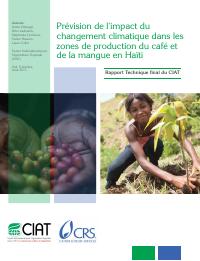
Predicting Climate Change Impacts on Haiti's Coffee and Mango Production Zones
- The August 2013 technical report models climate-change impacts on Haiti's coffee and mango production zones.
- The study uses WorldClim baseline climate data, 19 general circulation models and Maxent crop suitability models.
- It projects Haiti's average temperature to rise by 0.9 degrees Celsius by 2020 and 1.8 degrees Celsius by 2050.
- Average daily temperature range is projected to rise from 10.8 degrees Celsius to 11.1 degrees Celsius by 2050.
- The wettest month, May, is projected to lose 2 percent of its moisture, the wettest quarter to become 3 percent drier, and the driest month 10 percent drier by 2050.
- Coffee production zones range from about 400 meters in the North to 1,300 meters in the South, and future suitability shifts toward higher altitudes with a maximum between 1,500 and 1,800 meters by 2050.
- The report identifies more than 1.7 million hectares, or about 60 percent of Haiti's area, as agricultural land, with about 396,983 hectares available and medium-to-excellent soil capacity.
This final technical report from the Centro Internacional de Agricultura Tropical in Cali, Colombia, by Anton Eitzinger, Peter Läderach, Stephania Carmona, Carlos Navarro and Laure Collet, and dated August 2013, models the predicted impact of climate change on the zones where coffee and mango are grown in Haiti. Its value to this collection is that it is spatial and forward-looking where most of the material is descriptive and retrospective: it projects where these two export-relevant crops will and will not remain climatically suitable. It pairs naturally with the value-chain studies for coffee and mango held here, which describe those chains as they were without addressing where they can still be grown.
How to cite
International Center for Tropical Agriculture (CIAT), 2013, Predicting Climate Change Impacts on Haiti's Coffee and Mango Production Zones, https://agripubhaiti.org/wp-content/uploads/2025/03/CIAT-international-CImpact-Changement-Climatique-sur-le-Cafe-CIAT2013.pdf