
Saving Children, Saving Haiti? Child Vulnerability and Narratives of the Nation
- International media and humanitarian groups portray the Haitian child, often the restavèk, as vulnerable and in need of saving.
- Emerging ethnographic evidence on children's lived experience paints a different picture from these representations.
- Representations of children's vulnerability enable a critique of Haitian culture and the nation as fundamentally flawed.
- After the earthquake, offers to adopt Haitian children swamped internet blogs, chat rooms and the media, with over 800 posts to one State Department announcement.
- The author suggests the saving discourse is as much about the needs of the more powerful as about Haiti's needs.
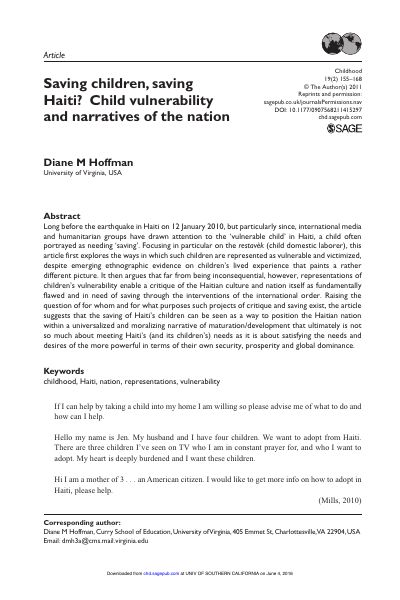
Diane Hoffman of the University of Virginia published this article in Childhood, volume 19, issue 2. It starts from the more than 800 internet posts to a U.S. State Department announcement after the January 12, 2010 earthquake, many of them offers to adopt Haitian children. Based on pilot field visits in 2007 and 2008 and on analysis of social commentary, media and advocacy literature from 2007 to 2011, the article examines how Haitian children, particularly the restavèk, are represented as vulnerable and victimized despite emerging ethnographic evidence on children's lived experience that paints a different picture.
It argues that representations of children's vulnerability enable a critique of Haitian culture and the nation as flawed and in need of saving through international intervention. The author suggests that this saving discourse is as much about the security, prosperity and global dominance of the more powerful as about meeting the needs of Haiti and its children.
How to cite
Childhood, 2011, Saving Children, Saving Haiti? Child Vulnerability and Narratives of the Nation, https://doi.org/10.1177/0907568211415297
- Rights holder
- Childhood