
Agro-Ecological Zones and Production Systems of the Upper Artibonite River Basin
- The study covers the upper Artibonite River basin on Haitian territory, with an area of 4,236 square kilometers and a population above 600,000 inhabitants.
- It reports an average population density of about 150 people per square kilometer, below the national average of 285 people per square kilometer cited in the text.
- The population grew by 45 percent between 1982 and 2002, compared with national growth of 56 percent over the same period.
- The terrain analysis says nearly 42 percent of land has slopes below 5 percent, while 27.5 percent has slopes between 12 and 30 percent and 9.4 percent has slopes above 30 percent.
- The erosion-risk discussion says 53 percent of the basin has medium erosion risk and 15.6 percent has serious to very serious erosion risk.
- The climate section reports annual rainfall from 942 mm in the Saint-Raphael area to 1,800-2,500 mm in wetter mountain and plateau zones.
- The study concludes that serious intervention requires a watershed management plan with stronger responsibilities for the central state and territorial governments.
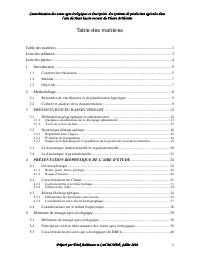
This study by Erick Balthazar characterizes the agro-ecological zones of the upper Artibonite river basin and describes the agricultural production systems within them. Its zoning runs from humid mountains and plateaux through semi-humid plateaux and mountains, each with its own production systems. The area covered is the upper watershed of Haiti's largest river, which spans the Centre department and the Plateau Central; note that the source filename labels it 'Plateau Central' while the document's own title is the upper Artibonite basin, and the basin framing is the one used here. Agro-ecological zoning of this kind is the input that makes crop and extension recommendations spatially specific rather than national.
How to cite
Erick Balthazar, 2010, Agro-Ecological Zones and Production Systems of the Upper Artibonite River Basin, https://agripubhaiti.org/wp-content/uploads/2025/03/PLC-Caracterisation-agro-ecologique-du-Plateau-Central.pdf