Extracted text from the original document for search indexing.
BTI 2022 Country Report
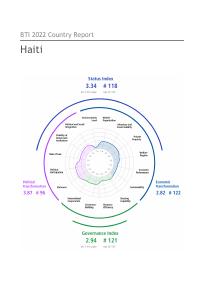
Haiti
�This report is part of the Bertelsmann Stiftung’s Transformation Index (BTI) 2022. It covers
the period from February 1, 2019 to January 31, 2021. The BTI assesses the transformation
toward democracy and a market economy as well as the quality of governance in 137 countries.
More on the BTI at https://www.bti-project.org.
Please cite as follows: Bertelsmann Stiftung, BTI 2022 Country Report — Haiti. Gütersloh:
Bertelsmann Stiftung, 2022.
This work is licensed under a Creative Commons Attribution 4.0 International License.
Contact
Bertelsmann Stiftung
Carl-Bertelsmann-Strasse 256
33111 Gütersloh
Germany
Sabine Donner
Phone
+49 5241 81 81501
sabine.donner@bertelsmann-stiftung.de
Hauke Hartmann
Phone
+49 5241 81 81389
hauke.hartmann@bertelsmann-stiftung.de
Claudia Härterich
Phone
+49 5241 81 81263
claudia.haerterich@bertelsmann-stiftung.de
Sabine Steinkamp
Phone
+49 5241 81 81507
sabine.steinkamp@bertelsmann-stiftung.de
�BTI 2022 | Haiti
3
Key Indicators
Population
M
11.4
HDI
Pop. growth1
% p.a.
1.2
HDI rank of 189
Life expectancy
years
64.0
57.1
Urban population %
GDP p.c., PPP $
2925
170
Gini Index
41.1
UN Education Index
0.456
Poverty3
%
50.3
Gender inequality2
0.636
Aid per capita $
64.5
0.510
Sources (as of December 2021): The World Bank, World Development Indicators 2021 | UNDP, Human Development
Report 2020. Footnotes: (1) Average annual growth rate. (2) Gender Inequality Index (GII). (3) Percentage of
population living on less than $3.20 a day at 2011 international prices.
Executive Summary
Haiti has fallen into a spiral of political, economic and social chaos not seen since the overthrow
of the Duvalier government in 1986. All state institutions such as parliament, the judicial system
and the public administration have collapsed. Many factors have caused this unprecedented crisis.
First, Jovenel Moïse, who became president in 2017, was never accepted by the population as a
legitimate leader. Second, he failed to hold scheduled parliamentary and municipal elections in
2019. Third, since he assumed the presidency, he has unilaterally replaced all officials that
contested his decision in the judicial branch and failed to renew the terms of the judges and
prosecutors who refused to accept his arbitrary decisions. Parliament has been shut down since
January 2019, and local elected officials were forced to leave their posts. Since 2019, there have
been only 11 elected officials in the country. Moïse has introduced decrees that curb people’s civil
and political rights, created agencies and promoted policies that should have required the approval
of parliament. Since 2018, the country has experienced a wave of kidnappings, summary killings
and massacres in the capital’s most heavily populated slums. Although human rights, civic and
international groups have called on the government to rein in the armed gangs that are terrorizing
the population, the government has ignored them and let these groups continue to wreak havoc
everywhere. These incidents have exacerbated the political crisis in the country and fueled
renewed calls for his resignation.
(Moïse was assassinated on July 7, 2021; presidential and parliamentary elections scheduled for
September 2021 have been postponed to 2022.)
Although Haiti has not experienced a major setback from the COVID-19 pandemic that has shut
down the world’s economy, the political crisis, the impunity and the demise of key state
institutions have been major factors in the country’s worst economic performance in years.
According to the World Bank, economic growth is expected to decline by 3.1% in 2020, the fiscal
deficit to widen to over 6% of GDP (from a pre-pandemic forecast of 3%), and inflation to reach
over 20%. The Economic Commission for Latin America and the Caribbean (ECLAC) projects
�BTI 2022 | Haiti
that Haiti’s GDP will only grow by 2% in 2021. Land spoliation, and a lack of effective control
over the country’s ports and tax offices have led to a free fall economy. Moreover, the government
has taken a number of arbitrary decisions related to the national currency that have, at times,
devalued the gourde or deprived businesses access to foreign currency. Since 2017, there has been
little foreign investments made in the country. Due to the government’s intimidation and threats
toward the private sector, businessmen are forced to leave Haiti or relinquish their company to the
government and allies of President Moïse.
So far, the country has been spared the devastating effect of the COVID-19 pandemic. There were
only 11,370 confirmed cases and 244 deaths as of writing. Nevertheless, according to the 2020
Latin American Public Opinion Project (LAPOP) survey, 61% of respondents in Haiti disapproved
of the government’s response to the pandemic, and half are worried that the COVID-19 pandemic
will negatively affect their household finances.
History and Characteristics of Transformation
Haiti, which became in 1804 the world’s first independent republic formed after a successful slave
revolt, is no stranger to political instability. One of the longest periods of stability in recent history
was during the brutal autocratic rule of “Papa Doc” Francois Duvalier (1957 – 1971) – known for
demonstrating paternalistic concern for poor Haitians – which was followed by his son “Baby
Doc” Jean-Claude, who maintained his power through intimidation until he was forced to flee in
1986 under the pressure of rioting crowds and the United States. Haiti’s first free and democratic
elections were held in 1990, when Jean-Bertrand Aristide, a former priest, was elected president.
Only 10 months later, a coup d’état interrupted the process of democratization, forcing Aristide
into exile and ushering in a military regime that lasted three years. The return to a constitutional
order in 1994, enforced by international military intervention under U.S. leadership, returned
Aristide to the presidency. In 1996, René Préval, a close ally of Aristide, succeeded him as
president.
In 2000, Aristide was elected president for a second time. Very popular among the poor, Aristide
began implementing redistribution measures and cut privileges for the wealthy. Confronted with
harsh measures by the United States and international financial institutions, the country’s fragile
economy suffered several blows, making it difficult for Aristide to govern amid an increasingly
polarized political environment. Following violent protests and an armed rebellion, Aristide had
to leave the country on February 29, 2004. The interim government invited the United Nations to
send peacekeeping forces to stabilize the country. In 2004, the UN Security Council authorized
the deployment of a multinational interim force to re-establish stability until the arrival of a UN
peacekeeping mission (MINUSTAH). In 2017, MINUSTAH was replaced by a smaller UN
mission (MINUJUSTH) with the goal of reforming the country’s judicial system. MINUJUSTH
was then replaced in 2019 by a UN monitoring program called the United Nations Integrated
Office in Haiti (BINUH).
4
�BTI 2022 | Haiti
During Préval’s second term (2006 – 2011), the country was hit by a devastating earthquake on
January 12, 2010, which killed more than 250,000 people, left 1.5 million homeless and severely
affected the country’s already fragile infrastructure. Amid this chaotic situation, the international
community insisted on organizing elections in November 2010. After a chaotic election process,
accompanied by irregularities and violence, Michel Martelly, a former singer and nightclub owner,
became president. In 2015, Martelly was unable to organize parliamentary and presidential
elections for an orderly change of government and was forced to relinquish power to a provisional
administration on February 7, 2016. Jocelerme Privert, president of the Senate, became the interim
president of the country with a mandate to hold presidential and parliamentary elections within
three months. However, dissension among the political parties and Privert’s allies prevented him
from implementing the mandate. After much quarreling among the parties and parliament
members, on November 20, 2016, Haiti held elections, which were by now a year overdue; the
Provisional Electoral Council (CEP) declared Jovenel Moïse the winner with 55% of the vote.
Only 21% of the five million eligible voters went to the polls, which seriously affected the
legitimacy of the new president. On February 7, 2017, Moïse became Haiti’s 58th president.
Haiti has a free market economic system which relies primarily on small-scale subsistence
agriculture, free trade, the assembly industry, tariff liberalization and foreign exports. In the 1980s
it began to liberalize its economy and became one of the key partners of the Reagan
administration’s Caribbean Basin Initiative, which transformed the economy from partially state
dependent to an open system. Since then, the country has gone through several structural
adjustment agreements with the International Monetary Fund (IMF), World Bank, Inter-American
Development Bank (IADB), and other international financial institutions to create necessary
conditions for private sector growth. However, many of these policies have failed to promote
growth and attract foreign investments due to political instability, corruption and government
failure to modernize the country’s infrastructure and legal systems.
5
�BTI 2022 | Haiti
6
The BTI combines text analysis and numerical assessments. The score for each
question is provided below its respective title. The scale ranges from 1 (worst) to
10 (best).
Transformation Status
I. Political Transformation
1 | Stateness
The state’s monopoly on the use of force is established nationwide in principle, but
severe challenges persist. The weakness of the state is challenged above all by (rival)
gang members who seek to maintain their power in areas they more or less control,
primarily in the Port-au-Prince region. Rising homicide rates – though still
comparatively low in a regional comparison, at approximately nine per 100,000
citizens in 2019 – and cases of abduction, as well as repeated gang clashes contribute
to a climate of insecurity. According to InSight Crime, some of these gangs – such as
the gang alliance “G9 an Fanmi” (G9 and Family), founded in June 2020 – benefit
from ties to the government, while the “government has found in them loyal foot
soldiers quelling insecurity, stamping out opposition voices and shoring up political
support across the capital.”
Marie Yolène Gilles, a leading human rights activist at the Fondasyon Je Klere
(FJKL) watchdog group, reported to the UN Security Council in February 2020: “To
date this year we have already noted 31 violent deaths, but the actual figure is likely
higher. The state is losing its monopoly of the use of legitimate violence. Entire areas
are controlled by armed gangs, which are often better armed and better equipped than
law enforcement authorities. … The authorities, in an attempt to survive politically,
often rely on gangs and use gang-warfare strategies. … As armed-gang fiefdoms have
become inaccessible to the police, the gangs have taken full control of the civilian
population living in those areas and of those they have kidnapped, who are often
subjected to the worst atrocities.”
In 2017 the UN mission, MINUSTAH, left Haiti. Given the absence of a domestic
military, MINUSTAH’s presence in some ways allowed the Haitian government to
have a police force in place without having to pay for it. Since 2017, national security
has been primarily provided by the – still rather underperforming – Haitian National
Police (HNP). The size of the HNP has gradually increased since 2004. According to
a September 2020 report from the United Nations Integrated Office in Haiti
Question
Score
Monopoly on the
use of force
4
�BTI 2022 | Haiti
7
(BINUH), the total number of police officers nationwide amounted to 15,022, a slight
decline compared to the previous BTI report. This brings the police-officer-topopulation ratio to 1.28 per 1,000 inhabitants, which is still below the United Nations
standard of 2.2 per 1,000, and even below the BINUH target of 1.4.
Doubts have been repeatedly raised as to whether the national police force is able to
guarantee security and protection for citizens, enforce the law, and promote political
stability. This issue resurfaced in 2017 (Grand Ravine), 2018 (La Saline) and 2019
(Bel Air), when the country experienced several days of disturbances that tested the
capacities of the police force to maintain order and resulted in massacres. Since
President Moïse’s tenure began, the police force has been politicized to a point where
there are several infighting factions. The undermining of the police force has
strengthened gang leaders who roam freely in the capital’s neighborhoods, as well as
in the major cities of the provinces.
In November 2017, President Moïse reinstated the Haitian Armed Forces, which were
disbanded in 1995 following a series of human rights abuses. He claimed that the
army would help in times of natural disaster and patrol Haitian borders. The force is
expected to be eventually expanded to 5,000 soldiers. Since the donor countries that
fund 60% of Haiti’s budget have expressed doubts about the reinstatement of the
army, Moïse has not been able to use it as he intended to. The majority of the force
has not been deployed. It lacks the arms and equipment needed to address the current
crisis in the country.
The majority of the population accepts the nation-state as a legitimate form of
authority. Concerning citizenship as such, there is no discrimination on the basis of
race, ethnicity, national origin, gender or political affiliation. Haiti was the first
country in the world to permanently abolish slavery and color prejudice in its
constitutional documents.
Historically, the state has struggled to provide birth certificates and national identity
cards to its citizens. Since 2006, there have been considerable efforts to address this
issue. The governments of former Presidents Préval, Martelly, and Moïse, with
support from international organizations, made considerable efforts to provide
citizens with identification papers and birth certificates. Many citizens still do not
have legal papers and remain completely outside government registers. President
Moïse continued his predecessors’ policy of providing identity cards to citizens.
However, the system has been plagued with corruption and mismanagement. Citizens
usually have to wait more than a year to obtain an identity card after applying for one.
The distribution of biometric identity cards had begun in anticipation of upcoming
elections but was subsequently delayed by the pandemic.
The political and economic division between rural and urban Haitians is wide. As a
result, fewer resources are allocated to rural areas, and educated middle class urban
citizens look down on rural Haitians. This relationship has created conditions where
significant resources are withheld from a large segment of the population since
approximately 45% of the population live in rural areas.
State identity
7
�BTI 2022 | Haiti
Although Catholicism is no longer the country’s official religion since the revised
constitution of 1987, which recognized Vodou as a legal religion, it still remains the
preferred faith for public officials, since heads of state usually seek the advice of the
Council of Catholic Bishops and the new cardinal on important national issues. The
bureau for religious activities in the Ministry of Foreign Affairs recognizes Vodou
priests and accords them the power to officiate all legal activities such as marriages,
baptisms and funerals. The Vodou priests enjoy equal protection under the law.
Although the state does not officially persecute citizens who practice Vodou, there
have been incidents in the past where members of the fundamentalist Protestant sects
have persecuted members of the Vodou religion by preaching against them or burning
down their sanctuaries. The country is also experiencing a rise in other religions such
as Rastafarianism and Islam.
8
No interference of
religious dogmas
9
Although religion does not have a direct influence on politics, the Catholic and
Protestant clergy have the moral authority to intervene on national issues. While in
the past the Catholic clergy played a central political role, this has now been
diminished by the increased power of Protestant groups, which act as vectors for links
with the United States and new forms of political ideology. Indeed, Protestant groups
can be considered a significant latent political force.
The Haitian state continues to fall into chaos and anarchy. Since the election of
President Jovenel Moïse, it has been unable to provide basic services to the
population. Haiti’s administrative structure is divided into 10 departments. Although
the constitution calls for a decentralized state, the government is highly centralized.
As a result, local officials have little or no resources for providing basic services such
as sanitation, clean water, health care, good education and housing. According to
World Bank data, in 2015 only 58% of the population had access to an improved
water source, and only 28% had access to sanitation. Eight million (out of an
estimated population of 10 million) live without electricity; five million cannot read
or write. In 2020 life expectancy was 65.3 years, one of the lowest in the Caribbean
region. The mortality rate is 42.6 per 1,000 live births among children five years or
younger. More than four times the regional average of women die in childbirth, and
infant mortality is twice the regional rate. More than half of all families live in
extreme poverty.
The fatal weakness of administrative structures became visible after the earthquake
in 2010 and have become worse since 2017. Urgent needs like housing, water and
sanitation remained incompletely met for over a decade. The 2020 LAPOP survey
found that 55% of respondents felt that the quality of drinkable water is very bad,
while 54% stated that the quality of trash disposal is very bad. The outbreak of
cholera, and ongoing problems controlling the spread of disease show that sanitation
and access to water, in particular, remain some of the most urgent issues facing the
country. As a result of the political turmoil in the country and the COVID-19
pandemic, the mortality rate in the country is expected to rise in the coming years.
Basic
administration
1
�BTI 2022 | Haiti
9
Most government offices are closed and have been closed intermittently during the
past three years of political violence, Petrocaribe protests, riots, and now the COVID19 pandemic. The current situation is chaotic, and various ministries give conflicting
instructions and reports.
2 | Political Participation
In 2019, the Haitian government failed to hold parliamentary and municipal elections
to renew the mandate of the lower house and one-third of the Senate. Since January
2020, Haiti has lacked a lower house of parliament and a regular upper house. It took
the Haitian president a long time to nominate a new prime minister after parliament
dismissed the then-chief executive in 2019. After negotiating with the 10 remaining
Senate members, President Moïse appointed Joseph Jouthe as Haiti’s 4th prime
minister on March 4, 2020.
Since the return of democratic rule to Haiti after the overthrow of President Aristide
in 2004, elections have been free, but not necessarily fair. All elections since 2006
have been contested by the losing parties. The attempted 2015 elections to replace
the outgoing president ended in fiasco when the Provisional Electoral Council could
not conduct them. A delayed election took place in November 2016 without serious
incidents of voter intimidation or restrictions on candidates and political parties,
despite complaints made by the losing parties. By all accounts, the election was free,
though not entirely fair, and the electoral body, the Provisional Electoral Council
(CEP), declared Moïse the winner with 55% of the vote.
Haiti’s complex electoral framework reflects democratic values. Unfortunately, many
provisions have not been realized. Haiti has held 15 elections since 1987. All of them
have been marked by irregularities or accusations of fraud. In the 2015 elections,
most of the nine members of the CEP were accused of corruption. Although the CEP
was not accused of corruption in 2016, it was criticized by the losing candidates for
working in favor of Jovenel Moïse, who received substantial support from the private
sector. Participation in the 2016 general elections was among the lowest since 1987.
Less than 21% of the five million eligible voters went to the polls.
Although all political parties were allowed to participate in the 2016 elections, in the
past the CEP, in collaboration with the president, found ways to exclude some
political parties. In 2010, Haiti’s largest political party, Fanmi Lavalas, was banned
from participating in the elections without substantial legal justification. Voter
registration problems and missing identity cards have contributed to widespread
claims of vote rigging and fraud. In addition, the financial resources of candidates
determine their capacity to access the media. Corruption and drug-related financing
still determine who wins elections.
Free and fair
elections
4
�BTI 2022 | Haiti
The government’s effective power to govern is limited by the absence of strong
leadership, a lack of resources and the inability to implement public policy. When
President Moïse assumed office in 2017, he introduced the concept of “Caravane du
Changement” to execute a series of public works such as irrigation canals, highways
and agricultural initiatives to increase the production of basic food staples such as
rice, yams, bananas and coffee. However, due to corruption, a lack of adequate
funding, nepotism and parliamentary rivalries over controlling the projects in
particular communities, the program has not lived up to expectations. In 2018, there
were two major attempts by opposition parties to overthrow Moïse’s government. On
July 16 and 17, 2018, Moïse’s government was on the brink of collapse because it
wanted to increase the price of fuel. There were a series of protests that forced Moïse
to replace his prime minister. Four months later, the opposition was in the streets
again, calling for Moïse’s removal. For the past three years, the country has
experienced large-scale disruptions at every level. These disruptions have severely
limited the ability of the president to rule effectively. Since 2020 Moïse had been
ruling by decree when parliament’s term ended without new elections.
10
Effective power to
govern
3
Since Haiti lacks robust laws to deal with foreign businesses and non-governmental
organizations (NGOs), national and foreign business actors frequently co-opt
members of the executive and the legislative branches by offering bribes. As a result,
democratically elected representatives have limited power to govern.
The main problem, however, is not that there are strong veto groups able to
undermine fundamental elements of democratic procedures – it is more that elected
representatives in Haiti do not have much “power” to govern at all. The structural
situation of the Haitian state is one of deep dependency upon foreign governments
and international organizations. The state’s ability to carry out any major initiatives
in the areas of infrastructure, education, or health care is extremely constrained by a
lack of economic resources and political cohesion. In many communities, basic
services, including health care and education, are provided by an extremely complex
patchwork of NGOs, mission groups and other small foreign organizations. This is a
broader structural situation that severely limits the action and aspirations of any
president and any political party.
The constitution protects the right to associate and assemble freely and protects
political parties and civic groups from state interference. Trade unions and other civil
society groups are often too weak to be involved in political discussions or wage
negotiations. There have been several cases of intimidation of public protests
organized by the opposition or movements critical of the government, and also of
protests by government supporters. Staging demonstrations is always risky because
it is a popular strategy in Haiti to buy “a mob” to disturb or dissolve marches through
aggression and increasing tension until the police step in. There are no prohibitions
against political parties, trade unions or civic associations assembling. Haiti has
hundreds of civic associations and they do not need to apply for state permits to
assemble or conduct their activities. This right has been one of the most sacred since
the overthrow of Jean-Claude Duvalier in 1986.
Association /
assembly rights
7
�BTI 2022 | Haiti
11
In March 2020, at the beginning of the COVID-19 pandemic, the government
imposed a sunset to sunrise curfew, mandated that citizens wear masks and banned
public assemblies to control the transmission of COVID-19. However, very few
people adhered to these decisions due to the inability of the government to enforce
them. The dire economic and social conditions of the population made it impossible
for these decisions to be implemented: the majority of the population live on a dayto-day basis, and they have no means to shop for groceries and store supplies for a
long period of time. Besides, most people don’t have the infrastructure to sustain a
prolonged quarantine. Temporary restrictions on freedom of movement and assembly
are still in place but are widely disregarded.
The constitution guarantees freedom of expression and freedom of the press.
Journalism, particularly radio journalism, is rather robust and varied, which is the
result of a long struggle during the Duvalier years. As a consequence, freedom of the
press is particularly cherished. In 2020, Reporters Without Borders (RSF) ranked
Haiti 83 out of 180 countries in terms of freedom of the press, a decline of 21 positions
since 2019, citing a dangerous and precarious work environment for journalists.
The Association of Haitian Journalists (AJH) has protested the undue pressure that
journalists experienced while covering demonstrations and parliament in 2018.
Journalists are occasionally subject to unofficial censorship and are victims of
violence and intimidation that lead to self-censorship. In the view of RSF, journalists
also suffer from a lack of financial resources, an absence of institutional support and
difficulty in accessing information. Under the presidency of Jovenel Moïse, there
have been several attempts to intimidate journalists by blocking their access to news
sites or through violence. In March 2018, Vladjimir Legagneur, a prominent reporter
for a local radio station, was lured to one of the capital’s slum communities where he
was murdered. His case is still unsolved. In 2019, journalist Néhémie Joseph was
murdered. Since 2020, there have been no major attempts by the government to
control press freedom.
With high rates of illiteracy, the majority of the population relies entirely on radio
broadcasts to keep up with information. Several hundred radio stations exist in the
country. Fewer than 10% of the population have access to television. There are no
formal restrictions on social media or the internet, but, due to limited resources, only
a small segment of the population has access to the internet.
Freedom of
expression
6
�BTI 2022 | Haiti
12
3 | Rule of Law
According to the constitution, there is a separation of powers between the president
and the prime minister as head of the government. Both houses of parliament (the
Senate and the House of Deputies), are tasked with oversight functions and
guaranteeing a degree of checks and balances. In reality, the president alone defines
policies and – if necessary – tries to bribe the necessary number of deputies to give
him support. The Constitutional Court – a permanent body separate from the Supreme
Court, which has the task of resolving disputes among branches of government and
reviewing the constitutionality of laws – has been inoperative since 2015. The
Superior Judiciary Council is responsible for setting and monitoring judicial
standards and safeguarding judicial independence. However, it began operations only
in 2012 and its work has been contested. On February 7, 2021, President Moïse fired
three members of the Supreme Court after one of them was accused of an attempted
coup against his government. Although this decision was decried by civil society
groups, since members of the Supreme Court cannot be fired by the president, there
is no structure in place that could have forced him to reverse his decision.
The first-round victory of Moïse in the November 2016 presidential election marked
the first time since 2001 that the president and the majority members of parliament
came from the same party, Martelly’s Tèt Kale Party (Parti Haïtien Tèt Kale, PHTK).
The last time this occurred, in 2001 when Fanmi Lavalas (under President Aristide)
had majority control of parliament as well as the presidency, the state was more
paralyzed than active. Since President Moïse took over with a majority in both
chambers of parliament, there have not been any checks and balances on the
executive. In January 2020, parliament was disbanded after the president failed to
call new elections. As a result, the president and 10 members of the Senate are the
last remaining elected officials from the 2016 election. The president ruled by decree
up to his assassination on July 7, 2021, including the contested decree enacting the
reform of the Penal Code.
To counter the pandemic, the government declared a state of emergency in March
2020, which was extended in May and ended in July. Other measures included the
declaration of several health emergencies, and implementation of curfews and
restrictions on assembly and movement. Since overdue parliamentary elections had
not taken place, there has been no sitting parliament since January 2020 and thus no
review of these measures.
Separation of
powers
3
�BTI 2022 | Haiti
Haiti’s judicial system is known for its dysfunction. 56% of respondents in the 2020
LAPOP survey believe that the country’s court system does not guarantee a fair trial.
On August 28, 2020, one of the most respected lawyers in Haiti, Monferrier Dorval,
was murdered in front of his house. Although he lived in proximity to the official
residence of the president, the investigation of his death has been slow. Although two
individuals have been identified as the perpetrators of the crime, the population still
has doubts that they are indeed guilty. Despite promises by the government for a
thorough investigation, there has not been any serious attempts by officials to begin
a trial. Beside Dorval, who was well known as the head of the Port-au-Prince bar
association and an eminent jurist, hundreds of other individuals have been killed and
kidnapped since 2017 without any definitive outcomes, leading to an overall climate
of impunity.
According to the constitution, the judiciary consists of the Supreme Court and the
Court of Appeals, and other smaller courts. The president appoints judges according
to lists of candidates submitted by the Senate and regional and local assemblies. In
reality, Haiti’s judicial independence is heavily impaired by political authorities and
very high levels of corruption. For the average Haitian citizen, it is nearly impossible
to call on judiciary channels, due to high costs of appealing, endemic corruption and
language problems (although every legal document should be made available in
Creole, documents only exist in French). Since 2012, the Supreme Court has been
operating with fewer than the mandated number of judges due to a conflict between
the president and the Senate on how to select the judges. The number of judges on
the court were further reduced after the president fired three of them in 2021.
After President Moïse took power in 2017, he had nine ministers of justice and several
state prosecutors. The national bar association held several protests against the
government due to its inaction and the lack of support for the prosecutors and judges.
Although there has been a national outcry over the killing of Monferrier Dorval and
an international call to find those who committed this heinous crime, the Moïse
administration did not initiate a serious investigation of his murder. In September
2018, the Superior Council of the Judiciary (CSPJ) warned in a letter addressed to
President Moïse of the “total dysfunction of the judiciary in almost all jurisdictions,”
pointing out that “courts can no longer function and have become inoperative because
judges are waiting indefinitely for renewal of their term and re-appointment.”
However, the CSPJ itself is also criticized for being “bogged down by corporatism
geared toward defending bad practices” (Jacques Létang, president of the Haitian Bar
Federation). In 2021 the working conditions of judges have further worsened, which
has led to a total dysfunction of the judiciary.
13
Independent
judiciary
3
�BTI 2022 | Haiti
Impunity at all levels of Haiti’s public administration has been the norm since the
Duvalier era and has gotten worse in 2021. Corruption is endemic and part of
everyday life. The official procedures required by the constitution, such as the
declaration of assets by senior state officials and the delivery of end-of-term
discharge papers, remain unfulfilled requirements despite recent statements by the
head of the anti-corruption agency (Unité de Lutte Contre la Corruption, ULCC) for
government officials to report their assets.
14
Prosecution of
office abuse
2
No individual has been arrested and brought to justice, even when there is clear
evidence that he or she broke the law. During the Martelly administration, two
deputies, after a thorough investigation by a judge, were found guilty of orchestrating
the murder of a police officer. To date, neither of the deputies have been arraigned or
brought to justice.
President Moïse was accused by the intelligence office on financial corruption (Unité
Centrale de Renseignement Financiere, UCREF) of money laundering. Although the
accusation existed before his election, the Provisional Electoral Council not only
endorsed his candidacy, but installed him in office on February 7, 2017. In July 2017,
Moïse replaced both heads of ULCC and UCREF with political allies and former
members of the Martelly administration. After he became president, several ministers
in his cabinet were accused of corruption. Instead of bringing them to justice, he
either transferred them to other offices or kept them on as his private advisers. Nou
pap Domi (“We are watching) is one of the leading civil society organizations in Haiti
that challenged the Moïse administration to provide a full accounting of the use of
the Petro Caribe fund. The organization not only held rallies, but initiated a major
social media campaign demanding “#Where is the PetroCaribe Fund?” The
Petrocaribe funds were low interest loans that Venezuela provided to the Preval and
Martelly administrations for development and economic activities. The majority of
the fund has disappeared and very few economic and infrastructure projects have
been built.
Various fundamental civil rights are not protected in Haiti. Due to the weakness of
the legal system, civil rights violations are seldom prosecuted. The many
shortcomings reflect dysfunction in the justice system, where access to a judge is
guaranteed neither for defendants who spend years in prolonged pretrial detention,
nor victims.
Thousands of prisoners have been in jail for years without trial, and many have served
by far in excess of the maximum jail time for their alleged crime. Police officers and
guards routinely beat and torture prisoners and detainees. Despite a legal prohibition
against arbitrary arrest, it occurs frequently. When cases do reach trial, they are often
processed in the French language only, despite the fact that the majority of the
population only understands Creole. Many defendants cannot follow or engage in
their own legal cases. It is common for prisoners to die in prison without ever seeing
a judge. Most of these deaths are due to lack of care for illnesses such as cholera,
Civil rights
3
�BTI 2022 | Haiti
15
HIV, or tuberculosis. Although some prisoners have been infected with COVID-19,
the government does not keep data on them. State prosecutors rarely remain in office
for more than a year.
Unlawful killings increased under President Jovenel Moïse’s government. Violence
against women and children, including rape and trafficking of persons, is widespread.
Since 2018, gang violence has overtaken normal life in Haiti. More than 938 people
lost their lives in 2020 due to gang violence. In 2020, 60% of the population surveyed
by LAPOP felt some degree of insecurity due to gang activities. Thousands of
children work illegally and without compensation in households and manufacturing.
Discrimination against women, the LGBTQ+ community, and persons with
disabilities is widespread. In November 2019, Charlot Jeudy, a gay man who founded
Haiti’s LGBTQ+ advocacy group Kouraj, was found dead at his home. To date, there
has not been any investigation into his death, even though he was constantly
threatened by those who expressed bias against LGBTQ+ citizens. There is no
discrimination due to religion, ethnicity or political preference.
4 | Stability of Democratic Institutions
In theory, Haiti’s political system is a semi-presidential republic. The president of
Haiti is the head of state. The prime minister, chosen by the president from the
majority party in the legislature, is the head of government. Executive power is
exercised by the president and prime minister, and legislative power by parliament.
Haiti’s parliament comprises a 30-member Senate (the upper house), which is elected
for six-year terms in staggered elections, with one-third of seats being contested every
two years, and a 119-member Chamber of Deputies.
In practice, however, the formal rules are heavily impaired. The continuing instability
in Haiti is due to the fact that politics have been marked by personalities for decades,
while political parties, which could stabilize the political game, have only played a
minor role in candidate selection. In 2015, Jovenel Moïse did not belong to any
political party and was chosen by Martelly over experienced members of the latter’s
newly formed political party. The ruling elite’s tradition of supporting politicians who
do not belong to political parties to run for higher offices such as the presidency and
parliament, has fostered a negative opinion toward professional politicians and
members of political parties.
Haiti’s democratic institutions are accepted as formal structures, but do not
necessarily earn the respect of all political actors and citizens. Haiti today has no
functioning political institutions. In addition, the government failed to hold
parliamentary and municipal elections to renew the mandate of the lower house and
one-third of the Senate. Since January 2020, Haiti has lacked a lower house of
parliament and a regular upper house.
Performance of
democratic
institutions
3
�BTI 2022 | Haiti
16
The Provisional Electoral Council of 2016 succeeded in holding the national and local
elections for all the elected offices named in the constitution. In 2020 President Moïse
decided to appoint a new provisional council without consulting the opposition and
civic organizations. Although this provisional council is contested by the opposition,
the president had no intention of revamping or firing the members.
At the point of President Moïse’s assassination in July 2021, Haiti had only 11 elected
officials: the president and 10 members of the Senate, whose term expires in January
2022. After Moïse decided to rule by decree when his term expired on February 7,
2021, the country experienced major interruptions by civil society, religious and
professional organizations, all protesting against his decision to schedule a
referendum for a new constitution in June 2021 and general elections for fall 2021.
Although there was general opposition to his unilateral decisions, Moïse did manage
to obtain the support of the United Nations, which provided his government with $22
million to prepare the elections.
Most democratic institutions are only weakly accepted as legitimate by relevant
actors. According to a report by the International Crisis Group, the main
responsibility for this situation lies with the political and economic elites who have
refused to fulfill the commitments made in various church-sponsored dialogues,
together with the impunity that is rampant in society. This situation clearly illustrates
the extent to which politics in Haiti is perceived as a zero-sum game, where individual
and group interests are placed above any idea of public welfare or well-being.
Commitment to
democratic
institutions
3
Apart from the political scene, there are certain business interest groups, such as the
Economic Forum composed of the major import businesses, the Haitian-American
Chamber of Commerce, the National Lottery Association and drug trafficking
networks, which seek to select a government easy to influence in order to serve their
interests. The successful parliamentary and presidential elections of 2016 did not
rekindle Haitians’ trust in democratic institutions, especially when the government
failed to hold scheduled elections in 2019 and 2020.
5 | Political and Social Integration
The party system is highly fragmented and volatile. Political parties do not represent
the interests of the population but individual or clientelistic interests. In addition, they
have little to no social base in the population outside of urban centers, and even there
it is weak. Political parties can appear and disappear literally overnight. This
happened when President René Préval founded a new political movement called Inite
(Unity) that became a melting pot for former members of other political parties. When
President Martelly came to power in 2012, many former Inite followers changed to
Martelly’s newly founded party, PHTK or “Tèt Kale” (one of Martelly’s nicknames,
which means “bald head”).
Party system
3
�BTI 2022 | Haiti
17
24 parties were represented in the 2016 – 2020 parliament. Three of the 119 deputies
were women. The outcome of the 2015 and 2016 elections allocated the majority of
the seats to PHTK and its allies. None of the parties are structured with loyal
members. Most leaders tend to change parties in the middle of the calendar year, and
they do not support any public policy issues or well-developed programs. Since
Jovenel Moïse took office in 2017, he barely referred to the PHTK, the party that
initially helped elect him to office. In the past year, several members of the party
demonstrated against his administration and accused him of betrayal. Since general
elections are scheduled to take place in 2021, several potential presidential candidates
have announced their intention to create new political parties to compete with PHTK,
the government’s main party. In the wake of the elections, the already weakened
national cohesion, combined with the lack of an elected legislature and the divide
between government and opposition have contributed to a climate of increasing
polarization.
Since the fall of the Duvalier regime in 1986, Haiti has created a thriving culture that
encourages the creation of interest groups representing most of the country’s sectors,
including labor unions, women’s groups and peasant associations, among others.
Although many of these groups still exist, they are not as effective as they once were.
Many of them have been transformed into NGOs to access foreign aid. There are
some 2,400 officially registered popular organizations, interest groups and civil
society organizations, though estimates of the actual number range from 3,000 to
10,000. Civil society groups do not have financial autonomy, making it difficult for
them to articulate their interests and advocate for them. In general, they have very
limited access to and influence on government decision-making. Some of them are
more active and popular than others, but many serve primarily as vehicles for
personal interest or as a means to access international funding.
Trade unions have lost much of their influence, as a majority of the population is
employed in the informal sector. Most grassroots organizations have access to local
officials or are sometimes indeed created by them to advance the latter’s agenda.
After the 2010 earthquake, the international community and the government rarely
sought the advice of these groups in rebuilding the country. Human rights groups
such as the National Human Rights Defense Network and Platform of Haitian Human
Rights Organizations (POHD) have been active since their creation and are the two
civil society groups that have maintained their independence. Therefore, since 2010
most interest groups have been weakened considerably and are unable to mediate
between society and the political system. The only groups that can effectively
organize are those in the business sector, due to their relationship with foreign
entities, which can leverage their power to force the government to act.
Interest groups
3
�BTI 2022 | Haiti
Since 1986, the majority of Haitians have expressed their support for democracy and
have consistently supported the values associated with it, such as free and fair
elections, freedom of assembly, speech, checks and balances on the institutions.
However, since 2016, support for democracy has been eroded by the failure of
successive governments to respect and enforce democratic practices. A 2020 survey
by the Latin American Public Opinion Project (LAPOP) indicates that there are
widespread negative evaluations of the political system and a lack of confidence in
elections. More than 53% of the people surveyed are not proud of the country’s
political system. Only 23% agree that citizens support the current political system,
while only 27% believe that democracy is the best form of government. Some 41.4%
would support a coup by the police to address the COVID-19 pandemic, though even
more would support a coup in case of high crime (47%) or high corruption (43%).
18
Approval of
democracy
n/a
In 2017, there were high hopes that Jovenel Moïse would attempt to address cynicism
in Haitian society and build trust through his national dialogue initiative. Instead, the
country has fallen into greater chaos and lower levels of trust in state institutions such
as the presidency, parliament and the judiciary. Moïse’s failure to hold scheduled
parliamentary and municipal elections in 2019 and 2020 and his decision to rewrite
a new constitution without consulting civil society groups have greatly contributed to
the government’s weakened support for democracy.
It is difficult to build social capital in a country that cannot protect its citizens from
violence and gang related activities. The last protests against the government by the
opposition in 2020 and 2021, and the increasing economic distress in the country,
have further eroded trust in the government and in society in general. Although
cooperative mechanisms exist, their impact remains weak. The main solidarity work
is conducted by religious and non-profit organizations. The young generation seeks
fortune abroad since the government does not offer policies and programs to improve
living conditions in Haiti which would encourage them to stay.
The Latin American Public Opinion Program (LAPOP) data from 2020 suggest that
interpersonal trust is greater when people are asked about their fellow Haitians in the
country than in their own neighborhood. This is a result of the violence that has
erupted in many neighborhoods, perpetrated by gangs that are supported by the
current government. Only 45% of the people surveyed by LAPOP feel that people in
the country are trustworthy, while 27% believe that people in their neighborhood are
very trustworthy. Despite these statistics, there are dense informal networks that
support individuals and provide resources in emergencies. Family networks – and not
the state – operate as primary providers of resources and are also agents who build
social capital to a degree.
Social capital
4
�BTI 2022 | Haiti
19
II. Economic Transformation
6 | Level of Socioeconomic Development
Although Haiti’s economic progress has been negatively affected by the COVID-19
pandemic due to the disruption to the world economy, the major cause of its setback
in 2020 was the political and social turmoil that has been a characteristic of the
country since 2017. The 2020 Human Development Index ranked Haiti 170 out of
187 countries, with a score of 0.510, indicating only minimum improvement since
2011. This is due to corruption, economic mismanagement, political turmoil and the
end of the Petrocaribe fund, which provided financial support for several social
projects in the country. In addition, Haiti has not fully recovered from the devastating
effects of Hurricane Matthew on October 4, 2016, which destroyed 80% of the
country’s economy in the south. According to the World Bank, the country’s GDP is
estimated to have contracted by 1.4% in 2019, and experienced rapid currency
depreciation (25.5%), and rampant inflation (17.3%) at the end of the fiscal year.
More than 70% of the population live below the poverty line, while approximately
50% live on less than $1.25 per day. Gender inequality is high, which means that
women are disadvantaged with regard to reproductive health, empowerment and the
labor market. In the Gender Inequality Index, Haiti scored 0.636 in 2019, one of the
20 highest inequality scores in the world, and almost unchanged since 2011. Women
are not integrated into all the country’s social and political structures. In 2019, only
three women were represented in parliament out of 149 representatives. Very few
women hold high executive positions in the private sector and public administration.
There is no recent information on the country’s Gini coefficient (it was 41.1 in 2012).
The overall loss in Haiti’s HDI score due to inequality was 40.6%, the third highest
percentage registered in 2019. Income disparity has a major impact on the rural
population, since 42% of the population is severely affected. More than one-third of
the population lacks sufficient food. Land resources are limited, and traditional
methods of farming do not produce sufficient food to ensure national food security.
Nearly half of the national income goes to the wealthiest 10% of the population.
Question
Score
Socioeconomic
barriers
1
�BTI 2022 | Haiti
20
Economic indicators
2017
2018
2019
2020
14213.8
15965.7
14332.2
13418.0
GDP
$M
GDP growth
%
2.3
1.7
-1.7
-3.4
Inflation (CPI)
%
10.7
12.5
18.7
22.8
Unemployment
%
13.7
13.6
13.5
14.5
Foreign direct investment
% of GDP
2.6
0.7
0.5
-
Export growth
%
-0.8
-0.8
-1.6
-5.0
Import growth
%
8.6
8.6
3.6
-4.1
Current account balance
$M
-265.0
-343.0
72.2
-
Public debt
% of GDP
19.0
21.6
25.8
21.3
External debt
$M
2169.8
2219.7
2213.9
2317.7
Total debt service
$M
20.0
18.6
21.6
25.5
Net lending/borrowing
% of GDP
-
-
-
-
Tax revenue
% of GDP
-
-
-
-
Government consumption
% of GDP
8.4
8.5
7.5
9.0
Public education spending
% of GDP
1.6
1.7
-
-
Public health spending
% of GDP
1.0
0.9
-
-
R&D expenditure
% of GDP
-
-
-
-
Military expenditure
% of GDP
0.0
0.0
0.0
0.0
Sources (as of December 2021): The World Bank, World Development Indicators | International
Monetary Fund (IMF), World Economic Outlook | Stockholm International Peace Research Institute
(SIPRI), Military Expenditure Database.
�BTI 2022 | Haiti
21
7 | Organization of the Market and Competition
The market in Haiti operates under a very weak institutional framework with few
regulatory mechanisms. The COVID-19 pandemic has further contributed to the
decline of the market economy, since the country was shut down for several months
in 2020. Even before the pandemic, all foreign assessments indicated that investors
in Haiti perceived the risks of doing business related to competitive conditions and
competition policies to be higher than in other countries in the Caribbean region.
These risks are primarily related to price controls and control of other market
variables that both limit the benefits that firms may obtain by competing and lower
incentives to invest; vested interests and discrimination against foreign firms hinder
innovation and preclude more efficient firms from gaining a share of the market.
Although capital repatriation is permitted, foreign businesses are reluctant to invest
in Haiti due to weak investment laws that do not protect investors.
The majority of the population works in the informal economic sector, and most
recent estimates by the World Bank and the Office of the Special UN Envoy for Haiti
suggest that more than 90% of private employment in Haiti is in the informal sector.
The formal sector is small and highly regulated in some areas, for example in taxes
and tariffs, and not regulated at all in other areas, especially in terms of workers’
protection and rights (such as wages and working conditions). The country’s most
important bilateral agreement (Hemispheric Opportunity through Partnership
Encouragement, HOPE II) grants its garment industry free access to the U.S. market,
with preferential terms for products from the United States. In 2020 the U.S.
government extended the Haiti Economic Lift Program (HELP) Act of 2010 and
extended the Caribbean Basin Trade Partnership Act (CBTPA) and HOPE II through
September 2025.
The majority of the national economy in essence belongs to approximately 15 large
families. Added to this are burdensome government regulations and various exit and
entry barriers to market. Accordingly, Haiti is ranked 138 out of 141 countries in the
2019 Global Competitiveness Report and 179 out of 190 economies in the overall
Doing Business ranking 2020 by the World Bank. Haiti’s rank in the Starting a
Business subindex is 189, due to a very high number of procedures (12), time (97
days) and cost (179.7% of income per capita). Considering the country’s weak legal
system, the high level of corruption, and the high level of political interference in
judicial decisions, investments are not protected, and market participation is therefore
risky. At the same time, a good relationship with the president or his family
guarantees a friendly environment for rentable investment. There are no restrictions
on currency convertibility.
Market
organization
3
�BTI 2022 | Haiti
22
Although there has been some economic liberalization, the trend of monopolistic
practices remains unbroken. According to the U.S. 2020 Investment Climate
Statements, there is still no law to regulate competition nor any anti-trust legislation.
The lack of regulation reinforces oligopolistic networking. The widely irregular
economic liberalization that has taken place serves the business elites who control
trade. The Global Competitiveness Report 2019 ranks Haiti 141 out of 141 countries
concerning the extent of market dominance by a few business groups. There is no
regulatory mechanism or institution to control mergers, price fixing or predatory
pricing. As an example, in 2012 two of the three private cellular telephone companies
were eliminated through protracted cooperation efforts between the state and Digicel,
which led to a de facto monopoly in telecommunications in the country. This event
not only is a symptom of the high level of corruption in the country, but it leaves
customers with poor service and higher prices. In 2020, the government seized the
assets of one of the companies that sold electricity to the state and forced its owner
to flee the country.
Competition policy
Foreign trade is liberalized in principle but, in reality, significant problems remain.
Haiti’s simple average tariff is 5.97% according to the most recent World Bank data
(2015), reflecting an increase from approximately 2.8% in 2012. The simple average
most favored nation applied tariff was 8.8% in 2016. Haiti has been a WTO member
since 1996 and a GATT member since 1950. However, regional non-tariff barriers
make it difficult for the country to participate in worldwide trade.
Liberalization of
foreign trade
Within Haiti, non-tariff barriers are still significant, and an inadequate infrastructure
and weak administration further hamper foreign trade. With regard to trade openness,
Haiti is ranked 80 out of 141 countries in the Global Competitiveness Report for
2019, but 139 concerning the prevalence of non-tariff barriers. Trade liberalization
has had a considerable negative impact on the economy, as local products cannot
compete with cheap imports. This has affected the agricultural sector in particular,
and during the period under review, there has been some discussion of introducing
measures to favor local production. The United States’ introduction in 2010 of the
Hemispheric Opportunity through Partnership Encouragement (HOPE II) gives Haiti
10 years of preferential access to U.S. markets through special tariff exemptions. In
2020 Congress extended the Hope II until 2025. Under the government of President
Moïse, unregulated trade between Haiti and the Dominican Republic increased.
Members of parliament have claimed special privileges to engage in trade with the
Dominican Republic without paying any custom fees. This has further increased
violence on the border of the two countries, since rival gangs fight each other for
control over the illicit trade.
2
6
�BTI 2022 | Haiti
The banking system and capital market are poorly differentiated. The banks are all
controlled by the same tiny business elite. The central bank is the sole financial
supervisor in Haiti. Its supervisory mandate extends to commercial banks, business
banks, saving banks and credit unions. However, the central bank is seriously and
increasingly undercapitalized and its operations have been, until recently, subject to
political interference, which led to the fall of Socabank in 2008.
Haiti’s banking system is considered vulnerable to systemic credit risk and suffers
from restrictions on the availability of capital. According to the U.S. Bureau of
Economic and Business Affairs (mid-2018), three major banking institutions
(Unibank, Sogebank and BNC) hold 80% of total banking sector assets, and 75% of
the total loan portfolio, while 70% of total loans are monopolized by 10% of
borrowers. The bureau has stated that the quality of the loan portfolios in the banking
system, measured by the ratio of non-performing loans compared to total loans
(without citing figures), has improved over the years, due to the recent modernization
of the regulatory and supervisory framework of the financial sector (again, not citing
figures). The framework requires that the central bank (Banque de la République
d’Haïti, BRH) conduct regular inspections to ensure that financial institutions are in
compliance with minimum capital requirements, asset quality, currency and credit
risk management.
According to the IMF, capital adequacy requirements are largely Basel I-compliant,
and since 1988, they have been primarily focused on credit risk. Others, such as
operational and market risks, which form – together with credit risks – the three
pillars of Basel II, are absent in the Haitian financial system. Therefore, there is
neither supervision nor market discipline. There are neither specific regulations on
minimum standards for risk management beyond traditional internal control
principles, nor independent auditing systems for most banks.
In 2020, total loans by the central bank represented 22.6% of GDP. Since there is no
independent auditing system for most banks, they have basically become the
preferred lender for the 15 Haitian families that control the economy. In 2020, the
country experienced one of its most severe economic slumps since 2011 and capital
continues to flow abroad. After 2019, President Moïse, in collaboration with the
central bank, implemented a series of arbitrary monetary and fiscal policies that have
had a major impact on the country’s currency.
23
Banking system
4
�BTI 2022 | Haiti
24
8 | Monetary and fiscal stability
According to the 2016 IMF report (“Haiti – Selected Issues”), the central bank (BRH)
has strived to contain inflation through a mix of exchange rate market interventions
and open market operations. As in many other low-income countries, the central bank
also resorted to amending legal reserve requirements for conducting monetary policy
that are transmitted to aggregate demand through credit channels. While monetary
policies have been broadly successful in maintaining price stability, policy
formulation is hampered by data gaps. Transmission is complicated by Haiti’s
vulnerability to shocks and by the shallow domestic market, and assessing policies is
at times difficult. Inflation has risen steadily since 2009 from 0.4% to 6.7% in 2015,
12.5% in 2018 and 18.7% in 2019. It is projected to remain above 20% in 2020 and
is approaching 30% in relation to the value of the food basket.
Monetary stability
5
The inflation rate and foreign exchange policy in Haiti are supervised and reported
on by the central bank. The central bank is directed by a governor and generally
operates independently, although it is at times subject to political interference.
According to the IMF, monetary policy was adequately geared toward protecting
reserves while ensuring a low and stable inflation.
The country’s exchange rate remained volatile. It was 46.75 gourdes (local currency)
to one dollar in 2014, before jumping to 65.70 gourdes to one dollar in 2017 and
increasing again to 80 gourdes to one dollar in 2018. In 2020, the government
arbitrarily decided that the daily exchange rate posted by the central bank is the only
rate that applies to all businesses in the country. Since then, the country’s exchange
rate has been set at 60 gourdes for one dollar. According to IMF data, the real
effective exchange rate has varied annually at 12.7% (2017), 2.8% (2018) and 10.8%
(2019).
The government’s fiscal and debt policies have been inconsistent and insufficient to
promote macroeconomic stability. The COVID-19 pandemic has further limited its
capacity to follow any sort of macroeconomic strategy since the country was shut
down for more than six months.
In 2010, the majority of the government’s external debts were canceled by the
international financial system but have since risen to $2.2 billion in 2019. Tax
revenue is limited. It fell significantly after the 2010 earthquake and has totaled
approximately 13% of GDP annually over the past few years. Public debt has risen
steadily since 2011, from 23.7% of GDP to 39.7% in 2018. In 2019, public debt rose
markedly to 47.7% of GDP, as a consequence of the government relying primarily
on borrowing to fund its operations. According to the IMF, the fiscal deficit was 1.4%
of GDP in 2019 and 2.3% in 2020.
Fiscal stability
3
�BTI 2022 | Haiti
25
The impact of lax governmental fiscal policy severely affected the country in 2020.
Government employees have not received their salaries for several months. Many
projects that the Moïse administration had undertaken in its early years have either
stopped or been canceled due to lack of funds. Although the World Bank provided
$20 million for COVID-19 pandemic relief, this made little difference to fiscal
stability. In order to at least partially restore macroeconomic stability, the government
requested emergency financial assistance, and the IMF granted $111.6 million under
the Rapid Credit Facility.
9 | Private Property
The constitution guarantees private property and assigns the state the duty of
protecting and promoting private entrepreneurship. The country has signed
international conventions on patents and trademarks. However, the weak judiciary,
endemic corruption and a general lack of political will impede effective enforcement
of these rights. Problems of land ownership are among the most urgent in economic
terms, seriously hampering the agricultural sector. Land titles and questions of
ownership are often unclear, and nonexistent legal structures lead to violent conflict.
Fraudulent sale of land titles and claims to traditional ownership are among the most
frequent sources of these conflicts. In the Quality of Land Administration Index
(Global Competitiveness Report 2019), Haiti scores 2.5 on a 0–30 scale and ranks
last. In principle, intellectual property rights are protected by law, but enforcement is
weak. The Global Competitiveness Report 2019 ranks Haiti 139 out of 141 countries
on both property rights and intellectual property protection. According to the World
Bank’s Doing Business 2020, it takes six procedures to register a property, but a
rather time-consuming 319 days, by far the longest registration period of any country.
Property rights
Private companies can act without restrictions and private business engagement is
encouraged by the government, at least at a rhetorical level. The only formal
limitations to start a business are the onerous and complicated administrative
procedures required to register an enterprise. Starting a business in Haiti takes four
times longer than the world average. According to Doing Business 2020, the process
takes 12 procedures, 97 days and costs 179.7% of GNI per capita. For comparison,
in the neighboring Dominican Republic starting a business takes 16.5 days and
requires seven steps at a cost of 13.5% of GNI per capita. Concerning the burden of
government regulation, Haiti ranks 134 out of 141 countries in the Global
Competitiveness Report 2019.
Private enterprise
One of the reasons for this long and frustrating process in Haiti is that commercial
laws are applied inconsistently and without transparency. Though private companies
represent the majority of the national market, joint public-private enterprises occupy
important sectors such as telecommunications, electricity, ports and airports. The
other side of the coin is the informal economy, meaning that private enterprise in a
3
5
�BTI 2022 | Haiti
26
broad sense (not only in terms of official companies) permeates throughout Haiti,
albeit practiced on a small scale. The vast majority of enterprises are small and seek
no official registration but are at the heart of the economic system.
10 | Welfare Regime
A welfare regime is nearly nonexistent in Haiti. The social safety net is fragmented,
limited in reach, and underfunded. The state provides a very basic health and pension
insurance scheme, but as only 10% of the population is formally employed, only a
few citizens benefit from this rudimentary system. According to World Bank data,
public expenditure on health in Haiti is relatively low, hovering around 1.0%
throughout the last decade. However, international aid, including investments from
the Petrocaribe Fund, as well as private expenditures, raised the percentage
significantly to an estimated 7% to 8% of GDP. Life expectancy in 2020 remains
comparably low at 65.6 years of age.
Family networks, as well as community networks, notably in rural areas where almost
70% of households are considered chronically poor, function as the only reliable
safety net. The most important contribution to social welfare comes from the large
Haitian diaspora. Remittances are reported to constitute 29% of the overall GDP
(2018) but are projected to have fallen by 20% due to the COVID-19 pandemic.
International NGOs to some extent provide some of the most basic services but lack
coordination, an issue that President Moïse repeatedly criticized.
Although Haiti has made some progress toward achieving several Millennium
Development Goals (MDGs) in primary education, vaccinations of children,
providing support for HIV+ women and prenatal care, the political instability that the
country has experienced since 2018 severely affected the government’s ability to
maintain progress, since many of the programs ended in 2016 when President
Martelly left office. After the riots in July and November 2018, the Moïse government
began to reopen soup kitchens and community restaurants and secured an interestfree loan of $229 million from the IMF to fund social programs. By 2019 many of
these programs were shut down due to political instability and lack of funding. In
2020 the World Bank pledged $20 million to the government to address the COVID19 pandemic. It is unclear how this money was spent, and which organizations
received it.
Social safety nets
3
�BTI 2022 | Haiti
Equality of opportunity does not exist. No special legal framework, apart from
general provisions, has been voted into place. Women have long been subjected to
widespread gender discrimination. Violence against women, girls, people with
disabilities and LGBTQ+ people is the most severe manifestation of discrimination.
27
Equal opportunity
3
Gender is one of the main risks for living under the poverty line. Women are largely
under-represented in public office. In the history of the two official legislative
chambers, women have never held more than 6% of the seats. There are no existing
public programs or incentives toward promoting greater gender equality. Although
Haiti has a Ministry of Women’s Condition and Women’s Rights, it is underfunded
and unable to implement the laws it proposes. Despite a 2012 constitutional
amendment requiring that 30% of public offices be held by women, there has been
no subsequent implementation. In the 2015 parliamentary elections, only three
women were elected to the two chambers (two deputies and one senator). An
exception was the 2015/16 municipal elections, when the 30% quota was
implemented by decree.
Women receive an inferior education to men and are limited in employment. In 2019,
the UN Education Index for women in Haiti was 0.456, while the Gender Inequality
Index was among the worst globally, at 0.636. The literacy rate for women is 58.3%,
whereas it is 65.3% for men. Although 47.4% of women participate in the labor force,
they are primarily concentrated in low-skilled (informal) employment, since highskilled employment is either restricted due to their lack of education or due to
institutional biases. There is no reliable enrollment data.
11 | Economic Performance
The Haitian economy was completely derailed by the 2010 earthquake. In 2010, per
capita GDP fell by 6.9%, then rebounded to 4% in 2011 due to the influx of foreign
aid. Since 2012, the growth rate has slowed, reaching a meager 0.2% in 2015 and
0.4% in 2018. Due to the political crisis in 2019, GDP per capita fell by 2.9%. For
2020, the Economic Commission for Latin America and the Caribbean (ECLAC)
estimates Haiti’s GDP per capita growth as -4.7%. GDP per capita (PPP) has been
relatively low, at approximately $3,000 in 2018 and 2019.
Hurricane Matthew devastated the southern region of the country on October 4, 2016,
and further contributed to the country’s decline, since Haiti lost 25% of its GDP.
After the installation of Jovenel Moïse as president in 2017, there was an expectation
that political stability would improve the country’s performance. Instead, almost all
the major indicators have fallen.
The country’s foreign reserves remained stable at about $1.3 billion from 2018 to
2020. The loss of the Petrocaribe program severely affected the economy.
Unemployment has remained at around 14% since years, but the real problems are
Output strength
2
�BTI 2022 | Haiti
28
informality and underemployment, with agriculture (38%) and services (50%) being
the sectors where most people are employed. Every sector, from manufacturing to
agriculture, has declined in the past three years. Inflation rose to 18.7% in 2019 and
is projected to remain above 20% in 2020. The national currency has lost over 60%
of its value since 2014. Public debt has risen steadily since 2011 to 33.3% of GDP in
2018. In 2019, public debt rose markedly to 47.7%. The fiscal balance turned negative
in 2018 (-2.7% of GDP) and 2019 (-3.8). The constant riots and political crises since
2018 have further contributed to the deterioration of the economy.
According to the BINUH report of September 2020, pandemic-induced weakened
economic activity led to an estimated 16% decline in fiscal revenues in Haiti by the
end of July 2020, while expenditures rose by 25% in real terms. The resulting large
government deficit prompted a central bank intervention equivalent to about 6% of
GDP at the end of July 2020. However, it is difficult to link the negative output
exclusively to the COVID-19 pandemic, since economic output was already negative
due to the political instability and rising gang violence that shut down tourism from
the diaspora and foreign investments.
12 | Sustainability
Haiti faces serious environmental degradation, which increases the country’s
vulnerability to natural disasters such as earthquakes and tropical storms, with serious
consequences for the population concerning health, economy and security. The
government fails to take environmental concerns into consideration, and there is no
noteworthy environmental policy, apart from symbolic actions and announcements.
There are almost no protected areas (1.9% of the total). Haiti ranks 170 out of 180
countries in the Environmental Performance Index 2020, scoring extremely low in
household solid fuels, lead exposure, and the growth rate of pollution emissions.
In 2016, Haiti signed the Paris Agreement to strengthen the global response to the
threat of climate change. The government hopes that the Paris Agreement will offer
the possibility to reorient its economic development toward a low carbon energy
system, increase reforestation programs and create alternative sources of energy,
since 70% of the country depends on charcoal for energy. With the assistance of
several international agencies, Haiti has engaged in several initiatives to protect its
watershed, combat soil erosion, promote alternative sources of fuel production and
invest in sustainable agriculture. In 2017, the Moïse government introduced a bill in
parliament to protect the country’s watersheds and reinforce the state’s capacity to
address the lack of access to safe drinking water for the population. Although the
Ministry of the Environment has promoted a series of conservation programs, the
country suffered a serious environmental setback in 2016, when its southern
peninsula was hit by Hurricane Matthew. As a result of the hurricane, the south lost
thousands of trees, which has caused further soil erosion and food scarcity. The
Environmental
policy
2
�BTI 2022 | Haiti
29
precarious economic conditions of the rural population mean that natural disasters
such as hurricanes and earthquakes can disrupt their only source of revenue:
agricultural production, causing them to turn to the felling of trees to produce
charcoal for energy and to sell. The political instability since 2018 has further
contributed to the erosion of environmental regulations.
According to the World Economic Forum’s Global Competitiveness Report for 2018,
Haiti is listed as one of the countries that does not perform well in primary and higher
education (there are no expenditure figures available). The country is ranked 130 out
of 140 countries in primary education and 135 in terms of the quality of its higher
education system. Educational training in the country is substandard. Fewer than 25%
of the 150,000 students pass the national exam every year. The higher education
system is unable to absorb more than 10,000 students a year. As a result, middle class
parents who can afford to send their children abroad to study. In the UN Education
Index, Haiti ranks 109 out of 187 countries, with a score of 0.456 in 2019.
The Haitian education sector suffers from a lack of state resources and the absence of
regulation capacity. It is also impaired by an influx of private service providers.
Approximately 90% of education is private and approximately 80% of the national
budget for education is provided by international donors. According to the World
Development Indicators (WDI), the literacy rate in the country was 61.7% (estimate
for 2016; men 65.3%, women 58.3%). Although accounting for the largest share of
social spending, public expenditure on education (2.8% of GDP in 2018) is
comparatively low. Access to higher education is extremely limited due to a lack of
resources to pay fees. Universities have irregular schedules and there is frequent
student unrest. Another constraint is the near total absence of vocational training,
which leads to extremely poor standards of technical qualifications.
Research and development are practically nonexistent. According to the 2018 Global
Competitiveness Report, Haiti ranks at the bottom with regard to the quality of
scientific research institutions (139), company spending on R&D (138) and
university-industry collaboration on R&D (135).
Education policy /
R&D
2
�BTI 2022 | Haiti
30
Governance
I. Level of Difficulty
The United Nations spent 13 years in Haiti after the overthrow of President Aristide
in 2004. The United Nations’ mandate was to stabilize the country and implement
political, economic and social reforms that would transform it from a failed state into
a functioning democracy. The United Nations has failed miserably in all these efforts.
More than 70% of the population live below the poverty line, while approximately
50% live on less than $1.25 per day. Haiti is still unable to provide basic services to
its population due to endemic corruption, lack of accountability and tacit support from
actors in the international community that prefer to support local corrupt leaders. The
constraints that the country faces currently are related to an absence of good
governance, a corrupt judicial system, an insufficiently skilled labor force and a lack
of trust in its leadership. Moreover, it has a failed health care system due to overcentralization and a heavy reliance on international NGOs to deliver basic services to
the population without adequate oversight. The country is geographically located in
the hurricane alley and there have not been any public policy initiatives on housing,
reforestation and infrastructure to support the population. As a result, the population
is vulnerable to annual severe weather conditions that cause the same destruction
every time, including to the country’s already poor infrastructure.
Structural
constraints
9
Despite the tremendous gains that Haiti has achieved in controlling pandemics such
as AIDS, the Zika virus, cholera and even COVID-19, the population has not fared
well. Although no current data is available on the effect of the COVID-19 pandemic
on Haiti’s economy, its impact has, to date, been less severe than initially projected.
As of December 2020, only 234 people have died of COVID-19 related illness in a
population of 11 million people.
Haiti has a fairly weak history of civil society, despite improvements after the fall of
the Duvalier regime in 1986. Civil society is primarily focused on non-political
issues, while a civic culture of participation in public life remains sparse. Many civil
society organizations are well-rooted in society, and they provide the majority of
social services that the government fails to offer. While civil society participation has
increased marginally since the 2010 earthquake, they are not effective at the
policymaking level. The decision by President Moïse to govern by decree and to
unilaterally exclude many groups in decision-making processes further weakened
their standing in the country. After 2019 many civil society groups had been at odds
with the president because he did not keep his promise to consult with them on major
Civil society
traditions
7
�BTI 2022 | Haiti
31
decisions. He also did not consult with these organizations when he decided to
implement the Caravane projects. Civil society organizations, such as human rights,
anti-corruption and budget-monitoring groups, play a major role in educating the
public about the election process, and pressing the government to launch an
investigation into corruption linked to the Petrocaribe Fund. These organizations
have been at the forefront of denouncing the Human Rights violations, specifically
the two massacres that took place in 2019 in the slums of Cite Soleil and La Saline
in the country’s capital.
Although Haiti is not marked by significant ethnic or religious cleavages, social and
political conflicts are an inherent part of the country’s history and have impeded
democratic and economic transformation. The exclusion of major segments of the
population and the enrichment of the political and economic elites have deeply
divided Haitian society, fueled violence and hindered dialogue. Political conflicts
often manifest in the streets in the forms of armed gangs that are often controlled by
political and business leaders. Jovenel Moïse, who became president in 2017, called
for a national dialogue to bring peace to the country. The opposition groups boycotted
his appeal after they realized that he had no intention of following through on their
recommendations. Since 2020 the country has experienced a level of conflict
intensity never seen before as a result of the polarization of the police force, random
killings, gang rules, kidnappings, extortion of business leaders and professionals (see
“monopoly on the use of force”), and Moïse’s decision to rule by decree after he
failed to call scheduled national elections in 2019.
Conflict intensity
7
II. Governance Performance
14 | Steering Capability
Jovenel Moïse became president despite allegations of money laundering and
corruption by the government’s anti-corruption office. Moïse, who was hand-picked
by former President Martelly, laid out a number of priorities, albeit without a coherent
or detailed vision. These priorities were: addressing corruption and climate change,
modernizing and reviving agriculture with the aim of establishing a viable organic
food industry, providing electricity to the country’s 10 departments within two years,
initiating a national dialogue with leaders and opposition groups to revamp the
country’s political system, and initiating a vast public works campaign called
“Caravane du Changement” to address the country’s chronic infrastructure deficit in
roads, agriculture and the environment. After four years, he was already on his fourth
prime minister. He did not keep his promise to provide electricity to the country’s 10
departments. Instead, Haiti experienced major power shortages during his time as
Question
Score
Prioritization
3
�BTI 2022 | Haiti
32
president. Opposition groups boycotted his appeal for a national dialogue, and he
faced two major protests that almost overthrew his government. Haiti’s political and
social conditions worsened, first due to the president’s failure to hold scheduled
elections to renew parliament and the municipalities, and in 2020 due to the COVID19 pandemic. Throughout his term, there was no visible strategy in terms of
prioritizing democracy and the market economy, nor an overall consistency of vision.
Overall, the pandemic did not have a major impact on the government’s already
flawed strategic priorities.
The Moïse government failed to implement the priorities he had laid out during his
campaign, such as the provision of electricity, engaging in dialogue with the
opposition and increasing agricultural production. All previous governments have
depended on the Petrocaribe Fund to support their priorities. After Moïse took office,
not only did revenue from the Petrocaribe Fund dwindle, due to the drop in oil prices
on the international market, but the Venezuelan government ended the program
because it could no longer subsidize it. Moïse had hoped that the international
community would fund his priorities, but it barely supported his projects. The
corruption associated with Martelly’s use of the Petrocaribe Fund and Moïse’s
authoritarian management dissuaded the international community from engaging
with him. Consequently, all major economic indices have declined. Inflation
skyrocketed to approximately 20% annually and the country’s foreign currency
reserve has declined, since the central bank has become the creditor-in-chief
supporting the government’s priorities.
Implementation
2
Efforts to attract foreign investments have been hampered by violent demonstrations
that shut down the country, gang violence in the capital that has kept tourists from
visiting, the COVID-19 pandemic, and the rising cost of basic food staples which led
to an increase in the poverty rate and the number of people who can barely afford a
daily meal. Since Haiti’s major economic and social indicators were already in a
downward spiral prior to March 2020, it is difficult to associate the failed policies to
the pandemic.
When Jovenel Moïse became president in 2017, he expressed interest in changing
how policies were made from the status quo under previous presidents. However, he
did not take concrete steps to differentiate himself from his mentor, Michel Martelly.
Politics continues to be a zero-sum game in Haiti, which makes political learning
difficult. Although Moïse was unable to implement the majority of the policies he
proposed at the beginning of his administration, he continued to promote them. He
generally appeared unwilling to listen and consult with academic experts or to learn
from past experiences. This is due to the fact that, historically, Haiti has had strong
personality-driven presidents, who see themselves as messiahs instead of democrats,
and there is an absence of strong institutions in the form of political parties and civic
organizations to exert pressure on the government to amend ineffective policies. Even
when Moïse introduced policy reforms such as civil service exams in the public
Policy learning
3
�BTI 2022 | Haiti
33
administration, and reforms in diplomacy, they were not taken seriously because
there was no continuity and transparency in articulating and implementing them.
Moïse’s most promising reform was in agriculture, with the “Caravane du
Changement.” By the end of 2020, this major policy initiative was not even
mentioned by government officials, and most policy experts have deemed it to be a
major failure.
Beyond these personality-related aspects, there are at least some elements of “policy
learning” that endured under the Moïse government, although their actual
“ownership” may be debatable. Most prominent is the cooperation with the UN
missions MINUJUSTAH and BINUH, the latter designed to advise the government
on promoting and strengthening political stability and good governance. Similarly,
the IMF has developed advice in various policy areas (inequality, social sector
spending, energy sector) following consultations with the government in 2019.
However, the various crises during the review period, including the questioned
legitimacy of Moïse himself and finally his assassination in July 2021, call into
question the impact and durability of such efforts in terms of true policy learning.
15 | Resource Efficiency
Poor fiscal management and economic governance have inhibited the efficient use of
both domestic resources and external assistance in recent years, resulting in the
widespread waste of most available human, financial and organizational resources.
The public sector primary balance continued to be (mostly) negative, at 0.3% in 2016,
-0.2% in 2017 and -2.2% in 2018 (IMF projection). Total debt service, which
decreased from $131.3 million in 2010 to $5.2 million in 2011, climbed steadily
afterwards to $88.4 million in 2016. Tax revenues are still limited, falling
significantly after the 2010 earthquake, totaling approximately 8% of GDP in 2013,
and reflected in very low government consumption (3.6% of GDP in 2017). Public
debt has risen steadily since 2011 (11.8% of GDP) to an estimated 33.3% of GDP in
2018 and 47.7% of GDP in 2019.
One example of the poor use of resources is the mismanagement of money from the
Petrocaribe Fund. This fund was supported by the selling of petrol donated by
Venezuela to the Haitian government on the international market. The money was
administered by the president’s office. Funds have also been raised through a special
communications tax, illegally implemented by the president’s office (taxing all
communications entering and leaving the country) and a special tax of $1.50 on all
remittances for education. In all cases, there has been no transparency. The funds
from remittances are supposedly intended to improve the country’s school system,
but since 2012 when the tax was authorized, there has been no accountability over
the use of the money raised by the tax. In 2020, realizing that the independent Cour
Superieure des Comptes, the Haitian comptroller’s office responsible for auditing the
public administration, would not approve many of his projects, President Moïse sent
a minister to intimidate the court’s members and later stripped it of the power to
approve government contracts on the basis that it took too long to approve them.
Efficient use of
assets
2
�BTI 2022 | Haiti
34
The already inadequate quality and quantity of human resources was further harmed
through the heavy loss of life and damage to public infrastructure during the 2010
earthquake. The country’s administrative system suffers from a lack of incentives to
motivate civil servants. Low wages reinforce corruption and clientelism, which are
deeply embedded in the system. The lack of public sector performance and absorption
is a serious obstacle to reconstruction. Due to the deteriorating security situation, the
few well-educated and trained people prefer to migrate rather than risk their families’
lives. With the intensification of gang violence in 2020, more professional Haitians
have left the country, which further strained the available skilled labor pool in terms
of managing the country’s assets. There were efforts to improve revenue collection
in the most important municipalities when mayors created mechanisms to recruit
personnel based upon their performance and qualifications through civil service
exams administered by the Office of Management of Human Resources (OMRH),
but these efforts have reached an impasse due to the current political crisis.
Haiti relies heavily on foreign aid, and most of these funds are seen as personal assets
of politicians. One cannot really talk of policies, as decisions are taken
opportunistically, on a day-to-day basis. The president’s decision to rule by decree
after he failed to hold parliamentary elections in 2019 shows once more the challenge
to the development of a politics in Haiti that formulates and coordinates proper
policies in accordance with democratic rules. This malaise was not unique to the
Moïse government; it reflects the structural challenges Haiti has faced for decades.
Hardly any policies are proposed, and the administration relies predominantly on
external sources to formulate such planning. In reality, the government considers this
planning only important insofar as it provides conditions for obtaining international
funding.
Policy
coordination
Haiti has always been one of the most corrupt countries in the world and has a
population that is used to paying for any service, given the absence of state services.
In 2004, Haiti created three state institutions to combat corruption. One is the Agency
to Combat Corruption (Unité de Lutte Contre la Corruption/ULCC), another is the
Central Unit for the Investigation of Financial Wrongdoing (Unité Centrale de
Renseignement Financière/UCREF), and the third is the Office of Contracts and Bids
(Passation de Marché). Since their creation, none of these agencies has prosecuted
anyone for financial crimes, even though several ministers and even President Moïse
had been accused of financial improprieties. All public institutions tasked with
tackling corruption suffer from bad reputations and/or a chronic lack of material and
human resources. According to the 2020 IMF report on the 2019 Article IV
Consultation, a bill aimed at strengthening the ULCC was never submitted to
parliament and the steering committee tasked with monitoring implementation of the
2009 anti-corruption strategy was never established. In addition, relevant agencies
lack the legal powers and financial means to fulfill their mandates.
Anti-corruption
policy
2
2
�BTI 2022 | Haiti
35
In a very recent and rather spectacular case, President Moïse was accused by the
financial intelligence unit of money laundering, but none of the judges were willing
to indict him. Once he took office in 2017, he removed the director of the ULCC
before the expiration of his term. In 2018, parliament released a report on the misuse
of the Petrocaribe Fund. Instead of following the legal and administrative process to
investigate these accusations, President Moïse used his power to suppress the report.
Although the law requires that office holders declare their assets upon assuming
office, none of the cabinet ministers and high-level government officials have
complied with this. In January 2019, the president decided to rule by decree after he
failed to hold scheduled national elections for parliament and municipal offices. In
January 2021, he decided not to reappoint the prosecutors who were investigating the
major corruption cases against his government. The national anti-corruption strategy
covering the period 2009 – 2019 has ended, and no new national anti-corruption
strategy has been developed to date, according to the BINUH 9/2020 report.
16 | Consensus-Building
Although democracy as a principle is theoretically accepted, only a very small
minority of the political players act according to democratic rules. The main objective
of the ruling class is to remain in power with access to funds. The main objective of
those not in power is to win access to these funds and positions. There seems to be
no middle ground in Haitian politics. Despite the political crisis that former President
Michel Martelly created before he left office, Haiti succeeded in electing a new
president who assumed office on February 7, 2017. Until 2019 all national and local
political offices were filled by elected officials. Although the major political actors
are in conflict with respect to the goals of democracy and a market economy, this
marked the first time since 2006 that Haiti was governed entirely by elected officials.
In 2019, the president failed to hold mid-term parliamentary elections for the Senate
and the lower house. As a result, there were only 11 elected officials in the country
in 2020. The president ruled by decree and decided to draft a new constitution without
parliament’s approval.
Although there are some members of parliament who advocate for an economy that
would provide preferential treatment for the poor, the majority of leaders are oriented
toward a market economy. The Moïse government prioritized a market economy
without regulation. This primarily benefited the political elite and the population only
secondarily. While some actors in parliament have asked for more regulations and
law enforcement, the majority seek their own political or economic advantage and
have engaged in commercial activities with the Dominican Republic, while avoiding
paying customs.
Consensus on goals
4
�BTI 2022 | Haiti
36
In 2011 when President Michel Martelly took office, many anti-democratic actors
were integrated into his administration as ministers or advisers since he openly
associated with the former Duvalier regime. President Moïse, who succeeded
Martelly in 2017, kept many of these actors in his administration and further
consolidated their power by adopting key elements of their agenda, such as the
restoration of the Haitian army and the use of gang members to terrorize the
population. While ex-army members have lost much of their political influence, the
reintroduction of the Haitian Armed Forces (FAd’H) in November 2017 was
followed in March 2018 by President Moïse’s appointment of six former soldiers to
head its high command. All of them had at one time had their assets frozen by the
United States as punishment for supporting the military coup that overthrew President
Jean-Bertrand Aristide in 1991. This has raised fears among civil society and prodemocracy groups that anti-democratic actors are being revived. There are close
relations between anti-democratic political actors and business groups which support
weak state institutions to better serve their interests. Many anti-democratic actors
were elected in the last parliamentary election. Some of these individuals use their
immunity to pursue illicit or criminal business activities and have been accused of
engaging in kidnapping and organized crime. According to several human rights
organizations, the 2017 parliament was dominated primarily by individuals who have
been associated with criminal activities, such as money laundering and drug
trafficking. Since 2020, areas of the capital have been under the control of various
gangs armed by members of parliament and other high-level government officials
who want to pursue undemocratic policies.
Anti-democratic
actors
The management of cleavages and conflicts did not improve during the Moïse
administration and became worse as he attempted to consolidate his power. Cleavagebased conflicts have escalated in the past four years, and they forced Moïse to replace
his prime minister four times since 2017. Unlike the previous president, whose tenure
was marked by conflict with parliament and the opposition, Moïse’s conflicts were
increasingly with the population, due to his inability to deliver on the promises he
made during his campaign, as well as his decision to draft a new constitution and
install an electoral council without the approval of parliament and civil society
organizations.
Cleavage /
conflict
management
There are numerous civil society organizations in Haiti, some of them well-rooted in
society, and they provide the majority of social services that the government fails to
offer. While civil society participation has increased slightly in recent years, the 2010
earthquake and the following process of reconstruction constituted a sobering
experience. None of the civil society organizations, except in the business sector,
were consulted in the process of outlining a medium- and long-term reconstruction
plan. Civil society groups, such as human rights, anti-corruption and budgetmonitoring groups, play a major role in educating the public about the election
process. After President Moïse took power, he was in conflict with the majority of
civil society groups. As a result, their influence to contribute to setting the national
Civil society
participation
4
3
4
�BTI 2022 | Haiti
37
agenda on budgeting, infrastructure projects and education, was limited. In 2017, the
government invited many interest groups to join a national dialogue platform.
Although civic organizations linked to prominent leaders such as Rosny Desroches
joined the platform at the beginning, they soon realized that President Moïse had no
intention of implementing the recommendations of the human rights groups and they
stopped participating. From that point, the relationship between the government and
the interest groups worsened. Between 2020 and 2021, the majority of civil society
organizations had called for the president’s resignation and the installation of a
provisional government to hold new elections.
Little effort has been made to overturn the culture of impunity in Haiti with respect
to past human rights violations. The return of former dictator Jean-Claude Duvalier,
or “Baby Doc,” in January 2011, revealed the criminal negligence of courts in pursuit
of injustice. No case had been successfully brought against Duvalier before he died
suddenly from a heart attack in October 2014. Under the leadership of President
Moïse, there were two large-scale massacres in the capital’s most populous slums:
Cite Soleil and La Saline, and the murder of the county’s pre-eminent jurist,
Monferrier Dorval. The United Nations report that these massacres had been
sanctioned by the government. So far, no one has been brought to justice for the
murder of Mr. Dorval. As a result, it has become more difficult to reconcile the
opposition with the government.
Reconciliation
4
17 | International Cooperation
The international community plays a major role in Haiti’s political, economic and
social development. The most visible role was the presence of the United Nations
Stabilization Mission in Haiti (MINUSTAH) until 2017. This mission was replaced
by a UN Justice Mission (MINUJUSTH), whose role was to support judicial reforms;
MINUJUSTH ended in 2019 and was replaced by the United Nations Integrated
Office in Haiti (BINUH). Since 2020 BINUH has lost its credibility and is openly
criticized by many political parties and civil society groups after its representative
advocated for extending President Moïse’s term in office and failed to take a stronger
position against the anti-democratic policies of the government, such as ruling by
decree, supporting gang leaders and encouraging the polarization of the police force.
Despite the opposition’s outcry, BINUH provided $22 million dollars to the
government to hold a referendum on the constitution and to proceed with general
elections in the fall of 2021.
In the past five years, with the support of multilateral institutions, the government has
developed several strategy papers on reconstruction. However, it is open to question
as to whether the government genuinely owned the plans and had the drive to
implement the necessary measures. Overall, international aid has not been used
effectively due to corruption and mismanagement. Reports on the Petrocaribe Fund
Effective use of
support
4
�BTI 2022 | Haiti
38
that Venezuela provided to Haiti indicate that most of the money was stolen by
government officials. This left several construction projects initiated with proceeds
from the fund, such as public markets, the parliament building, highway overpasses
and others, unfinished. In 2018, the International Monetary Fund (IMF) initiated a
Staff-Monitored Program (SMP) with the Haitian government. The Haitian
government committed to conducting economic and structural reforms to promote
economic growth and stability and alleviate poverty in the country. However,
violence erupted immediately after it was signed and President Moïse had to postpone
implementation of the program. For most of the president’s remaining term, he
received little financial aid from the international community, despite their claims
that they supported his government.
Haiti gained increased donor trust through the first decade of the millennium with its
full integration into the Caribbean Community Common Market (CARICOM), and
major support from the European Union and other international agencies. However,
it has not been able to uphold its international commitments. Human trafficking, labor
violations, gender discrimination and the lack of a fair judicial system remain
endemic problems. Although Haiti has signed all major conventions on human, labor
and gender rights, working conditions are still appalling. Under the Martelly
presidency, there was an attempt to project a different image of the government. But
once the international community realized that most of the politicians Martelly
supported were involved in drug trafficking and money laundering, that image was
no longer sustainable. The funds that the international community provided for the
2015 and 2016 elections were managed by the United Nations, not by the Haitian
government. Reports on the Petrocaribe Fund that Venezuela provided indicate that
most of the money was stolen by government officials, further undermining the
government’s credibility. After the installation of President Moïse in 2017, foreign
aid was reduced considerably. The COVID-19 pandemic further contributed to the
decline of aid, since the country could not implement the recommendations of the
International Monetary Fund (IMF) and there was an increased perception that
Moïse’s administration had no intention to implement any of the reforms that he had
promised at his inauguration.
Credibility
Haiti is a member of all regional organizations and has signed conventions to support
regional cooperation to combat human trafficking, money laundering, promote
regional security and support initiatives to control its border and prevent illegal
migration. However, the Moïse government was incapable of implementing these
conventions due to the ineptitude of its officials. There are very few seasoned officials
at all levels of the administration and the high turnover among them hampers any
continuity in government’s policy.
Regional
cooperation
Haiti is also a member of the Caribbean Community Common Market (CARICOM).
It participated in Venezuela’s Petrocaribe program, which ended in 2017 due to
Venezuela’s economic hardships. Haiti has special ties with Cuba, which still sees it
3
5
�BTI 2022 | Haiti
as an icon as the first post-colonial independent, black-led nation in the world, and
offers the island free medical assistance. It has strong bilateral economic agreements
with the Dominican Republic which is its most important trading partner. The largescale illegal migration of Haitians to the Dominican Republic seeking employment
and other services that Haiti does not provide to its citizens has increased tensions
between the two countries.
As a charter member of the Organization of American States (OAS), Haiti has
obtained political support from the OAS and, at the same time, has been unable to
prevent it from interfering in its domestic policy. In 2018, Haiti supported the United
States motion to expel Venezuela from the OAS. This was an unprecedented decision
by the Moïse administration since it isolated his government from many Latin
American and Caribbean nations and further jeopardized Haiti’s standing in the
region. Despite opposition parties’ calls for Moïse to resign after his presidential term
ended on February 7, 2021, the OAS backed his decision to extend his mandate and
rule by decree.
39
�BTI 2022 | Haiti
Strategic Outlook
During the review period, Haiti could not be described as a democracy, even a defective one.
Instead, President Moïse introduced decrees that curtailed people’s civil and political rights,
created agencies, and promoted policies without parliamentary approval. Instead of promoting
democratic values, he chose to support gang leaders who control important parts of the capital and
many other cities in the provinces. The political situation worsened after his assassination in July
2021. Meanwhile, the country’s economic conditions continued to deteriorate with a shrinking
GDP, a widening budget deficit, and high inflation, a situation that was exacerbated by the
pandemic.
The interim government of Prime Minister Ariel Henry, in office since July 20, 2021, and the new
government to be elected in 2022, face major challenges in an extremely tense political and
economic environment. Several opposition politicians and activists immediately criticized the lack
of representation of civil society and the opposition in the interim government. This means that
Henry’s government’s already meager legitimacy will be put to the test, and there is a risk of it
leading to violent protests, as was the case under Moïse. To navigate this risk, Henry should engage
in honest dialogue with opposition party leaders to build trust, end gang violence and prepare for
a peaceful transfer of power. In addition, a more conciliatory approach should include a series of
confidence-building measures to restore democratic values, promote growth, and engage the
private sector. The government should also reconsider holding a referendum for a new
constitution, as the majority of the population opposes it.
With Haiti’s economy severely affected by political instability and the COVID-19 pandemic, it
will be important to promote major economic reforms to restore confidence in the private sector.
If the transitional government (as well as the new one to be elected) is able to take these
confidence-building measures, there may be a good chance that foreign investment will return and
Haiti will recover from the disastrous economic conditions of the past decade. In the short term,
however, there is an urgent need to take proactive measures to address the pandemic’s impact.
According to the United Nations, 4.4 million Haitians will need humanitarian assistance in 2021,
a sharp increase of about 80% from the already devastating pre-pandemic conditions. Given the
country’s scarce resources, it will not be possible for the government to provide this aid without
seeking international assistance and thus building trust with these actors. Confidence-building is
also needed to address the pandemic itself, as mistrust of medical care, as well as resistance to
vaccination among the population, has increased. The vaccination program did not begin in Haiti
until July 16, 2021, when 500,000 doses of a COVID-19 vaccine arrived, donated by the United
States through the COVAX mechanism (on which Haiti is completely dependent).
40
�