Extracted text from the original document for search indexing.
BTI 2016 | Haiti Country Report
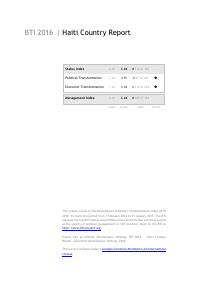
Status Index
1-10
3.46
# 114 of 129
Political Transformation
1-10
3.75
# 97 of 129
Economic Transformation
1-10
3.18
# 116 of 129
Management Index
1-10
3.44
# 109 of 129
scale
score
rank
trend
This report is part of the Bertelsmann Stiftung’s Transformation Index (BTI)
2016. It covers the period from 1 February 2013 to 31 January 2015. The BTI
assesses the transformation toward democracy and a market economy as well
as the quality of political management in 129 countries. More on the BTI at
http://www.bti-project.org.
Please cite as follows: Bertelsmann Stiftung, BTI 2016 — Haiti Country
Report. Gütersloh: Bertelsmann Stiftung, 2016.
This work is licensed under a Creative Commons Attribution 4.0 International
License.
�BTI 2016 | Haiti
2
Key Indicators
Population
M
10.6
HDI
Pop. growth1
% p.a.
1.3
HDI rank of 187
Life expectancy
years
63.1
57.4
Urban population %
0.471
GDP p.c., PPP $
1731.8
168
Gini Index
UN Education Index
0.374
Poverty3
%
71.0
Gender inequality2
0.599
Aid per capita $
112.2
60.8
Sources (as of October 2015): The World Bank, World Development Indicators 2015 | UNDP, Human Development
Report 2014. Footnotes: (1) Average annual growth rate. (2) Gender Inequality Index (GII). (3) Percentage of
population living on less than $3.10 a day at 2011 international prices.
Executive Summary
Since the end of the Duvalier dictatorship in 1986, Haiti has lived through recurrent circles of
crises and the nation’s social and political elites are trapped in a vicious circle of mistrust and zerosum politics. A desperately needed national consensus on how to govern the country is far from
being reached.
Michel Martelly’s presidency has been a failure. Instead of tackling the urgent issues of
reconstruction and reconciliation, the political situation today is worse than before Martelly
assumed office. For the second time this century, the country is without constitutional powers and
has to be governed by an interim commission. Martelly’s failure to organize a compromise on an
electoral body led to a situation where there is actually no more Parliament or Senate in Haiti.
Following massive and violent street riots, Prime Minister Lamothe had to resign in December
2014. One of the oldest figures of the opposition, Evans Paul, former mayor of Port-au-Prince,
replaced him. Following the recommendations of a mixed commission, President Martelly
promised to share power with the opposition until new elections could be held at the end of 2015,
but instead the majority of government positions remain under his control. It remains unclear if,
under these conditions, a compromise regarding an electoral body that organizes the electoral
process will be found.
Martelly promised to stabilize and restructure the Haitian economy, as well as combat and
eventually reverse impunity and insecurity in order to boost economic development. Salient
among his promises were access to free education and an increase in well-paying jobs that could
foster some form of economic stability in the country. In none of those areas has there been
substantial progress. The majority of the population lives in the same extreme poverty as before,
with prices rising. It remains unclear where the money from a special fund for the One Million in
School for Free Program went and how many pupils have actually been reached. In the agriculture
and energy sectors, literally nothing happened. The only economic success: the inauguration of
�BTI 2016 | Haiti
the Caracol Industrial Park. But, even there, there is considerable criticism due to bad working
conditions and poor wages; workers earn between four and six dollars per day.
At the beginning of 2015, the future of Haiti looks bleak, and the lack of consensus among elites
gives little reason for optimism that they might be able break the cycle of little progress and
subsequent regression. If, in the forthcoming electoral year 2015, no compromise on an electoral
body and the partition of power is found, the country will face increasing internal unrest.
History and Characteristics of Transformation
Haiti, which became the first independent slave republic in the world in 1804, has ever since
suffered from political instability. One of the longest periods of stability in recent history was
during the autocratic rule of Francois Duvalier. He came to power in 1957, backed by a majority
in both houses of the legislature. Duvalier had been known as “Papa Doc” because of his
paternalistic concern for the poor Haitians. During his fourteen-year reign, he became more and
more autocratic and brutal. In 1961, he discarded the bicameral legislature and made himself
president for life. One of his heaviest and most dangerous legacies is the so-called Tonton
Macoute, a secret paramilitary group, which used blackmail and terror to control Haiti’s citizens.
When Duvalier died in 1971, his son, Jean-Claude came to power – at the age of 19. Baby Doc
Duvalier became well-known for his lavish lifestyle. He continued to maintain power with
intimidation.
A visit from Pope John Paul II in 1983 became known as the beginning of the end for Baby Doc.
Threatened by rioting crowds and pressured by the United States, Baby Doc went into exile in
France.
Haiti’s first free and democratic elections were held in 1990, when Jean-Bertrand Aristide, a
former priest, emerged as president. Only ten months later, a coup d’état interrupted the process
of democratization, forcing Aristide into exile and installing a three-year military regime. The
return to a constitutional order in 1994, enforced by international military intervention under U.S.
leadership, returned Aristide to the presidency. In 1996, Réné Preval, a close ally of Aristide,
succeeded him as president.
Against the background of a political crisis, triggered by controversial parliamentary elections in
2000 and an increasingly difficult relationship between the opposition and Aristide’s party, Famni
Lavalas, Aristide was elected president for a second time. Very popular among the poor, Aristide
began implementing redistribution measures and cut privileges for the wealthy. The United States
introduced harsh economic measures against a government it considered antidemocratic. The
country’s fragile economy suffered several blows, making it increasingly difficult for Aristide to
govern amid an increasingly polarized political environment. Following violent protests and an
armed rebellion led by former army staff (the Haitian military had been dissolved by Aristide),
3
�BTI 2016 | Haiti
Aristide had to leave the country on 29 February 29 2004. Whereas the U.S. described Aristide’s
departure as a “voluntary escape,” Aristide accused the United States of hijacking him.
In 2004, the U.N. Security Council authorized the deployment of a multinational interim force to
re-establish stability until the arrival of a U.N. peacekeeping mission (MINUSTAH).
Presidential and parliamentary elections were held in February 2006. René Preval was declared
winner with 51% of the vote.
On 12 January 2010, a devastating earthquake hit the country killing more than 250,000
individuals and leaving 1.5 million people homeless. The entire U.N. headquarters were destroyed,
more than 30 staff members died, including the U.N. representative. Many Haitian intellectuals
and political activists died. Most of the political and administrative buildings collapsed.
Although the disastrous situation seemed to be chaotic, the international community insisted on
the organization of elections. Former singer and nightclub owner Michel Martelly came out of the
contested elections as Haiti’s new president. Due to numerous problems with the counting, he
could be only sworn in May 2011, more than one year after the elections occurred.
4
�BTI 2016 | Haiti
5
The BTI combines text analysis and numerical assessments. The score for each
question is provided below its respective title. The scale ranges from 1 (worst) to
10 (best).
Transformation Status
I. Political Transformation
1 | Stateness
Since Aristide dissolved the army in 2001, security is jointly provided by the HNP
(Haitian National Police) and the U.N. Stabilization Mission in Haiti (MINUSTAH).
The U.N. is now entering its second decade of presence in the country. MINUSTAH
has been among the most costly U.N. peacekeeping missions in the world. The size
of the HNP has gradually increased since 2004, to about 11,000 officers in 2010.
Question
Score
Monopoly on the
use of force
3
The earthquake presented a major setback and MINUSTAH increased its presence to
approximately 14,000 staff members. The number of troops have been significantly
reduced in the meantime, but the national police force still cannot guarantee the
security needed to protect citizens, enforce the law and underpin political stability.
There is criticism by Haitians and the international community because of the
military’s history of brutality and the very limited state budget. While a special
commission will decide on the fate of the military, former military officers train in
informal military camps, constituting a threat to stability. Although the population
perceives MINUSTAH’s continued presence as an occupying force, there are no
plans for complete withdrawal.
The idea of the nation-state is not essentially questioned but exists only as a loose
concept or guiding principle at best. Although historical references to the glorious
past (Haiti having gained independence through a slave rebellion) are frequent and
strong, they remain the only sources of national identity that the deeply divided elites
can rely on. Powerful and functioning symbols of modern stateness are missing,
however.
The large majority of the population cannot even acknowledge the concept of a
nation-state, having never experienced the fundamentals of citizenship, such as the
provision of social services or participation in elections. Less than 20% of the
population voted in the last elections and many citizens do not even possess legal
documentation. While the small political and intellectual elites of the country pretend
to represent a nation and, as such, maintain dialogue with the international
community, 90% of the population is disconnected from this reality.
State identity
7
�BTI 2016 | Haiti
6
A popular saying in Haiti claims that 80% of the population belongs to the Roman
Catholic Church, but a large majority of the population believe in the existence of
voodoo spirits. Other figures indicate that there is a growing number of Protestant
churches. Most religious temples both in Port-au-Prince and outside the capital
function as social service agencies, psychological and medical centers and market
places. Temples form imaginary families, in which congregations are the children of
priests, who are the charismatic local leaders. Aristide, for example, won his
popularity and finally the presidency due to his work as a priest. Since he left power,
religion has lost its direct influence on politics, although religious belief still plays an
important role in social and political life. President Martelly is known to regularly
consult a voodoo priest.
No interference of
religious dogmas
The state as a provider of social services is nearly nonexistent. Eight million (out of
an estimated population of 10 million) live without electricity, five million cannot
read or write. Widespread misery is endemic. More than four times the regional
average of women die in childbirth and infant mortality is twice the regional rate.
More than half of all families live in extreme poverty. (cepal.org)
Basic
administration
9
2
The fatal weakness of administrative structures became visible after the earthquake
in 2010. Urgent needs like housing, shelter and sanitation remained incompletely
seen to for over three years. The outbreak of cholera and ongoing problems
controlling the spread of disease show that sanitation and access to water remain some
of the most urgent issues in the country.
2 | Political Participation
Haiti’s complex electoral framework reflects democratic values. Unfortunately, many
provisions have not been realized yet. Haiti has held 13 elections since 1987. All of
them have been marked by irregularities and fraud or accusations of fraud. In the
elections in 2010, at least three of the nine members of the electoral body (CEP) were
accused of corruption. One member resigned. Nineteen presidential candidates and
16 political parties – including Famni Lavalas – Haiti’s largest political party, have
been banned from participation in elections without providing substantial legal
justification. Voter registration problems and missing identity cards have contributed
to widespread claims of vote-rigging and fraud. In addition, the financial capacity of
the candidates determines their capacity to access media. Only six months after the
first electoral round, and under immense pressure from the international community,
did the electoral commission declare Michel Martelly the winner of the last
presidential election.
Five years later, President Martelly has yet to create an impartial and independent
electoral commission. Instead, he tried to create an environment to promote his close
allies and friends. Due to a lack of political will and growing mistrust among the
Free and fair
elections
5
�BTI 2016 | Haiti
7
opposition and Martelly, the missing electoral commission became the key to
political failure during Martelly’s presidency. No Senate elections have been
organized, nor the scheduled parliamentary elections. Prime Minister Lamothe was
forced to resign. In order to maintain a minimum of political stability and to avoid a
situation where President Martelly has to govern by decree, a mixed commission is
supervising the political decisions Martelly makes. Elections shall now be held at the
end of 2015 and, once more in history, Haiti’s future remains uncertain.
Overall, it cannot be stated that the government has an effective power to govern. For
more than ten years, the country has hosted a U.N. mission that meets most of Haiti’s
security needs and is also charged with providing assistance in organizing and
supervising elections. Haiti is heavily dependent on foreign aid. This dependence was
amplified by the earthquake. While the international community lamented the
government’s lack of leadership, 99% of the earthquake relief went to nongovernmental organizations. This reinforced the government’s role as an observer in
the reconstruction process while donor countries and international organizations
maintained significant influence on policies. Their strong role and their presence in
the country produce other unintended effects: the best civil servants are often
attracted to international organizations. They pay the higher salaries and offer a better
working environment. In addition, national and foreign business actors can co-opt
members of the executive and the legislative branches by giving them bribes.
Effective power to
govern
The constitution protects the right to associate and assemble freely. Political parties
and civic groups are able to operate free of state interference. Nevertheless, trade
unions and other civil society groups are often too weak to be involved in political
discussions or wage negotiations.
Association /
assembly rights
2
7
In several cases, there have been intimidations of public protests organized by the
opposition or critical movements – but also by Martelly supporters. Public claims are
always risky because it is a popular strategy in Haiti to buy “a mob” to disturb or
dissolve marches by spreading aggression and increasing tension until the police step
in.
The constitution guarantees freedom of expression and freedom of the press. In
general, the media is free to report without censorship, but there are cases when this
is not so. In 2011, the National Television station fired two journalists for their critical
reporting on President Martelly. Journalists are also victims of violence and
intimidation that lead to self-censorship. According to some journalists, President
Martelly, his bodyguards and other affiliated persons exhibit open hostility towards
journalists at press conferences.
With high rates of illiteracy, the majority of the population relies entirely on radio
broadcasts to keep up with information. Several hundred radio stations exist on the
national territory. Less than 10% of the population has access to television. There are
no formal restrictions on social media or the Internet, but, due to limited resources,
only a small part of the population has access to the Internet.
Freedom of
expression
6
�BTI 2016 | Haiti
8
3 | Rule of Law
According to the constitution, there is a separation of powers between the president
and the prime minister as head of the government. Both houses of Parliament (i.e.,
Senate and House of Deputies), tasked with oversight functions and guaranteeing a
degree of checks and balances. In reality, the president alone defines policies and –
if necessary – tries to bribe the necessary number of deputies to give him support. As
the Senate’s mandate expired over a year ago and no elections have been organized
since, the Senate is not functional. The same became true for Parliament, as the
deputies’ mandate expired in January 2015. The Constitutional Court – a permanent
body separate from the existing Supreme Court, which has the tasks to resolve
disputes among branches of government and to review the constitutionality of laws –
is not yet in place. The Superior Judiciary Council for setting and monitoring judicial
standards and safeguarding judicial independence began operations only in 2012 and
its work has been contested.
Separation of
powers
According to the constitution, the judiciary consists of the Supreme Court and the
Court of Appeals, followed by other smaller courts. The president appoints judges
according to lists of candidates submitted by the Senate and regional and local
assemblies. In reality, Haiti’s judicial independence is heavily impaired by political
authorities and very high levels of corruption. For the average Haitian citizen, it is
nearly impossible to call on judiciary channels, due to high costs of appealing,
endemic corruption and language problems (although every legal document should
be available in Creole, in reality documents only exist in French).
Independent
judiciary
Independence suffers from the executive’s influence, exerted by the Ministry of
Justice and the administration of the courts. This influence became very clear during
the trial against former Dictator Jean-Francois Duvalier, who – after 25 years in exile
– returned to Haiti in 2011. He was charged with crimes against humanity and
corruption. When Martelly became president, most charges against Duvalier were
dropped. Martelly has close ties to the Duvalier network and has repeatedly publicly
called for amnesty for Duvalier. The judiciary’s inability to act independently stems
primarily from its lack of resources, a shortcoming that became worse after the
earthquake in 2010 due to a loss of archives, files and the destruction of judicial
buildings. But, a lack of political will to change the system remains the major obstacle
to greater independence of the justice system. On different occasions, the various
presidents’ families have intervened in corruption charges filed against them.
3
3
�BTI 2016 | Haiti
9
Corruption is endemic and part of everyday life. The official procedures required by
the constitution, such as the declaration of assets by senior state officials and the
delivery of end-of-term discharge papers, remain unfulfilled requirements. The heads
of government are regularly implicated in widely publicized corruption allegations.
Such scandals become public, but are never investigated or prosecuted. Impunity for
abuses by security forces is widespread. Although corruption is endemic and
widespread, there is no single case yet where a civil servant has been condemned for
office abuse. There are rhetorical confessions on the need for more ethical spirit in
the administration made by the government and public actors.
Prosecution of
office abuse
Various fundamental civil rights are not protected in Haiti. Due to the weakness of
the legal system, civil rights violations are seldom prosecuted. Thousands of
prisoners have been in jail for years without trial and many have exceeded by far the
maximum jail time for their alleged crime. Police officers and guards routinely beat
and torture prisoners and detainees. Despite a legal prohibition against arbitrary
arrest, it is frequent. When cases do reach trial, they are often processed in French
language only, despite the fact that the majority of the population only understands
Creole. Many defendants cannot follow or engage in their own legal cases.
Civil rights
2
4
Violence against women and children, including rape and trafficking of persons, is
widespread. Thousands of children work illegally and without compensation in
households and manufacturing. The police have been unwilling to respond to reports
of sexual abuse and domestic violence, and the judiciary has been reluctant to
prosecute cases.
There is no discrimination due to religion, ethnicity or political preference.
4 | Stability of Democratic Institutions
In theory, Haiti’s political system is a semi-presidential republic. The president of
Haiti is the head of state. The prime minister, chosen by the president from the largest
party in the legislature, is the head of government. Executive power is exercised by
the president and prime minister, and legislative power by the two-chamber
Parliament of Haiti. The Assembly comprises a 30-member Senate (the upper house),
which is elected for six-year terms in staggered elections, with one-third of seats
being contested every two years, and a 99-member Chamber of Deputies. In practice,
however, the formal rules of the game are heavily impaired.
The continuing instability in Haiti is due to the fact that politics have been marked by
personalities and personalized politics for decades, while political parties, which
could stabilize the political game, have only played a minor role in candidate
selection. When presenting his candidature for presidency, President Martelly had no
political base at all; he was relying on his popularity as a folksinger and nightclub
Performance of
democratic
institutions
3
�BTI 2016 | Haiti
10
owner. Only when coming to power did he create his own party. From the beginning,
he showed a deep disrespect for and misunderstanding of democratic norms and
institutions. Therefore, one of the main challenges for the country remains generating
institutionalized politics. While Martelly tried to appear as if he would strengthen
institutions, in his first year in office, when appointing members of the Superior
Judiciary Council, he created new problems by appointing a person who had passed
the age limit for judges.
At the same time, he failed to organize senate elections. In addition, elections on the
regional/communal level are seriously overdue. The terms of ten members of the 30member Senate ended in 2012. Another ten senators’ terms ended by the end of 2014,
as well as the terms of the House of Deputies and those of the 142 mayors. President
Martelly had to govern by decree from January 2015 on – due to his own incapacity
to respect the domestic electoral agenda. Everything depends on the formation of the
permanent electoral commission (CEP). The undersized Senate has failed to reach
the quorum needed to nominate its three representatives to the CEP.
Following a decree establishing the six-member CEP, Martelly faced increasing
pressure and polarization of the political landscape. His political opponents
immediately suspected that the president was preparing the floor for the installation
of political allies. Due to rising pressure, also from donors, Martelly’s Prime Minister
Lamothe had to resign in December 2014 (claiming that he did his job), while
Martelly installed an independent commission charged to make proposals to escape
the political impasse.
Haiti’s democratic institutions are accepted as formal structures but do not
necessarily earn the respect of all political actors and citizens. Haiti today has no
functioning political institutions and an uncertain electoral calendar. No electoral law
and no members of the agreed-upon electoral body are on the horizon. According to
a report by the International Crisis Group, the main responsibility for this situation
lies with the political and economic elites who have refused to fulfill their
commitments made in various church-sponsored dialogues. Some of the current
parliamentarians fear that they will lose their seats. President Martelly has not been
willing to make the compromise required to ensure elections. This situation shows
clearly in how far politics in Haiti are perceived as a zero-sum game where individual
and group interests are placed above any idea of common wealth or well-being.
Apart from the political scene, there are certain business interest groups, including
drug trafficking networks that would seek to select a government that would be the
easiest to influence in order to serve their interests.
Commitment to
democratic
institutions
2
�BTI 2016 | Haiti
11
5 | Political and Social Integration
The party system is highly fragmented and volatile. Political parties do not represent
the interests of the population, but represent mainly individual or clientelistic
interests. In addition, there is little to no social basis in the population outside of urban
centers, and even there it is weak. Political parties can appear or disappear literally
overnight. This happened when President Rene Preval founded a new political
movement called Inité (Unity) that became a melting pot for former members of other
political parties. When President Martelly came to power in 2012, many of the former
Inité followers changed to Martelly’s newly founded party, Tet Kale (one of
Martelly’s nick names which means “bald head”). According to data provided by the
Inter-Parliamentary Union, there are 16 parties with representation in the Chamber of
Deputies and two independent legislators. Ten parties were represented in the 30member Senate, including 17 senators from Lavalas and other parties associated with
Lavalas such as Inité, Lespwa and L’avni. No party has presented a real program.
Party system
Haiti’s grassroots movements operate alongside a vast number of foreign NGOs.
There are some 2,400 officially registered popular organizations, interest groups and
civil society organizations, though estimates range from 3,000 to 10,000. Civil
society groups do not have financial autonomy, making it difficult for them to
articulate their interests and advocate for them. In general, they have very limited
access to and influence on government decision-making. Some of them are more
active and popular than others, but lots of them serve mainly as vehicles for personal
interest or as a means to access international funding. Trade unions have lost most of
their influence, as a majority of the population is employed in the informal sector.
Interest groups
3
3
There are many local grassroots organizations, and in some cases, such groups are
able to effectively represent the interests of the local population. These organizations’
access to local officials remains traditionally higher than in Port-au-Prince, but given
the high level of centralization, all important political decisions are still made in the
capital. The reconstruction process showed how little emphasis the government puts
on local knowledge and local involvement in the reconstruction process. The main
business contracts went to Chinese or Dominican Republican firms, while national
professionals have been kept apart.
According to the Latin American Public Opinion Project (LAPOP) 2014, support for
democracy remains high on an abstract level, but decreases dramatically when it
comes to tolerating minorities or opposition parties. Support for the political system
in general is the third lowest in the Americas, and Haitians also have low opinions of
the Parliament, the courts, political parties and elections. Only ten percent of the
population espouses the combination of attitudes most propitious for stable
democracy: high political tolerance and high system support. In the Americas, only
Honduras shows lower levels of these specific attitudes. Forty percent the Haitians
hold the combination of attitudes most likely to put democracy at risk: low political
tolerance in combination with low system support.
Approval of
democracy
n/a
�BTI 2016 | Haiti
12
This means, in practice, that a vast majority of people do not have clear ideas what it
means to live in a democracy. The LAPOP data show that intolerance of political
opponents is widespread. Open criticism, an attitude crucial for democracy, is poorly
regarded. While the president as a strong and leading figure is accepted, political
parties and the Parliament are mostly rejected.
The 2010 earthquake facilitated the further dissolution of social capital within Haitian
society. Although cooperative mechanisms exist, their impact remains weak. The
main solidarity work is done by churches and religious organizations. The young
generation seeks fortune abroad, rather than staying home to improve living
conditions in their own country.
Social capital
3
LAPOP data from 2012 suggest that interpersonal trust was the lowest in the
Americas, with only 33% of respondents affirming that they would trust people in
their community. LAPOP 2010 found that the earthquake in 2010 had boosted levels
of not only distrust towards the political system, but also social distrust, compared to
2008 and 2006.
Despite what these statistics purport, social activity on a local level in Haiti is one of
the highest in the whole region. Due to the absence of public structures and services,
social networking is the only means of surviving outside the capital.
II. Economic Transformation
6 | Level of Socioeconomic Development
The United Nations Development Index 2014 ranked Haiti 168th out of 187
countries, one place above Afghanistan. In the period under review, this position
deteriorated even further in comparison to the years before. This is due to the cholera
epidemic and the still-insufficient recovery efforts to mitigate the effects of the 2010
earthquake. Haiti shows by a large margin the worst performance in all indicators for
Latin America and the Caribbean. One of Latin America’s biggest slums is situated
in Port-au-Prince, with an estimated 500,000 people living in dire conditions
featuring high rates of criminality.
More than 80% of the population live below the poverty line, while approximately
60% live on less than $1.25 per day. Rural areas are the most affected, with nearly
four-fifths of Haiti’s extreme poor living outside cities. More than one-third of the
population lack sufficient food. Land resources are limited and traditional methods
of farming are not producing sufficient food to ensure national food security. Levels
of income inequality are among the highest in the Americas. Nearly half of the
national income goes to the richest 10% of the population, while nearly 80% of the
population lives below the poverty line.
Question
Score
Socioeconomic
barriers
1
�BTI 2016 | Haiti
13
No accurate data on school enrollment is available. It is estimated to be 48%, though
it may be less than that. Even before the earthquake struck Haiti, poverty and a lack
of infrastructure contributed to low school enrollment rates across Haiti. The
earthquake only exacerbated this long-standing problem.
The Ministry of Education estimates that 80% of schools west of Port-au-Prince were
destroyed or severely damaged in the earthquake, and 35% to 40 % were destroyed
in the southeast. This means that as many as 5,000 schools were destroyed and up to
2.9 million children in Haiti are being deprived of the right to education. In the wake
of the earthquake, a logistical “Education Cluster” of organizations was created – coled by UNICEF and Save the Children – to support the government in getting children
back into school. No exact data on gender inequalities in education exist. Estimates
indicate that only 39% of women are literate, compared with 53% of men.
Access to health services is very limited. More than 8,000 people died due to the
cholera outbreak in 2010. This indicates the very severe problems with access to clean
water and sanitation. Infant and maternal mortality rates are among the highest in the
Americas with about 76 deaths per 1000 births.
Economic indicators
2005
2010
2013
2014
4310.4
6622.5
8452.7
8713.0
GDP
$M
GDP growth
%
1.8
-5.5
4.2
2.7
Inflation (CPI)
%
15.7
5.7
5.9
4.6
Unemployment
%
7.4
8.0
7.0
-
Foreign direct investment
% of GDP
0.6
2.7
2.2
-
Export growth
%
0.0
5.1
5.0
4.5
Import growth
%
6.6
20.7
3.2
2.6
Current account balance
$M
7.0
-101.8
-543.4
-
Public debt
% of GDP
47.2
17.3
21.4
26.6
External debt
$M
1346.8
952.8
1270.5
-
Total debt service
$M
57.8
131.3
9.0
-
�BTI 2016 | Haiti
14
Economic indicators
2005
2010
2013
2014
Cash surplus or deficit
% of GDP
-
-
-
-
Tax revenue
% of GDP
-
-
-
-
Government consumption
% of GDP
7.3
-
-
-
Public expnd. on education
% of GDP
-
-
-
-
Public expnd. on health
% of GDP
0.9
2.6
0.7
-
R&D expenditure
% of GDP
-
-
-
-
Military expenditure
% of GDP
0.0
0.0
0.0
-
Sources (as of October 2015): The World Bank, World Development Indicators 2015 | International
Monetary Fund (IMF), World Economic Outlook, October 2015 | Stockholm International Peace
Research Institute (SIPRI), Military Expenditure Database 2015.
7 | Organization of the Market and Competition
The market in Haiti operates under a very weak institutional framework with hardly
any regulatory mechanisms. The majority of the population works in the informal
economic sector, and most recent estimates by the World Bank and the Office of the
Special U.N. Envoy for Haiti suggest that more than 90% of private employment in
Haiti is in the informal sector. The formal sector is small and highly regulated in some
areas, for example in taxes and tariffs, and not regulated at all in other areas,
especially when it comes to workers’ protections and rights (such as wages and
working conditions). The country’s most important bilateral agreement (Hemispheric
Opportunity through Partnership Encouragement, HOPE II) gives its garment
industry free access to the U.S. market, with preferential terms for products from the
United States.
On the other hand, most of the national economy in essence belongs to approximately
15 large families. Adding to this are burdensome government regulations and various
exit and entry barriers. Accordingly, Haiti is ranked 137th among 144 countries in
the 2014 Global Competitiveness Report. Considering the country’s weak legal
system, the high level of corruption and the high level of political interference in
judicial decisions, investments are not protected and market participation is therefore
risky. At the same time, a good relation with the president or his family guarantees a
friendly environment for rentable investment.
Foreign investment remains weak. Haiti established a Commission on Price Controls
to propose measures to stabilize commodity prices considered sensitive by the
government due to their importance to Haiti’s food basket. There are no restrictions
on currency convertibility.
Market-based
competition
3
�BTI 2016 | Haiti
15
Although there has been some economic liberalization, the trend of monopolistic
practices remains unbroken. The lack of regulation reinforces oligopolistic
networking. The widely irregular economic liberalization serves mainly the business
elites who control trade. The Global Competitiveness Report 2014 ranks Haiti 137th
out of 144 countries and 140th concerning the effectiveness of its anti-monopoly
policy. There is no regulatory mechanism or institution to control mergers, price
fixing or predatory pricing. As an example, in 2012 two of the three private cellular
telephone companies were eliminated by protracted cooperation efforts between the
state and Digicel, which led to a de facto monopoly in telecommunications in the
country. This event not only is a symptom of the high level of corruption in the
country, but it leaves customers with bad service and higher prices.
Anti-monopoly
policy
Haiti’s simple average tariff is one of the lowest in the region (about 2.8%, according
to the World Bank). Haiti has been a WTO member since 1996 and a GATT member
since 1950. But regional non-tariff barriers make it difficult for the country to
participate in worldwide trade. However, also within Haiti, non-tariff barriers are still
significant, and an inadequate infrastructure and weak administration further hamper
foreign trade. Trade liberalization has had considerable negative impact on the
economy, as local products cannot compete with cheap imports. This has affected the
agricultural sector in particular, and during the period under review, there has been
some discussion of introducing measures to favor local production. The United
States’ introduction in 2010 of the Hemispheric Opportunity through Partnership
Encouragement (HOPE II) gives Haiti 10 years of preferential access to U.S. markets
through special tariff exemptions. Concerning the burden of customs procedures,
Haiti is ranked 140th out of 144 countries in the Global Competitiveness Report for
2014-2015.
Liberalization of
foreign trade
The banking system and capital market are poorly differentiated, and the banks are
all controlled by the same tiny business elite. The central bank is the sole financial
supervisor in Haiti. Its supervisory mandate extends to commercial banks, business
banks, saving banks and credit unions. However, the central bank is seriously and
increasingly undercapitalized and its operations have been, until recently, subject to
political interference, which led to the fall of Socabank in 2008. In a recent example
of political interference, President Martelly ordered the central bank to leverage one
percent of the remittances to Haiti. Such a fiscal measure should be taken by the
Ministry of Finance and not by the central bank. Furthermore, according to the
constitution, such a decision cannot be made by the president alone but requires the
approval of the Parliament. Therefore, this step has been largely criticized by the
opposition.
Banking system
According to an IMF report, capital adequacy requirements are largely Basel Icompliant, and since 1988, they have been primarily focused on credit risk. Others,
such as operational and market risks, which form, together with credit risks, the three
pillars of Basel II, are absent in the Haitian financial system. Therefore, there is
2
6
4
�BTI 2016 | Haiti
16
neither supervision nor market discipline. There are actually neither specific
regulations on minimum standards for risk management beyond traditional internal
control principles, nor independent auditing system for most banks.
According to the central bank of Haiti, shareholders’ equity as a percentage of assets
dipped from 6.49% in 2008 to 6.17% in 2011, for an average of 6.41% in the last four
years. There was an improvement in the performing of loans, evidenced by the
diminution of nonperforming loans, which, as percentage of total loans, were
estimated at 9.69% in 2008 and 3.69% in 2011, with an average of 6.88% for the
same period. There is no independent auditing system for most banks. It is unclear in
how far the continued non-servicing of loans following the 2010 earthquake will
affect smaller banks.
8 | Currency and Price Stability
Between 2003 and 2014, the inflation rate averaged about 12%, reaching an all-time
high of 42.5% in September 2003 and a record low of -4.7% in September 2009.
After rates of 8.4% in 2011, 6.3% in 2012 and 5.9% in 2013, the inflation rate for
2014 was estimated at about 5%. The inflation rate and foreign exchange policy in
Haiti are supervised and reported on by the central bank (Banque de la République
d’Haiti, BRH). The BRH is directed by a governor and operates mostly
independently, but is at times also subject to political interference. According to the
IMF, monetary policy was adequately geared towards protecting reserves while
ensuring a low and stable inflation. According to the IMF Annual Report on
Exchange Arrangements and Exchange Restrictions 2014, Haiti’s exchange rate
policy follows a crawl-like arrangement and maintains a de facto exchange rate
anchored to the U.S. dollar. The real effective exchange rate remained stable between
2010 and 2013, with only slight appreciation of about 2% on average (more recent
data not available).
Anti-inflation /
forex policy
The effects of the 2010 earthquake undermined much of the previous progress made
in stabilizing Haiti’s economic situation and has further limited the government’s
capacity to follow any sort of macroeconomic strategy. The fiscal balance continued
to be negative, with an estimated -6.3% of GDP in 2014, after -3.6% in 2011, -4.8%
in 2012 and -7.1% in 2013. Although the external debt was cancelled by donor
countries following the earthquake, it has since risen to $1.1 billion. Government debt
rose from 11.9% of GDP in 2011 to 21.3% in 2013 and 26.7% in 2014.
Macrostability
Haiti’s original three-year $140 million poverty reduction and growth facility was
automatically converted to an extended credit facility prior to the earthquake. The
IMF approved an additional $102 million loan after the earthquake. The fund also
reduced the debt service burden and made arrangements to help maintain an adequate
foreign reserve cushion.
6
4
�BTI 2016 | Haiti
17
Remittances are the primary source of foreign exchange and total up to 20% of GDP.
In 2012, remittances represented more than five times the earnings from exports.
From 2011 until 2014, remittances averaged about $2 billion annually.
Haiti suffers from a lack of investment, partly because of weak infrastructure, but
also due to political instability and corruption. The government relies on formal
international economic assistance for fiscal sustainability, with over half of its annual
budget coming from outside sources. The Martelly administration launched a
campaign to foster foreign investment. A commission has been created to reform the
Commercial Code. In 2013, the government inaugurated the Caracol Industrial Park
on the northern coast, which should provide up to 30,000 jobs.
9 | Private Property
The constitution guarantees private property and assigns the state the duty of
protecting and promoting private entrepreneurship. The country has signed
international conventions on patents and trademarks. However, the weak judiciary,
endemic corruption and a general lack of political will impede effective enforcement
of these rights. Problems of land ownership are among the most urgent in economic
terms. Land titles and questions of ownership are often unclear and the nonexistent
legal structures lead to violent conflict. Fraudulent sale of land titles and claims to
traditional ownership are among the most frequent sources of these conflicts. The
Global Competitiveness Report for 2014-2015 ranks Haiti 143rd out of 144 countries
concerning the protection of property rights.
Property rights
Private companies can act without restrictions and private business engagement is
encouraged by the government, at least on a rhetorical level. The only formal
limitations to start a business are the heavy and complicated administrative
procedures required to register an enterprise. Starting a business in Haiti takes four
times longer than the world average. According to the Global Competitiveness Report
for 2014-2015, the process takes 12 procedures (ranked 131st out of 144) and 97 days
(ranked 140th), while in the neighboring Dominican Republic starting a business
takes 18.5 days and is completed in seven steps. Concerning the burden of
government regulation, Haiti ranks 92nd out of 144 countries. Overall, Haiti ranks
137th out of 144.
Private enterprise
One of the reasons for this long and frustrating process is that commercial laws are
applied inconsistently and without transparency. Though private companies represent
the majority on the national market, public enterprises occupy important sectors such
as telecommunications, electricity, ports and airports. The Martelly administration
had plans to privatize the National Port Authority and the electricity company but
nothing has happened yet.
4
5
�BTI 2016 | Haiti
18
10 | Welfare Regime
A welfare regime is nearly absent in Haiti. The state provides a very basic health and
pension insurance scheme, but as only 10% of the population is formally employed,
only a few citizens benefit from this rudimentary system. Public expenditure on
health is about 1% of GDP, life expectancy at 62 years.
Social safety nets
3
Family networks function as the only reliable safety net. The most important
contribution to social welfare comes from the large Haitian diaspora. Remittances are
reported to constitute 20% of the overall GDP. International NGOs partially provide
some of the most basic services, but cannot replace the state.
Equality in opportunity does not exist. No special legal framework has been voted
into place. Women have long been subject to widespread gender discrimination. Only
a tiny minority of women is represented in public office. Violence against women
and girls represent the most severe manifestation of discrimination. In 2011,
President Martelly proposed subsuming the Ministry for the Status of Women and
Women’s Rights into the Ministry of Social Affairs, but withdrew the proposal in
consideration of massive protests from women’s groups.
Equal opportunity
3
Levels of income inequality are among the highest in the Americas. Nearly half of
the national income goes to the richest 10% of the population, while nearly 80% of
the population lives below the poverty line. Gender is one of the main risks for living
under the poverty line. Women are largely underrepresented in public office. In the
history of the two official legislative chambers, women have never held more than
6% of the seats. There are no existing public programs or incentives targeted towards
promoting greater gender equality.
11 | Economic Performance
The Haitian economy was completely derailed following the 2010 earthquake. In
2010, per capita GDP fell by 6.6%, according to the Economic Commission for Latin
America and the Caribbean (ECLAC). In 2011, GDP grew by 5.5% due to the influx
of foreign aid, but in 2012, the growth rate slowed down to 2.9%, reaching 4.3% in
2013 and an estimated 3.5% in 2014. Among the causes of this low performance are
the lack of reconstruction, hurricanes that heavily affected agriculture, and the
retrenchment of 12% in international assistance. International donors are reluctant to
contribute due to endemic corruption and low state performance. Therefore, in 2012,
private investment exceeded international aid for the first time. This is mainly due to
the inauguration of Caracol Industrial Park. In 2011, the budget exceeded $2.5 billion
for the first time in history.
Output strength
3
�BTI 2016 | Haiti
19
An economic take-off seems more unlikely as security remains insufficient and
energy crises are growing in number. Deficits in the energy sector are one of the main
reasons why direct investment remains limited.
The trade and current account deficits have widened during the review period, as
domestic production remains weak and the demand for imported food and
reconstruction materials has risen. GDP per capita is estimated at $1,300 for 2013.
Even though the Haitian government has been talking extensively about the need to
attract foreign investment as its priority, significant investments seem very unrealistic
unless the authorities attack the legal and physical insecurity problems and give
transparency signals. In fact, international actors as well as Haitian society perceive
the contrary. There are no reliable figures on unemployment, but it is estimated to be
more than 70% of the labor force.
12 | Sustainability
Haiti faces serious environmental degradation, which increases the country’s
vulnerability to natural disasters. There is a high risk that each tropical weather
phenomena produces serious consequences for the population, as flooding and
erosion have most recently shown. The government fails to take environmental
concerns into consideration, and there is no noteworthy environmental policy. Of the
country’s 30 watersheds, 25 are without natural cover. The remaining forests,
covering only 1% of the territory, cannot play any significant environmental role.
Deforestation and land degradation undermine efforts to improve agricultural
production. The disastrous and widespread effects of cholera can only be explained
by the large scale of environmental degradation, as the water from the Artibonite
River, one of the main water sources in the country, is used as a source of drinking
water as well as a public toilet. Considering demographic growth, these problems will
only become more serious in the future.
Environmental
policy
The Haitian education sector suffers from lack of state resources and absence of
regulation capacity. It is also impaired by the influx of private service providers.
About 90% of education is private and about 80% of the national budget for education
is provided by international donors. While coming to power, President Martelly made
free schooling one of the top priorities of his agenda, but little is known regarding
any outcomes. State expenditure on education was 1.6% of GDP in 2012.
Education policy /
R&D
According to the most recent data from World Development Indicators for 2014, the
literacy rate is one of the lowest worldwide at 48.7% (male: 53.4%; female 44.6%).
There is no data available concerning enrollment. UNICEF estimates that, in 2012,
77% of children between ages six and 11 had been to school. Access to higher
education is extremely limited due to a lack of resources to pay fees. Universities
have irregular schedules and are prone to student unrest. There is no data on research
activities, as such activities hardly exist. Another constraint is the near total absence
of vocational training, which leads to extremely poor standards of technical
qualifications.
2
2
�BTI 2016 | Haiti
20
Transformation Management
I. Level of Difficulty
Structural constraints are very high in Haiti: 80% of the population lives in poverty
and nearly 50% is illiterate. The 2010 earthquake worsened the already difficult
situation by incurring massive destruction of infrastructure, massive loss of lives and
destruction of files, archives and administrative infrastructure. Vulnerability to
natural events like hurricanes, floods or earthquakes is extremely high.
Structural
constraints
9
The government depends on external aid. Due to endemic corruption, donors prefer
to give money to NGOs and Haiti has become “the country of NGOs”. This may be
to the advantage of some fringes of the population, which benefit from direct aid, but
constitutes a major obstacle for the government. It is impossible for the government
to coordinate or orchestrate the NGOs present in the country. Additionally, a severe
cholera pandemic causing more than 8,000 deaths has hit the country.
Civil society traditions are fairly weak and were mostly quashed during the
successive Duvalier regimes. Considering Haiti’s traditionally weak state structures
and the lack of trust by the population in political institutions, the country today has
a fairly active civil society culture, especially at the local level. But many groups
have been incorporated or manipulated by political and economic elites in recent
years. It also should be noted that much international humanitarian engagement in
Haiti has been channeled through civil society organizations, and thus membership
in such groups has become a means to live and survive for many Haitians. The
emergence of civil society organizations in recent years reflects more the strong
engagement of international NGOs than a real push in local civic engagement.
However, some of the civil society organizations are very outspoken and active in
the political arena. Yet Haitian civil society is still highly fragmented and split along
religious, social, political and cultural lines. This reduces civil society groups’
capacity to influence political decisions.
Civil society
traditions
8
�BTI 2016 | Haiti
Although Haiti is not marked by significant ethnic or religious cleavages, social and
political conflicts are an inherent part of the country’s history and have impeded
democratic and economic transformation. The exclusion of major parts of the
population and the enrichment of the political and economic elites have deeply
divided Haitian society, fueled violence and hindered dialogue. Political conflict is
often carried out in the streets, as the demographically most significant group – young
men between the ages of 15 and 25 – are easy to influence and are often manipulated
to engage in violent protest.
21
Conflict intensity
6
II. Management Performance
14 | Steering Capability
When Martelly came to office, he promised to promote education, energy and
agriculture. But during his presidency, the government failed to set strategic
priorities. Although some specific goals were proposed, these remained unspecific
and unrealistic. One goal was to achieve free education for everyone. The policy in
agriculture was to promote self-sufficiency and reduce dependency on imports.
Instead of engaging with accurate plans in order to achieve these goals, Martelly ruled
on a day-to-day basis, with his only aspiration to keep himself and his allies in power
for as long as possible. This strategy led the country straight into another
constitutional crisis and, in December 2014, Prime Minister Lamothe had to resign.
Question
Score
Prioritization
3
President Martelly has not been willing to take the necessary steps to ensure elections.
While a compromise agreement (The El Gaucho Agreement) was made in 2014 –
under pressure from the international community – it has not been implemented. Haiti
still has no election calendar, no electoral law and no members of the agreed-upon
electoral body. There is no more Senate and the mandate for the members of
parliament ran out in January 2015. Local governments likewise have been
undermined because mayors and local assemblies should have also been elected long
ago. Instead, the executive appointed individual officials when the terms of the
previous ones had expired.
The Martelly administration has failed to implement the goals the president set during
his campaign. While Martelly promoted free education, energy, agriculture, jobs and
telecommunications, in none of these sectors has there been substantial progress.
Prices increased again and living conditions for the poorer remain very difficult. It
remains unclear where the money from a special fund for education went and how
many pupils can attend school with support from this fund. In agriculture, literally
nothing happened. The only achievement of the Martelly administration is the
Implementation
2
�BTI 2016 | Haiti
22
inauguration of the Caracol Industrial Park. However, the wages in this park are far
from being adequate – most of the workers earn between four and six U.S. dollars
per day. In the last year of his presidency, Martelly faced more than a hundred
nationwide protests against him.
Regarding the political agenda, it must be said that the Martelly administration faced
a complete disaster. Martelly failed to install a functioning electoral commission and
therefore could not adhere to the electoral agenda. The country is now without a
Senate and a Parliament and the only way to prevent Martelly from ruling by decree
was the installation of a reconciliation commission.
The government has made no correction to its policies, and seems not to be inclined
to learn from past experiences, knowledge exchange or consultancies. The longlasting tradition of personalized politics and the inability to make compromises have
long since undermined any prospects for political stability in Haiti. Polarization and
an understanding of politics as a zero-sum game have made political learning
difficult. President Martelly follows this tradition. From the very beginning of his
presidency, his style was marked by confrontation and conflict rather than
compromise and discussion. To give an example: a member of parliament was
arrested following a personal fight with Martelly (disregarding his immunity);
another example is the publication of a list of businessmen who owe taxes and the
imposition of a travel ban on some of them. Some on the list had engaged in
disagreements with the president.
Policy learning
3
15 | Resource Efficiency
Poor fiscal management and economic governance have inhibited the efficient use of
both domestic resources and external assistance in recent years. The fiscal balance
continued to be negative at an estimated -6.3% of GDP in 2014, after -3.6% in 2011,
-4.8% in 2012 and -7.1% in 2013. Although Haiti’s external debt was cancelled by
donor countries following the earthquake, it has since risen to $1.1 billion.
Government debt rose from 11.9% of GDP in 2011 to 21.3% in 2013 and 26.7% in
2014. Tax revenue is limited, dropping significantly after the 2010 earthquake and
totaling approximately 8% of GDP in 2013.
The already inadequate quality and quantity of human resources have further
deteriorated with the heavy loss of life and damage to public infrastructure. The
country’s administrative system suffers from a lack of incentives for motivated civil
servants. Low wages reinforce corruption and clientelism, which have come to be
deeply embedded in the system. The lack of public sector performance and absorption
is a serious obstacle to reconstruction. Due to the deteriorating security situation, the
few well-educated and trained people who remain in the country prefer to migrate
rather than risk their families’ lives.
Efficient use of
assets
3
�BTI 2016 | Haiti
23
One example of the poor use of resources is the mismanagement of money from the
Petro Caribe Fund. This fund is nourished by selling petrol, donated by Hugo Chavez
(Maduro now) to Haiti and sold by the government on the international market. The
money is administrated by the president’s office. Also there is money that has been
raised through a special “communications” tax illegally implemented by the
president’s office (taxing all communications coming in and going out of the
country). In both cases, no transparency is provided and the public is dependent on
figures provided by the president himself – a practice severely criticized by the Cour
Superieure des Comptes, the Haitian comptroller’s office responsible for auditing
public administration.
The Martelly government mostly failed to coordinate conflicting objectives. Haiti
relies heavily on foreign aid, and most of these funds are seen as personal assets of
politicians. One cannot really talk of policies, as decisions are taken on a day-to-day
basis, depending on opportunities. The continued confrontation between the
executive and legislative branches, due to the government’s formal and legal
negligence, shows once more the failure of the Martelly government to formulate and
coordinate proper policies in accordance with democratic rules. This malaise is not
unique to the current government; it reflects the structural challenges Haiti has faced
for decades. But, since 2010 and in particular during the Martelly administration, the
situation has worsened. Dialogue, trust-building, compromise and consensus among
all actors are still urgently needed. In fact, however, hardly any policies are proposed
and the administration relies 100% on external sources to formulate such planning.
In reality, the government considers this planning only important insofar as it
provides conditions for obtaining international funding.
Policy
coordination
Actually, there are no functioning mechanisms for curbing corruption in Haiti, and
state institutions do not have effective control over corruption. Haiti has always been
one of the most corrupt countries in the world and has a population that is used to
paying for any service given the absence of state services. But, especially in the
security sector, the situation seems to be deteriorating. While the police had a rather
good reputation in prior years, a recent report found that police bribes had increased
and that various high-ranking security officials had been involved in corruption and
crime scandals. With some of Martelly’s closest allies involved, people do not expect
that there will be an effective anti-corruption fight. All public institutions in charge
of corruption – the financial intelligence unit, the Anti-Corruption Unit and the Public
Administration Audit Court – suffer from bad reputation and/or a chronic lack of
material and human resources. There have been no major corruption trials so far. An
anti-corruption law has been proposed to the Parliament but has not been adopted. In
a very recent and rather spectacular case, a judge who sued the Martelly family for
bribery and corruption died of a heart attack following massive pressure and
intimidation from the Martelly camp.
Anti-corruption
policy
2
2
�BTI 2016 | Haiti
24
16 | Consensus-Building
The electoral fiasco in 2010 demonstrated serious mistrust in the entire political
system, and the situation continued to worsen up until 2014. The mandates of the
Senate, the Parliament and the local governments expired. One crisis follows another
and there is always the threat of a new uprising and continuing unrest. Although
democracy as a principle is theoretically accepted, only a very small minority of the
political players would act according to democratic rules. The main objective of the
ruling class is to remain in power and to have access to funds. The main objective of
those not in power is to win access to these funds and positions. There seems to be
no middle ground in Haitian politics.
Consensus on goals
5
The country’s economic situation is so deplorable that discussions of the nature of
the market economy remain highly academic. Although there are some socialist
factions in the Parliament, the majority of players are oriented toward the U.S.
system. The Martelly government has set its priorities on a market economy without
regulation. This primarily benefits the political elite and only secondarily the
population. The best example is an analysis of how the reconstruction money had
been spent and how some high-ranking politicians made big business with senior
officials from development or aid agencies. It is no coincidence that Prime Minster
Lamothe served as a manager in Telecommunications in the U.S. before becoming
Prime Minister of Haiti, and that he then provided special operating conditions to
only one company (Digicel), while the two other previously existing firms vanished.
While some actors in the Parliament ask for more regulation and law enforcement,
the majority seek their own political or economic advantage.
While ex-army members and supporters of former President Jean-Bertrand Aristide
who favor autocratic rule have lost much of their political influence, new
antidemocratic actors have been emerging who could challenge reforms. There are
close relations between political actors and business interest groups that support weak
state institutions to better serve their individual interests, and a considerable amount
of drug-trafficking money circulates in the political realm. Some former members of
Congress use their immunity to pursue illicit or criminal business activities. Highranking security officials are involved in cases of kidnapping and organized crime.
The role of drug trafficking and its impact on politics are underestimated by the
international community but remain unclear in their impact.
Anti-democratic
actors
5
�BTI 2016 | Haiti
The management of cleavages and conflicts did not improve during the Martelly
administration. Instead, it became worse. The government lacks the legitimacy to
prevent conflicts. While the Préval administration left behind a legacy of political
and social polarization that has fostered corruption, clientelism and inefficiency,
Martelly’s presidency has been marked by conflicts with the Parliament, the Senate
and the whole political class. This has undermined any political agreements to
enhance governance or to facilitate development and reconstruction. From the very
beginning, Inite, the party that holds the majority in the Assembly, delayed for several
months the forming of a new government in 2011, successively rejecting two of
Martelly’s nominees for the post of prime minister. Other conflicts are provoked by
Martelly himself, like the arrest – despite parliamentary immunity – of a member of
the Parliament with whom Martelly had a personal confrontation one day prior to his
arrest. Likewise, a conflict that stems from Martelly is his unwillingness to pave the
way for elections. He displays an aggressive and arbitrary way of being. Only at the
end of 2014, facing a substantial constitutional crisis, was he forced to give in and
fire his Prime Minister Laurent Lamothe.
25
Cleavage /
conflict
management
4
Overcoming the state’s historic weakness and mustering the political will to mitigate
social cleavages remain major challenges. The almost amorphous structure of
political and civil society, reflected in the highly fragmented and volatile party
system, complicates this task. Despite a further increase of poverty and a
deterioration of living conditions, the political elites seem incapable of overcoming
governance patterns dominated by short-term interests.
There are numerous civil society organizations, some of them well-rooted in society,
and they provide for the majority of social services that the government fails to offer.
While civil society participation has increased slightly in recent years, the 2010
earthquake and the following process of reconstruction constituted a sobering
experience. None of the civil society organizations, except for in the business sector,
were consulted in the process of outlining a medium- and long-term reconstruction
plan. Only one seat within the Interim Reconstruction Committee was reserved for
civil society groups, although such groups provide major competencies in nearly all
strategic sectors. National organizations of architects and engineers complained
about their noninvolvement in both planning and in realizing the reconstruction
efforts in the last years.
Civil society
participation
Little effort has been made to overturn the culture of impunity in Haiti with respect
to past human rights violations. The return of former dictator Jean-Claude Duvalier,
or “Baby Doc,” in January 2011, revealed the criminal negligence of courts in pursuit
of injustice. No case had been successfully brought against Duvalier and he moved
freely in Port-au-Prince and the national territory. Instead, President Martelly invited
him to official events like the inauguration of the new university in Limonade.
Duvalier died suddenly from a heart attack in October 2014. Martelly considered
giving him a state funeral, but facing massive national and international protests, he
withdrew his proposal and a smaller ceremony was organized.
Reconciliation
4
4
�BTI 2016 | Haiti
26
17 | International Cooperation
The international community plays a major role in Haiti’s political and social
development. The most visible role is the presence of the United Nations
Stabilization Mission in Haiti (MINUSTAH). In past years, with the support of
multilateral institutions, the government has developed several strategy papers on
reconstruction. In addition, Bill Clinton, the U.N. special envoy for Haiti, tried to
give a personal push to the reconstruction effort. But it has been questioned whether
the government really felt it owned the plans and had the drive to implement the
necessary measures. Moreover, international aid still was not being used effectively.
Corruption is endemic and it appears that personal gain is still the major driving force
behind the majority of politicians.
Effective use of
support
4
After the 2010 earthquake, the reluctance of bilateral donors to actually transfer funds
that had been promised during donor conferences reflects donor fatigue and doubts
about the government’s commitment and capacity to effectively use the money.
Reconstruction efforts have yielded unsatisfactory results. This is clearly related to
the government’s inability to organize consistent policies.
While Haiti had gained more donor trust throughout the first decade of the
millennium (which was reflected by the IMF approval of additional disbursements
and the augmentation of Haiti’s quota within the institution) the 2010 earthquake and
following rigged elections represented a clear step backward. The government’s
ability to manage the crisis was so poor that donors felt reluctant to disburse urgently
needed reconstruction money for fear of further mismanagement. Despite the
establishment of an Interim Reconstruction Commission, where the main donor
countries have important influence on how reconstruction is managed, not one single
project was approved in 2010. Although some minor progress has been made, there
is no substantial breakthrough in the reconstruction process made by the Martelly
administration. There have been no major improvements in living conditions during
the years of President Martelly’s government. Misery stays the same and Martelly
faced more than 200 protests during his presidency, during which protestors asked
him to step down. Although Martelly tries to project the image of a decent statesman,
donors remain reluctant. In 2013, Canada suspended its aid because of ongoing fraud
and corruption issues within the government.
Credibility
4
�BTI 2016 | Haiti
Haiti is a member of the Caribbean Community and Common Market (CARICOM)
and participates in Venezuela’s PetroCaribe program. Venezuela delivers oil at
preferential prices to member states, which can resell it at international market prices.
But after the death of Chavez and the price of oil falling to record lows, the “oil rent”
has considerably declined, thus limiting the government’s scope of action.
Haiti also has special ties with Cuba, which still sees Haiti as an icon as the first postcolonial independent black-led nation in the world and offers the island free medical
assistance. Relations with the Dominican Republic are difficult, which is mainly due
to massive illegal migration to the Dominican Republic.
The United States have always played a crucial role in Haiti’s development. One of
the major interests of the United States is to avoid an influx of “boat people,” or
immigrants and to keep the island as stable as it is needed in order to not become
another failed state. The line between aid and interference in internal affairs,
however, is often not respected. The majority of democratization efforts must be
understood in this context.
27
Regional
cooperation
7
�BTI 2016 | Haiti
Strategic Outlook
President Martelly has acted inadequately in tackling most of the serious challenges that Haiti is
facing. Instead of managing national reconciliation and mediation, he has fostered conflict and
cleavages. Today there is no Parliament, no Senate, and no permanent electoral body. The most
visible failures of the Martelly administration in the political system – the constitutional
amendment process, as well as the bitter conflict among the Permanent Electoral Council are also
testament to the lack of trust and the absence of political consensus. Haiti urgently needs a national
plan for reconstruction and development. President Martelly has to pursue public dialogue and
consensus building and renounce confrontational tactics. In this respect, the year 2015 can be seen
as an opportunity, if Prime Minister Evans Paul continues to participate as a representative of
opposition groups in national politics.
But if state corruption remains high, even the closest donors will drop out of the “help circle,” and
the stability of the system will be further threatened. President Martelly has to convince the
international community that he is really playing according to democratic rules. The U.S.
especially urges him to show respect for the constitution and transparent political management.
But considering Martelly’s personality and his personal record, it is very unlikely that he will bring
about changes by the end of his term.
It is unlikely that the U.N. mission can withdraw its troops in the near future. The country needs
to at least double its current number of police. The police need to be part of a comprehensive and
professional justice system founded on the rule of law.
Martelly’s presidency has been marked by conflicts with parliament and all other sectors. These
conflicts have blocked the consensus needed to facilitate governance. His election ended 26 years
of exclusion of the Duvalierists from a share in executive power. Lavalas, which had dominated
government most of the time since 1990, has no more executive influence and suffered a loss of
legislative power when Parliament’s mandate ran out in January 2015. Aristide and Lavalas remain
unknown factors within the country. The key to stability lies within compromise and powersharing, no more zero-sum politics.
28
�