
BTI 2010 Country Report - Haiti
- Reforms since 2006 produced little, held back by poor executive-legislature cooperation, parliamentary fragmentation and repeated shocks.
- The National Police with MINUSTAH reduced gang violence, though weak justice institutions put the gains at risk.
- April 2008 cost-of-living riots removed Prime Minister Alexis and five months of stalemate followed.
- Four hurricanes and storms struck in August and September 2008.
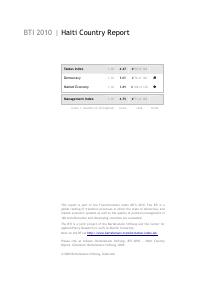
- Status Index 4.47, Management Index 4.75.
The Bertelsmann Transformation Index 2010 country report finds that reform initiatives attempted since the 2006 elections, including in the security sector, produced little. It gives three reasons: poor cooperation between the executive and the legislature, high parliamentary fragmentation, and political and economic shocks. The National Police working alongside the United Nations Stabilization Mission in Haiti made inroads against criminal gangs and the general level of violence fell, though the report judges those gains at risk from persistent political and social fragmentation and the weaknesses of the justice system.
Riots over rising living costs in April 2008 led to the removal of Prime Minister Jacques Edouard Alexis, and five months of political stalemate followed before Michele Pierre-Louis took office in September 2008. Four hurricanes and tropical storms in August and September 2008 had a severe effect on the social and economic situation of the poor. The Strategic Outlook puts reconstruction after the 2008 disasters first, calls on donors to participate more actively and to produce an operational reconstruction plan, and points to the donors conference planned for April 2009. The Status Index is 4.47 and the Management Index 4.75.
How to cite
Bertelsmann Stiftung, BTI 2010 Country Report - Haiti, https://bti-project.org/fileadmin/api/content/en/downloads/reports/country_report_2010_HTI.pdf