
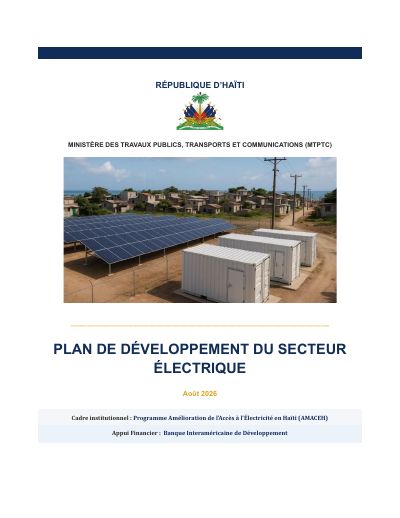
Electricity Sector Development Plan for Haiti
- The plan proposes six autonomous regional grids, mini-grids and solar home systems.
- The optimal generation setup is 4.5 MW of solar, 1 MW of four-hour battery storage and 1.3 MW of thermal capacity per MW of average demand.
- Interconnecting RN1 and RN0 would cost close to 330 million USD and does not generate cost reductions large enough to justify it.
- Solar home systems have the lowest annual equivalent cost for dispersed rural households, at 200 to 239 USD per connection per year for baseline demand.
- Mini-grids are viable only for dense areas and could serve at most about 100,000 households.
- The plan recommends starting implementation with the RN1 Northern Corridor around Cap-Haïtien.
The plan, dated August 2026, sets a roadmap for universal access to electricity in Haiti despite weak coverage, degraded infrastructure and a lack of reliable data. Because no official demand projection exists, it designs the system around a target demand and lets investment follow actual demand growth. The architecture has six regional grids (RN0 to RN5), mini-grids for isolated communities and solar home systems for dispersed households. Phase I brings each regional grid to 20 percent of target demand while rehabilitating existing networks, and Phase II adds investment when infrastructure reaches about 70 to 80 percent utilization.
The study finds that solar plus batteries plus thermal backup is the optimal generation mix, that liquefied natural gas is not justified, and that interconnecting RN1 and RN0 does not pay for itself. It recommends starting with RN1, the Northern Corridor around Cap-Haïtien, to test the technical and concession model.
How to cite
National Energy Sector Regulatory Authority (ANARSE), 2026, Electricity Sector Development Plan for Haiti, https://anarse.gouv.ht/wp-content/uploads/2026/10/Plan%20de%20De%CC%81veloppement%20du%20Secteur%20E%CC%81lectrique%20en%20Hai%CC%88ti.pdf
- Rights holder
- Autorité Nationale de Régulation du Secteur de l'Énergie (ANARSE)