
Haiti Poverty & Equity Brief
- In 2012, 58.5% of Haitians (about 6 million people) lived below the national poverty line and 29.2% below $2.15 a day, the highest rate in Latin America and the Caribbean.
- Real GDP per capita in 2024 was 12.3% below its 2012 level after six consecutive years of contraction from 2019 to 2024.
- Nowcasts put 2025 poverty at 37.6% at $2.15 a day and 66.7% at $3.65 a day.
- At $3.65 a day, poverty was 74.4% in rural areas and 40.1% in urban areas, and 70.7% among adults without education compared with 12.7% among those with tertiary education.
- September 2024 data show about half the population in acute food insecurity, including 2 million at emergency level and 6,000 at catastrophic level.
- Inflation accelerated from 20.9% year on year in January 2024 to 29.7% in January 2025; food inflation was 36.7%.
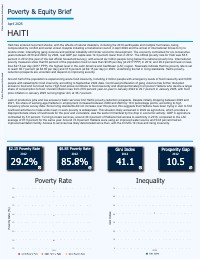
Two-page World Bank brief dated April 2025, by poverty economist Jonathan W. Lain. The last household survey usable for poverty measurement is the 2012 ECVMAS: that year 58.5% of the population (about 6 million people) was below the national poverty line, 29.2% lived on less than $2.15 a day and 58% on less than $3.65 (2017 PPP). The economy contracted for six consecutive years from 2019 to 2024, leaving real GDP per capita 12.3% below its 2012 level, and nowcasts project poverty of 37.6% at $2.15 and 66.7% at $3.65 in 2025. Poverty at $3.65 was 74.4% in rural areas and 40.1% in urban areas. The brief reports acute food insecurity for about half the population, inflation of 29.7% in January 2025 (36.7% for food), and 2016 electricity access of 40.4%. It also explains the cost-of-basic-needs method.
How to cite
World Bank, 2025, Haiti Poverty & Equity Brief, https://documents.worldbank.org/en/publication/documents-reports/documentdetail/099637004212520807