
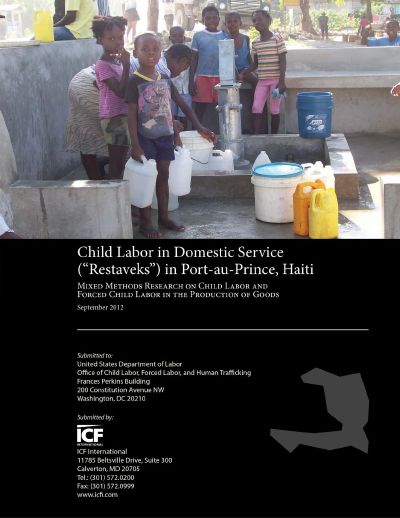
Child Labor in Domestic Service (Restavèks) in Port-au-Prince, Haiti
- The study conducted 225 interviews between July and September 2012.
- Sending families cited poverty or inability to look after their children, often after household shocks such as the death of a parent, injury, family discord or the 2010 earthquake.
- Experts identified a longstanding, culturally accepted tradition of having domestic workers as the demand factor.
- Arrangements between families were often informal, and little evidence pointed to coercion or a third party, although experts described intermediaries.
- Experts, families and children agreed that restavèks rarely have input in the decision, and the consensus was that the earthquake worsened their conditions.
The study was submitted to the US Department of Labor's Office of Child Labor, Forced Labor, and Human Trafficking by ICF International, with authors Allen Cooper, Pablo Diego-Rosell and Christelle Gogue. Fieldwork took place from July to September 2012, with 225 interviews in Port-au-Prince and in areas where children are known to originate, with formal and informal experts, current and former restavèks, and sending and receiving families.
The authors divide the reasons for the system into supply factors, mainly the poverty and shocks that left sending families unable to look after their children, and demand factors, a longstanding tradition of employing domestic workers. Arrangements were often informal between relatives or acquaintances, and experts described intermediaries more often than families did. Most children interviewed reported long hours of chores and risks such as heavy loads, hazardous chemicals and burns, and some accounts suggested psychological or physical abuse. The consensus was that the 2010 earthquake made restavèk children more vulnerable and put more children at risk of entering domestic service. The report also covers the legal framework and programs addressing the problem.
How to cite
United States Department of Labor (USDOL); ICF International, 2012, Child Labor in Domestic Service (Restavèks) in Port-au-Prince, Haiti, accessed via HaitiDocs, https://www.haitidocs.org/doc/usdol-2012-09-child-labor-domestic-service-port-au-prince
- Rights holder
- United States Department of Labor (USDOL)|ICF International