
UNICEF Humanitarian Action Report 2008: Haiti
Summary — The Haiti chapter of UNICEF's 2008 Humanitarian Action Report, published two years before the earthquake.
Key Findings
- A pre-earthquake baseline, published two years before January 2010.
- Records only 33 percent of children under one completely vaccinated against preventable diseases.
- Of an estimated 17,000 children living with HIV/AIDS, 300 had access to antiretroviral therapy.
- Reports 30 percent of children in primary school not reaching third grade and 60 percent leaving before sixth grade.
- Population under 18 of 4.19 million, under-five mortality of 80 and infant mortality of 60 per 1,000 as of 2006.
Full Description
The Haiti chapter of UNICEF's 2008 Humanitarian Action Report, published two years before the earthquake. Its value is as a pre-earthquake baseline: the core country data it carries on child mortality, vaccination and school retention describe the situation the 2010 response was later measured against.
Full Document Text
Extracted text from the original document for search indexing.
UNICEF HUMANITARIAN ACTION REPORT 2008
For every child
Health, Education, Equality, Protection
ADVANCE HUMANITY
UNICEF HUMANITARIAN ACTION
HAITI
IN 2008
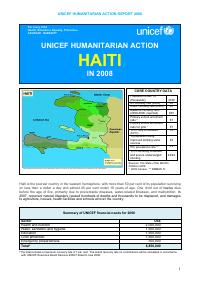
CORE COUNTRY DATA
Population under 18
(thousands) 4190
U5 mortality rate (2006) 80
Infant mortality rate (2006) 60
Maternal mortality ratio
(2000-2006, reported) 630
Primary school enrolment
ratio * 67
Primary school enrolment
ratio for girls * 57
% U1 fully immunized 53
(DPT3)
% population using
improved drinking water 54
sources
HIV prevalence rate ** 2.2
% U5 suffering moderate
and severe underweight/ 22/24
stunting
Sources: The State of the World’s
Children 2008
* 2003 Census ** EMMUS IV
Haiti is the poorest country in the western hemisphere, with more than 50 per cent of its population surviving
on less than a dollar a day and almost 45 per cent under 18 years of age. One child out of twelve dies
before the age of five, primarily due to preventable diseases, water-related illnesses, and malnutrition. In
2007, recurrent natural disasters caused hundreds of deaths and thousands to be displaced, and damages
to agriculture, houses, health facilities and schools all over the country.
Summary of UNICEF financial needs for 2008
Sector US$
Health and nutrition 2,000,000
Water, sanitation and hygiene 1,500,000
Education 1,500,000
Child protection 1,500,000
Emergency preparedness 350,000
Total* 6,850,000
*The total includes a maximum recovery rate of 7 per cent. The actual recovery rate on contributions will be calculated in accordance
with UNICEF Executive Board Decision 2006/7 dated 9 June 2006.
1
UNICEF HUMANITARIAN ACTION REPORT 2008
1. CRITICAL ISSUES FOR CHILDREN
The situation of women and children in Haiti remains tenuous, largely due to chronic poverty, natural
disasters, absence of child protection systems, and a history of violence linked to political instability. While
countries in the region are showing gradual improvement, Haiti continues to be characterized by inadequate
primary health care, limited access to nutrition services and overburdened water and sanitation systems.
Unable to meet the needs of the 45 per cent of the population under 18, one child out of 12 dies before the
age of five, primarily due to preventable diseases and malnutrition. With only 30 per cent of the population
having access to adequate sanitation, poor hygiene contributes to the persistence of water-related diseases
which have been exacerbated during recent emergencies.
In 2007, persistent rains and flooding have plagued the people of Haiti, causing hundreds of deaths and
thousands to be displaced. Because of Haiti’s high population density and its decaying infrastructure, the
country is particularly vulnerable to the effects of natural disasters. Tropical storm Noel, which passed
through Haiti in October 2007, caused damage to agriculture and destroyed houses, infrastructure (including
water and sanitation systems), health facilities and schools all over the country, creating acute and urgent
humanitarian needs for children who represent half of the victims.
Home to some of the poorest and most vulnerable children in the region, Haiti has among the worst
indicators in Latin America and the Caribbean. In fact, only 33 per cent of children under one have been
completely vaccinated against preventable diseases. HIV prevalence remains among the highest in the
region at 2.2 per cent, especially for women who make up the highest share of those infected (2.3 per cent
against 2 per cent for men). Of an estimated 17,000 children living with HIV/AIDS, only 300 have access to
antiretroviral therapy.
Hundreds of thousands of children remain out of school and child-friendly learning spaces and qualified
teachers are in short supply. Approximately 30 per cent of children attending primary school will not make it
to third grade and 60 per cent will abandon school before sixth grade. Of 2 million children attending school,
more than 50 per cent are overaged. Gender discrimination is an obstacle to Haiti’s development; while girls
enter school on parity with boys, girls are subject to higher drop-out rates and they represent 60 per cent of
the overaged students.
Despite mobilization of humanitarian assistance and improvements in the security situation, Haiti’s children
continue to be in urgent need of protection. There are an estimated 2,500 street children in the capital and,
while the exact number of children associated with armed groups is unknown, it may be around 1,000 in
Port-au-Prince. Three children out of ten have no birth certificate, and of the 8 per cent of children aged 5-17
years who are in domesticity, three-quarters are girls.
2. KEY ACTIONS AND ACHIEVEMENTS IN 2007
Health and nutrition. In the health sector, emergency was supported through various partners centring
UNICEF’s efforts in making sure that quality essential health care is available to all affected population. This
included providing partners with health kits and shelter materials and ensuring that health centres were
operational and consultations free during the emergency period.
In collaboration with NGO partners and in coordination with government counterparts, UNICEF closely
monitored emergencies to ensure that standards were maintained in all services provided. As the
responsible agency for the procurement of all vaccines in the country, UNICEF ensures that there are, at all
times, enough doses to be able to carry out an emergency measles campaign, if needed.
As cluster focal point for nutrition, UNICEF ensured that there were enough emergency nutrition supplies in
the country at all times (Plumpy’nut, F-75, F-100, BP5 etc.). UNICEF also supported the training of partners
in the identification and management of acute malnutrition, as well as advised them on the correct
procedures to conduct a nutritional survey.
Water, sanitation and hygiene. In the water, sanitation and hygiene sector, some 40,000 children had
access to safe water, and are using this water in an appropriate way. UNICEF drilled eight new boreholes,
rehabilitated 50 existing boreholes, constructed three water systems (spring catchments) and rehabilitated
one water system to provide safe drinking water. In addition, seven communities benefited from sanitation
2
UNICEF HUMANITARIAN ACTION REPORT 2008
facilities, including the construction of 300 household latrines, 4 communal latrines and 2 institutional school
latrines. Promotion of health and hygiene education activities was also carried out in 61 local communities.
Education. Extreme poverty and deep inequalities in access to basic social services, such as primary
education and literacy, continue to be the main concern in Haiti. In 2006, humanitarian actions were mainly
concentrated in Cité Soleil, which was in urgent need of specific interventions to help decrease the violence
and improve access to basic social services. In 2008, targeting the goal of increasing access, particular
emphasis will be placed on ensuring that school-aged children, particularly girls living in vulnerable areas of
Port-au-Prince, enrol and stay in school.
Seventy public schools in Port-au-Prince and four new schools were rehabilitated in order to empower local
communities and youth to help upgrade the learning environment and facilitate the incorporation of out-of-
school children, especially those excluded due to social conflict and violence. This included rehabilitating
water and sanitation facilities (latrine blocks and water points) in all schools, classrooms and playgrounds;
providing school furniture (4,000 three-seat school benches, 500 teachers’ desks and 500 blackboards);
procuring supplies (60,000 kits) for teachers and schoolchildren; and training teachers on school health,
hygiene promotion, peace-building and negotiation skills. This intervention increased the capacity of the
schools to receive out-of-school children. Some 6,700 out-of-school children are now enrolled in four new
schools (three in Cité Soleil and one in Martissant) completely furnished and equipped by UNICEF. In
addition, 500 children and adolescents affected and/or infected by HIV/AIDS, monitored by the GHESKIO
centres, received education support (textbooks and tuition fees) to encourage these particularly vulnerable
children to remain in school. Finally, 32 incarcerated minor girls had access to non-formal education and
vocational training.
The right to education encompasses more than access to school. It includes being able to stay in school and
the ability to finishing one’s studies, the quality of teaching, gender equality, learning efficiency, and learning
life skills. The rights-based approach means education for all, without exception. UNICEF prioritizes groups
excluded form the educational system because of poverty, violence, gender and other forms of
discrimination.
Child protection. Throughout 2007, UNICEF addressed the needs for protection and support of the most
vulnerable children by reinforcing actions in metropolitan areas particularly affected by armed violence, such
as Cité Soleil. From the very beginning of the year, Cité Soleil and other slums of the capital had become
accessible, allowing UNICEF to build upon medium-term interventions targeting vulnerable families and
children. Through AVSI (Associazione Volontari per lo Sviluppo), UNICEF continued to provide psychosocial
support to at least 5,000 children, promoting back-to-school as well as vocational training and allowing
children to rediscover their childhood through sports and other recreational activities.
Through collaboration with GHESKIO and several partners working towards the protection of street children,
UNICEF provided medical and psychosocial support to at least 1,500 children living on the street (both girls
and boys) as well as voluntary counselling and testing to identify and treat children and youth made
vulnerable by HIV/AIDS or other sexually transmitted diseases.
Emergency preparedness. As part of the emergency preparedness process for 2007, UNICEF Haiti
prepositioned emergency items in different locations in order to be better prepared to respond to
emergencies in a decentralized way covering different regions in the country and to ensure a minimum level
of permanent operational capacity. Five international NGOs and one UN agency were identified in different
areas to preposition emergency items. For each area, several coordination activities were implemented,
including field visits, logistics assessments, and the signing of a Memorandum of Understanding with each of
the organizations. Clear policies and procedures were agreed upon for the provision and distribution of
emergency assistance. In October 2007, following flooding and tropical storm Noel, UNICEF provided
emergency supplies (hygiene kits, cooking kits, water containers, blankets etc.) to more than 1,000 families
in the affected areas.
3
UNICEF HUMANITARIAN ACTION REPORT 2008
3. PLANNED HUMANITARIAN ACTION FOR 2008
Coordination and partnership
UNICEF is an active member of the UN-led coordination structure, under the umbrella of the Office
for the Coordination of Humanitarian Affairs (OCHA). Memoranda of Understanding with the UN
Population Fund (UNFPA) and the World Health Organization/Pan American Health Organization
(WHO/PAHO) as well as partnerships with the UN Office of Project Services (UNOPS) and the World
Food Programme (WFP) are evidence of the efforts of UN agencies to streamline their humanitarian
activities in close collaboration with the Government’s Civil Protection Department.
Regular programme
The UN system is in the process of finalizing the UN Development Assistance Framework (UNDAF)
in collaboration with other development partners based on national priorities as reflected in the
Poverty Reduction Strategy report which will provide the programmatic framework for the new 2008
Country Programme. Considering recurrent natural disasters and political instability, humanitarian
preparedness and response activities are part of each sectoral programme.
Health and nutrition (US$ 2,000,000)
UNICEF’s assistance will include the following key activities:
• Address the basic health needs of 20,000 affected people through the prepositioning and distribution of
emergency kits;
• Treat 1,500 severely malnourished children;
• Treat 10,000 moderately malnourished children;
• Give nutritional support to 10,000 pregnant and lactating women;
• Distribute 50,000 insecticide-treated mosquito nets to people living in flood-affected areas;
• Vaccinate, if necessary, 50,000 under-five children in affected areas.
Water, sanitation and hygiene (US$ 1,500,000)
Up to 200,000 persons, focusing particularly on children and women, will be reached through the following
key activities:
• Drill 60 new boreholes and rehabilitate 100 existing boreholes to provide safe drinking water to some
100,000 people;
• Rehabilitate/construct five water systems;
• Construct 1,000 household latrines and 10 institutional latrines;
• Promote hygiene and environmental education in 200 communities, involving children, young people,
parent associations, teachers, community leaders;
• Train 200 local water committees to assure adequate operation and maintenance of the water and
sanitation facilities;
• Provide the local water committees with simple equipment for water treatment, water quality control and
sanitation materials;
• Equip masons with the necessary tools and latrine moulds to be able to continue building latrines after
the project leaves the community;
• Provide technical assistance to local authorities and community-based organizations.
Education (US$ 1,500,000)
Up to 40,000 vulnerable children attending public schools and 700 teachers will benefit from the following
key activities:
• Supply basic scholastic materials including school bags, notebooks and pencils, for 40,000 primary
schoolchildren;
• Train 700 primary schoolteachers, with particular attention to HIV/AIDS and peace education;
• Rehabilitate schools and build latrines in all public schools in the selected localities;
• In case of major emergency, set up 50 temporary school structures and provide supplies to
15,000 students.
4
UNICEF HUMANITARIAN ACTION REPORT 2008
Child protection (US$ 1,500,000)
Following improvement in security conditions, UNICEF will extend protection and psychosocial support to
almost 5,000 children and youth affected by armed violence, including those associated with arms groups in
the most affected slums of Port au Prince, such as Cité Soleil and Martissant, to 1,500 street children and to
more than 5,000 children infected or affected by HIV/AIDS. Vulnerable children, including children victims of
natural disasters, such as floods, will benefit from support and protection through the following key activities:
• Provide medical care and psychosocial support to at least 1,500 street children, including HIV/AIDS
prevention, testing, treatment, counselling and peer education;
• Provide medical, psychological and legal support to victims of sexual violence;
• Promote HIV/AIDS prevention and reinforce community-based support to families made vulnerable by
HIV/AIDS as well as provide medical and psychosocial support to orphans and children affected or
infected by HIV/AIDS in at least three departments;
• Support and strengthen the reintegration of vulnerable children (affected by armed violence, street
children, sexual violence or natural disasters survivors, orphans and other vulnerable children) through
schooling, life skills, sport and recreational activities, the promotion of active participation in their own
recovery;
• Train teachers, social workers, and as well as health staff on response and psychosocial support to
violence/abuse in emergencies;
• Extend social activities for children in peace-building, including information, education and sensitization
sessions on child rights, conflict resolution, self-esteem and prevention of HIV/AIDS and sexually
transmitted diseases, targeting the rights of girls and promoting their participation in society;
• Support the identification, documentation, tracing, care and reunification of separated children.
Emergency preparedness (US$ 350,000)
Given the continued threat of natural disasters and volatile political landscape, UNICEF needs to be
prepared to respond at all times, with short notice, through a thorough and dynamic plan of action. This plan
emphasizes the need to strengthen our partners in the management of emergencies from a human rights-
based approach, always keeping children and women as the priority categories. The main areas of
intervention for 2008 will be:
• Train governmental and non-governmental partners in emergency preparedness and response, with
particular attention to adequate response in floods and to displaced populations (the most common
emergencies in Haiti);
• Purchase and preposition emergency stock, including the peripheral warehouses that are managed by
our partners;
• Train emergency partners in warehouse management, distribution evaluation, and reporting;
• Hire a dedicated emergency officer for one year;
• Build the capacity of the Departmental Committees for Risk and Disaster Management in order to
improve the national network and ensure an equitable, fast, and comprehensive management in all
regions of the country.
5
How to cite
UNICEF Humanitarian Action Report 2008: Haiti, accessed via HaitiDocs, https://www.haitidocs.org/doc/unicef-2008-humanitarian-action-report-haiti