
International Religious Freedom Report 2021: Haiti
- Armed gangs took clergy and lay people for ransom through 2021. Religious leaders said the gangs were targeting a prominent social position with access to money, and that no particular religion was singled out.
- The Ahmadiyya community registered with the Bureau of Worship in May, the first Muslim group in the country to obtain official status; the larger Sunni and Shia communities remained unregistered at year's end.
- Certified clergy counts did not move from 2020: 9,195 Protestant pastors, 704 Catholic priests, two Vodou clergy, and no certified Muslim clergy.
- Police fired tear gas around the 15 April Mass for the Freedom of Haiti at the Church of St. Peter in Pétion-Ville, and again on 21 April at a Vodou ritual protest outside the National Palace.
- About 75 percent of primary and 82 percent of secondary enrolment sits in private, usually religious, schools, and for 2020-2021 the Ministry of Education disbursed 100 million gourdes to religious schools split 50, 40 and 10 million to Catholic, Protestant and Episcopalian schools.
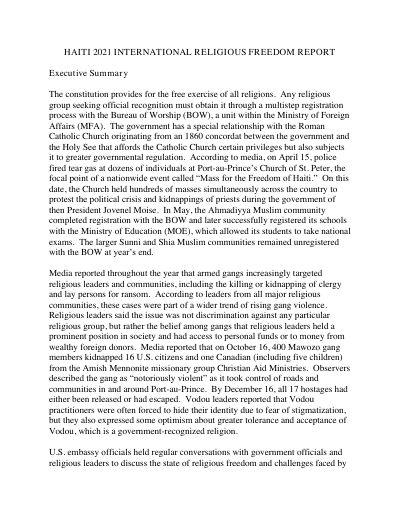
The 2021 chapter is the longest of the series held and the year is why. Media reported through the year that armed gangs increasingly took religious leaders and lay people for ransom, and leaders of every major community said this was not discrimination against a particular religion but the gangs' belief that clergy hold a prominent position and can reach personal or foreign donor money. On 16 October the 400 Mawozo gang kidnapped sixteen U.S. citizens and one Canadian, five of them children, from the Amish Mennonite missionary group Christian Aid Ministries; by 16 December all seventeen had been released or had escaped.
On registration, the Bureau of Worship granted an operating licence in May to the Ahmadiyya community, the smallest of the country's three Muslim communities and the first to obtain official status, which then let the Ministry of Education register its schools so its students could sit national exams. The larger Sunni and Shia communities remained unregistered at year's end, citing what one leader called the complex political environment; the Bureau's director general rejected that reading and pointed to the Ahmadiyya case. Certified clergy counts did not move from 2020: 9,195 Protestant pastors, 704 Catholic priests, two Vodou clergy, and no certified Muslim clergy at all.
On government practice, police fired tear gas on 15 April around the Church of St. Peter in Pétion-Ville, the focal point of hundreds of simultaneous masses protesting the political crisis and the kidnapping of priests; authorities said the gas was used after Mass ended, to stop demonstrators burning cars. A Vodou ritual protest outside the National Palace on 21 April was also tear-gassed. The 1860 concordat was itself a subject of argument among religious leaders, defended as a binding contract by some and cited by Vodou leaders as historical institutionalised predisposition against them. Several Protestant leaders argued for more, not less, government regulation of clergy, one of them tying the case to pastors preaching against COVID-19 vaccination.
On education the chapter carries the sharpest numbers in the series: about 75 percent of primary and 82 percent of secondary enrolment sits in private, usually religious, schools, with public schools 12 percent of all schools. For 2020-2021 the Ministry of Education disbursed 100 million gourdes through the National Education Fund, split 50 million to Catholic, 40 million to Protestant and 10 million to Episcopalian schools, roughly in proportion to each group's share of students. The chapter closes on the Provisional Electoral Council: after Prime Minister Ariel Henry dismissed the incumbent members in September, the Catholic Church and Protestant Federation initially refused to nominate replacements, and none of the religious communities had nominated anyone by year's end.
How to cite
United States Department of State, 2022, International Religious Freedom Report 2021: Haiti, https://www.state.gov/reports/2021-report-on-international-religious-freedom/haiti/
- Rights holder
- United States Department of State