Full Description
The report sets out the legal framework first. The Ministry of Foreign Affairs and Religious Denominations administers the laws on religious groups, and within it the Bureau of Worship registers religious buildings, clergy and missionaries. Registration is required by law to operate and receive government benefits, but there is no penalty for operating without it and many groups do. What registration confers is standing in legal disputes, tax-exempt status, exemption from customs duties on imports, and civil recognition of marriage and baptismal certificates, which the government treats as legal documents only when prepared by government-certified clergy. A baptismal certificate carries legal authority similar to a birth certificate.
Catholicism has not been the state religion since the 1987 constitution, but the 1860 concordat with the Holy See remains in force. It gives the Vatican power to approve and select a set number of bishops with government consent, and the government pays a monthly stipend to Catholic priests. Episcopalian clergy receive no stipend, though Catholic and Episcopalian bishops both hold official licence plates and diplomatic passports. No other group's clergy receive stipends.
On practices, houngans and mambos said the government still issued them no recognised documents for marriages and baptisms, with the ministry saying it was developing a certification process suited to the Vodou belief system. The ministry had still not acted on a Muslim registration request dating from the 1980s, continuing to require financial documentation first, and Muslims said civil marriage licences remained their only legal option. The government funded maintenance of Catholic churches and some Catholic schools; negotiations with the Protestant Federation over access to public funding continued, and in November the Federation said none was available to Protestants. The government said it had no plans to extend public funding to any non-Catholic group. Prison authorities cited limited institutional capacity for the religious needs of Muslim prisoners, who could pray freely and request a cleric but were not always near an institution that could send one.
Societal sections record continued stigmatization of Vodou practitioners, including public accusations of using occult powers to commit violent crimes, with one November arrest in Grand'Anse over an alleged poisoning for a Vodou ceremony, and discrimination against Muslims in public and private hiring, reported as sharpest for women wearing hijabs.
Full Document Text
Extracted text from the original document for search indexing.
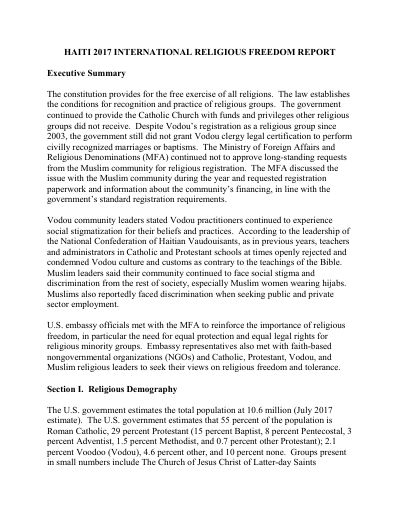
HAITI 2017 INTERNATIONAL RELIGIOUS FREEDOM REPORT
Executive Summary
The constitution provides for the free exercise of all religions. The law establishes
the conditions for recognition and practice of religious groups. The government
continued to provide the Catholic Church with funds and privileges other religious
groups did not receive. Despite Vodou’s registration as a religious group since
2003, the government still did not grant Vodou clergy legal certification to perform
civilly recognized marriages or baptisms. The Ministry of Foreign Affairs and
Religious Denominations (MFA) continued not to approve long-standing requests
from the Muslim community for religious registration. The MFA discussed the
issue with the Muslim community during the year and requested registration
paperwork and information about the community’s financing, in line with the
government’s standard registration requirements.
Vodou community leaders stated Vodou practitioners continued to experience
social stigmatization for their beliefs and practices. According to the leadership of
the National Confederation of Haitian Vaudouisants, as in previous years, teachers
and administrators in Catholic and Protestant schools at times openly rejected and
condemned Vodou culture and customs as contrary to the teachings of the Bible.
Muslim leaders said their community continued to face social stigma and
discrimination from the rest of society, especially Muslim women wearing hijabs.
Muslims also reportedly faced discrimination when seeking public and private
sector employment.
U.S. embassy officials met with the MFA to reinforce the importance of religious
freedom, in particular the need for equal protection and equal legal rights for
religious minority groups. Embassy representatives also met with faith-based
nongovernmental organizations (NGOs) and Catholic, Protestant, Vodou, and
Muslim religious leaders to seek their views on religious freedom and tolerance.
Section I. Religious Demography
The U.S. government estimates the total population at 10.6 million (July 2017
estimate). The U.S. government estimates that 55 percent of the population is
Roman Catholic, 29 percent Protestant (15 percent Baptist, 8 percent Pentecostal, 3
percent Adventist, 1.5 percent Methodist, and 0.7 percent other Protestant); 2.1
percent Voodoo (Vodou), 4.6 percent other, and 10 percent none. Groups present
in small numbers include The Church of Jesus Christ of Latter-day Saints
�HAITI
2
(Mormons), Jehovah’s Witnesses, Muslims, Bahais, Rastafarians, Scientologists,
and atheists. According to societal leaders, an estimated 50 to 80 percent of the
population practices some form of Vodou, often blended with elements of other
religions, usually Christianity. Muslim leaders estimate their community at
approximately 10,000. There are fewer than 100 Jews.
Section II. Status of Government Respect for Religious Freedom
Legal Framework
The constitution provides for the free exercise of all religions and establishes laws
to regulate the registration and operation of religious groups. The constitution
protects against being compelled to belong to a religious group contrary to one’s
belief. The MFA is responsible for monitoring and administering laws relating to
religious groups; within the MFA, the Bureau of Worship is responsible for
registering churches and other religious buildings, clergy, and missionaries of
various religious denominations.
Although Roman Catholicism has not been the official state religion since the 1987
constitution, an 1860 concordat between the Holy See and the state according some
preferential treatment to the Catholic Church remains in effect. The concordat
gives the Vatican power to approve and select a specific number of bishops in the
country with government consent. Under the concordat, the government provides
a monthly stipend to Catholic priests. The government does not provide stipends
to Episcopalian clergy, although both Catholic and Episcopalian bishops have
official license plates and carry diplomatic passports. No other religious groups
receive stipends for their clergy.
By law, religious institutions must register with the MFA in order to operate in the
country and receive government benefits; however, there is no penalty for
operating without registration, and many religious groups continue to do so.
Registration affords religious groups standing in legal disputes, provides taxexempt status, and extends civil recognition to documents such as marriage
certificates and baptismal certificates. The government recognizes these
certificates as legal documents only when prepared by government-certified clergy.
Baptismal certificates are identifying documents with similar legal authority as
birth certificates. The government does not tax registered religious groups, and it
exempts their imports from customs duties. Requirements for registration include
information on the qualifications of the group’s leader, a membership directory,
and a list of the group’s social projects. Registered religious groups must submit
International Religious Freedom Report for 2017
United States Department of State • Bureau of Democracy, Human Rights, and Labor
�HAITI
3
annual updates of their membership, projects, and leadership to the MFA. Foreign
missionaries are required to submit registration paperwork to operate privately
funded clinics, schools, and orphanages. Foreign religious groups do not have
special visa requirements.
The country is a party to the International Covenant on Civil and Political Rights.
Government Practices
Houngans (male) and mambos (female) priests said the government continued its
practice of not issuing them government-recognized documents for marriage and
baptismal ceremonies, even though Vodou is a registered religion. The MFA said
it was working with the Vodou community to develop a certification process in
accordance with the Vodou belief system.
The MFA still did not act on a request dating from the 1980s to register Muslims
as a religious group. The government continued to request financial
documentation as a prerequisite to complete registration. Muslims said they
continued to obtain civil marriage licenses as their only legal option.
The government continued to provide financial support for the maintenance of
Catholic churches and some Catholic schools. Negotiations between the Protestant
Federation and the MFA continued regarding Protestant access to government
funding; however, the Protestant Federation said in November that government
financial support was still unavailable to Protestants. The government said it had
no plans to extend public funding to any non-Catholic religious groups.
Government sources stated that limited institutional capacity continued to restrict
their ability to provide for the religious needs of Muslim prisoners throughout the
country, namely offering meals in compliance with Islamic dietary restrictions and
arranging access to Muslim clerics. Prisoners could request to see a Muslim cleric;
however, not all prisons were close enough to a Muslim institution that could
provide such services. Volunteers provided religious services in some prisons.
Muslim prisoners could pray freely.
Protestant and Catholic clergy continued to report largely positive working
relationships with the government, citing good access to government officials.
Section III. Status of Societal Respect for Religious Freedom
International Religious Freedom Report for 2017
United States Department of State • Bureau of Democracy, Human Rights, and Labor
�HAITI
4
Vodou community leaders said Vodou practitioners continued to experience some
social stigmatization for their beliefs and practices. They said members of the
public often accused Vodou practitioners of using “occult powers” to commit
violent crimes. For example, a man from the southwestern department of GrandAnse was arrested in November for using “magic” to poison another man to use his
corpse in a Vodou ceremony. At year’s end, the accused was in prison awaiting
trial.
According to some Muslim leaders, members of the Muslim community
experienced societal stigmatization and alienation, especially Muslim women
wearing hijabs. Muslims also reportedly faced discrimination when seeking public
and private sector employment.
Section IV. U.S. Government Policy and Engagement
U.S. embassy officials met with government officials, including the minister of
foreign affairs and religious denominations, to advocate for fair and equal
treatment for all religious groups, as well as to advocate for registration of
religious groups that have completed the requisite registration procedures.
Embassy officials met with faith-based NGOs and religious leaders in the
Protestant, Catholic, Muslim, and Vodou communities to discuss religious
freedom, societal stigmatization of some religious minorities, the importance of
religious tolerance, and challenges some groups faced in obtaining the registration
of their group and clergy.
International Religious Freedom Report for 2017
United States Department of State • Bureau of Democracy, Human Rights, and Labor
�