
Aggression in Haitian Schools: The Involvement of Schoolchildren
- The study interviewed 31 pupils selected in four schools in Port-au-Prince.
- Aggression is very recurrent in the schools studied, in physical and verbal forms and as threats.
- Most pupils interviewed are involved in aggression toward classmates and toward school staff.
- Some pupils are at once witnesses, victims and aggressors, and some are reported to belong to armed groups.
- The results link pupils' aggression to the influence of family, community and school.
- The author recommends public policies to reduce daily violence, awareness campaigns, non-violent sanctions and conflict management training.
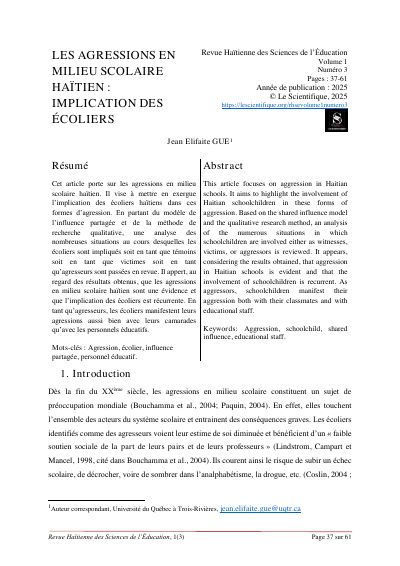
The article studies aggression in Haitian schools and the roles of schoolchildren as witnesses, victims or aggressors, using a qualitative method and the shared influence model of Epstein (1995). It rests on interviews with 31 pupils selected in four schools in Port-au-Prince.
The results show that aggression is very frequent in the schools studied and takes physical and verbal forms and threats, directed at classmates and at school staff. Some pupils play several roles at once and some are reported to belong to armed groups. The author recommends funding studies of the extent of the problem, public policies to reduce daily violence, awareness campaigns, training of parents and educators in non-violent sanctions, and conflict management programs for pupils.
How to cite
Le Scientifique, 2025, Aggression in Haitian Schools: The Involvement of Schoolchildren, https://lescientifique.org/wp-content/uploads/2025/08/Les-agressions-en-milieu-scolaire-haitien-implication-des-ecoliers-1.pdf
- Rights holder
- Le Scientifique