
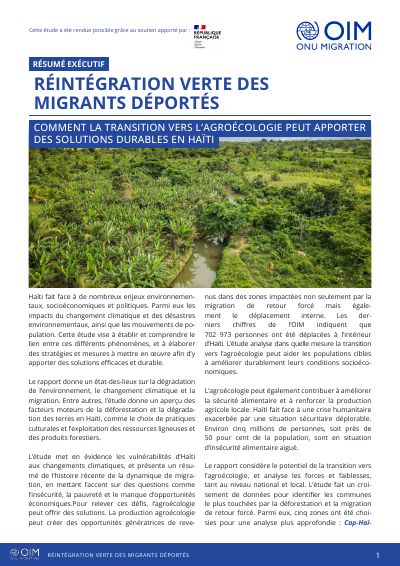
Green Reintegration of Deported Migrants: How the Transition to Agroecology Can Provide Lasting Solutions in Haiti (Executive Summary)
- The study finds that the latest IOM figures show 702,973 people displaced inside Haiti.
- About five million people, close to 50 percent of the population, are in acute food insecurity.
- The study selects five zones for deeper analysis: Cap-Haïtien, Cornillon/Grand-Bois, Gonaïves, Port-de-Paix and the Port-au-Prince metropolitan area.
- The study states that agroecology can support local capacity to adapt to climate change and prevent deforestation.
- The study recommends agroforestry, small-scale livestock and garden systems adapted to local conditions in each zone.
The study examines the links between environmental degradation, climate change and migration in Haiti. It reviews the drivers of deforestation and land degradation, such as the choice of farming practices and the exploitation of wood resources and forest products. It describes Haiti's vulnerability to climate change and recent migration dynamics, with attention to insecurity, poverty and a lack of economic opportunities. It cross-checks data to identify the communes most affected by deforestation and forced return migration, then selects five zones for deeper analysis: Cap-Haïtien, Cornillon/Grand-Bois, Gonaïves, Port-de-Paix and the Port-au-Prince metropolitan area. The analysis draws on scientific data and interviews with local authorities, farmers and returned migrants. It ends with practical recommendations for each zone.
How to cite
Food Security Sector (FSS) Haiti, 2024, Green Reintegration of Deported Migrants: How the Transition to Agroecology Can Provide Lasting Solutions in Haiti (Executive Summary), https://fscluster.org/sites/default/files/2024-12/OIM%20-%20R%C3%89INT%C3%89GRATION%20VERTE%20DES%20MIGRANTS.pdf
- Rights holder
- Food Security Sector (FSS) Haiti