
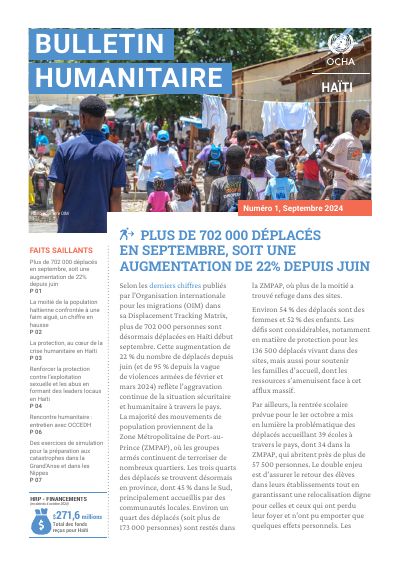
Haiti Humanitarian Bulletin, Number 1, September 2024
- More than 702,000 people were internally displaced in early September 2024, 22 percent more than in June and 95 percent more than before the armed violence of February and March 2024.
- Three quarters of the displaced were in the provinces, 45 percent of them in the South and mostly hosted by local communities; 136,500 people were living in sites, and women were 54 percent and children 52 percent of the displaced.
- Thirty-nine schools, 34 of them in the Port-au-Prince metropolitan area, were serving as displacement sites housing more than 57,500 people as the 1 October school year approached.
- The IPC analysis for August 2024 to February 2025 placed 5.4 million people, half the population, in acute hunger, 2 million of them in Phase 4 and about 6,000 displaced people in Port-au-Prince sites in Phase 5.
- A 230 million dollar shortfall stood against food programmes to the end of 2024, and FAO called for 48 million dollars to reach 608,000 people through emergency agricultural activities.
The first issue of OCHA Haiti's relaunched humanitarian bulletin, dated September 2024. The numbering restarts at 1 after the previous run ended.
Displacement leads the issue. IOM's Displacement Tracking Matrix counted more than 702,000 internally displaced people in early September 2024, 22 percent more than in June and 95 percent more than before the armed violence of February and March 2024. Most movement originated in the Port-au-Prince metropolitan area, and three quarters of the displaced were by then in the provinces, 45 percent of them in the South and mostly hosted by local communities. More than 173,000 remained in the metropolitan area, over half of them in sites. Women were 54 percent of the displaced and children 52 percent, and 136,500 people were living in sites.
The 1 October start of the school year exposed a second problem: 39 schools across the country, 34 of them in the metropolitan area, were serving as displacement sites and housing more than 57,500 people. Humanitarian partners were supporting the authorities to rehabilitate the buildings, distribute school supplies and rehouse the displaced families, with the twin aim of returning pupils to their classrooms and relocating the displaced in dignity.
On food security, the bulletin reports the IPC analysis published by the CNSA with FAO and WFP for August 2024 to February 2025: 5.4 million people, half the population, could not obtain enough food, 2 million of them in Phase 4, and about 6,000 displaced people in Port-au-Prince sites were in Phase 5, on the edge of famine. A 230 million dollar shortfall stood between partners and funding their programmes to the end of the year, and FAO, after a high-level visit in September, called for 48 million dollars under the 2024 Humanitarian Response Plan to reach 608,000 people through emergency agricultural activities.
The remaining sections cover protection as the centre of the humanitarian crisis, the training of local leaders to strengthen protection against sexual exploitation and abuse, an interview with the national organisation OCCEDH, and disaster preparedness simulation exercises in the Grand'Anse and Nippes.
How to cite
United Nations Office for the Coordination of Humanitarian Affairs (OCHA), Haiti Humanitarian Bulletin, Number 1, September 2024, https://reliefweb.int/report/haiti/haiti-bulletin-humanitaire-numero-1-septembre-2024
- Rights holder
- United Nations Office for the Coordination of Humanitarian Affairs (OCHA)