
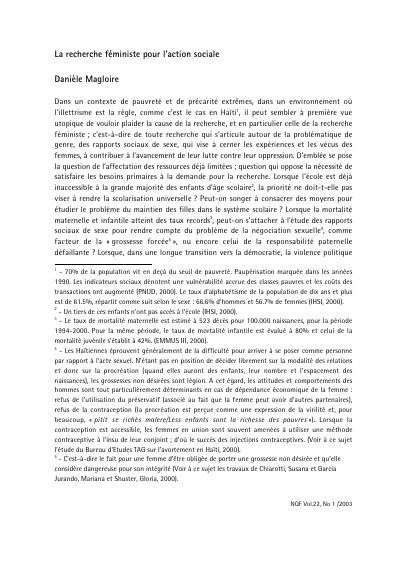
Feminist Research for Social Action
- The author argues that the absence of reliable data prevents the State, bilateral cooperation and development organizations from planning rigorously or acting over the long term.
- She states that interventions that ignore gender variables, including those declared in favor of women, keep women in a subordinate position.
- She describes a growing feminization of poverty in Haiti, linked to occupational segregation, unstable jobs, wage discrimination and women's unemployment.
- She cites 2000 figures on poverty, literacy and maternal mortality to show the scale of the needs that research must inform.
Published in Nouvelles Questions Féministes, volume 22, number 1 (2003), this chapter takes up the objection that research, and feminist research in particular, is a luxury in a country marked by extreme poverty and widespread illiteracy. Magloire answers that without reliable data, decision makers in the State, bilateral cooperation and development organizations cannot plan rigorously or act over the long term.
She argues that interventions which leave out gender variables, including those declared to favor women, overlook the fact that social relations between the sexes shape hierarchy in every sphere of social life. The text cites the growing feminization of poverty in Haiti and draws on survey figures such as EMMUS-III and national statistics from 2000. It places the case for feminist research within a call for equity and a democratic State governed by law.
How to cite
Nouvelles Questions Féministes, 2003, Feminist Research for Social Action, accessed via HaitiDocs, https://www.haitidocs.org/doc/nqf-2003-recherche-feministe-action-sociale
- Rights holder
- Nouvelles Questions Féministes