
Detailed Syllabus for Social Sciences, 4th Year of the New Secondary
- The syllabus has three parts: national history, world history and geography.
- National history covers 1934 to 1957, the Duvalier governments and 1986 to 1991, after a review of 1888 to 1934.
- World history runs from the First World War and the Russian Revolution through the 1930s crisis, fascism and Nazism.
- Geography studies world powers, including the United States, Japan, the European Union, Russia and Canada, and globalization.
- Each theme is set out with competencies, content and suggested activities, often group research in groups of five.
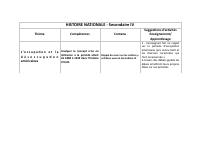
The syllabus is laid out in tables with four columns: theme, competencies, content, and suggested teaching and learning activities. The national history part starts with a review of the 1888 to 1934 period seen in Secondary III, then covers the end of the US occupation and the governments from 1934 to 1957, including Vincent, Lescot, Estimé and Magloire, the Duvalier governments, and the 1986 to 1991 period with the constitution of March 29. The world history part covers the First World War, the Russian Revolution, the world between the wars, the crisis of the 1930s, fascism and Nazism, and later conflicts. The geography part covers the measures of national power, the diversity of civilizations, the United States, Japan, the European Union, Russia and Canada, globalization, and international bodies such as the IMF, WHO and FAO. Suggested activities include guided debates, research in groups of five and short written syntheses.
How to cite
Ministry of National Education and Vocational Training (MENFP), 2007, Detailed Syllabus for Social Sciences, 4th Year of the New Secondary, accessed via HaitiDocs, https://www.haitidocs.org/doc/menfp-nouveau-secondaire-sciences-sociales-s4