
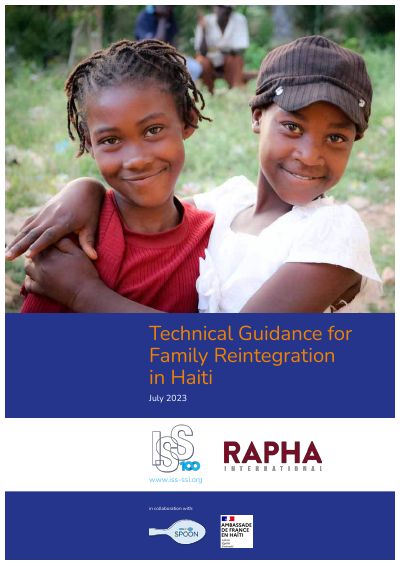
Technical Guidance for Family Reintegration in Haiti
- The guidance proposes a harmonized procedure for social workers of the State, civil society organizations and NGOs working with separated children.
- Part II sets out eight steps, from assessing the child's needs to case closure.
- The basic principles include the best interests of the child, the child's participation and the do not harm principle.
- The guidance states that the poverty of the family should never be the sole reason for placing a child in an institution.
- It calls for networking across Haiti's 10 departments to reduce the logistical costs of social work.
The guidance supports the Institut du Bien-Être Social et de Recherches (IBESR) and NGOs working with separated children by proposing a harmonized procedure for social work professionals, with the aim of improving collaboration, reducing duplication and sharing information. It was written by Marie Jenny (ISS) and Heather Nozea (Rapha International) and financed by the Embassy of France in Haiti.
Part I sets out the basic principles of family reintegration, including the best interests of the child, the child's participation and the do not harm principle, and states that the poverty of the family should never be the sole reason for placing a child in an institution. Part II sets out eight steps: assessing the child's needs, family tracing, assessing the family and community, the reintegration decision, preparing the child and family and the individual care plan, physical reunification, follow-up support and case closure. It calls for networking across Haiti's 10 departments.
How to cite
International Social Service (ISS), 2023, Technical Guidance for Family Reintegration in Haiti, https://iss-ssi.org/storage/2023/07/ISS_RAPHA-FAMILY-REINTEGRATION-GUIDANCE-HAITI-ENG.pdf
- Rights holder
- International Social Service (ISS)