
Cholera in the Time of MINUSTAH: Experiences of Community Members Affected by Cholera in Haiti
- Seventy-seven cholera-focused micro-narratives were selected from 2,541 collected around 10 UN bases in Haiti.
- The accounts cover cholera cases and deaths, access to care, protests and riots against the UN, compensation, and anticolonialism.
- Most participants think the UN should compensate cholera victims through direct financial aid.
- No participant or family had received compensation from the UN when the data were collected in 2017.
- By June 2020, about 20.7 million of the 400 million dollars requested for the UN cholera response fund had been collected.
- The authors state that the results are not representative because the sample was a convenience sample.
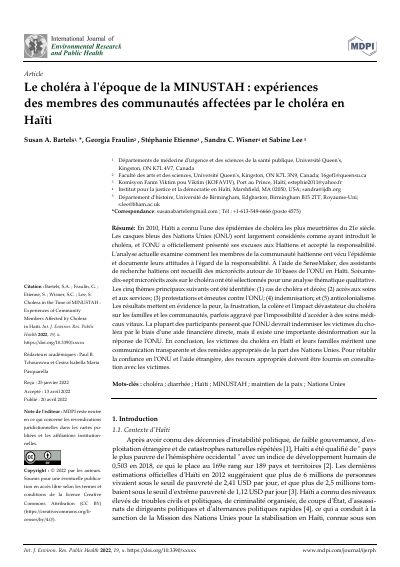
The article, co-authored by researchers from Queen's University, KOFAVIV, IJDH and the University of Birmingham, examines how Haitians experienced the cholera epidemic introduced in 2010 by UN peacekeepers. Haitian research assistants used the SenseMaker tool to collect micro-narratives within 30 km of 10 MINUSTAH bases. Of 2,541 narratives collected, 77 first-person accounts about cholera were selected for thematic analysis. The accounts cover cholera cases and deaths, access to care and services, protests and riots against the UN, compensation, and anticolonialism. Most participants think the UN should compensate victims through direct financial aid, and the study finds substantial misinformation about the UN response. The authors conclude that victims need transparent communication and appropriate remedies, developed in consultation with them. The authors note that the sample is a convenience sample and the results cannot be generalized.
How to cite
Institute for Justice and Democracy in Haiti (IJDH), 2022, Cholera in the Time of MINUSTAH: Experiences of Community Members Affected by Cholera in Haiti, https://ijdh.org/wp-content/uploads/2022/05/Le-chole%CC%81ra-au-temps-de-la-MINUSTAH.pdf
- Rights holder
- Institute for Justice and Democracy in Haiti (IJDH)