
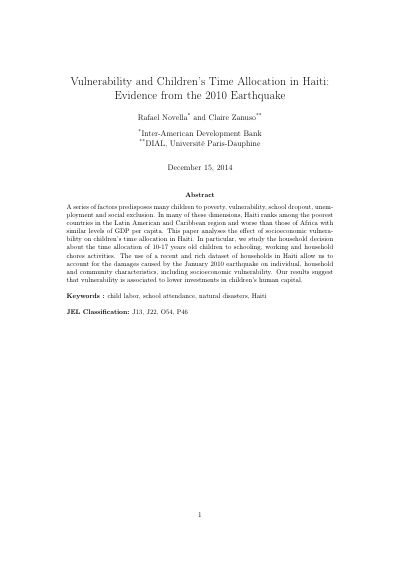
Vulnerability and Children's Time Allocation in Haiti: Evidence from the 2010 Earthquake
- More vulnerable households at the time of the 2010 earthquake had children less likely to attend school and more likely to work or be idle two years later.
- These children spent more hours on household chores, in particular girls, and fewer hours on leisure.
- The estimates show gender differences favoring boys in the probability of being idle and attending school.
- The analysis controls for peak ground acceleration, observed house damage, commune fixed effects and changes between 2010 and 2012.
- Cross-sectional data prevent control for all household and child characteristics that changed between the earthquake and the interview.
The paper analyzes the effect of socioeconomic vulnerability on the time children aged 10 to 17 spend on schooling, working and household chores. It draws on the first nationwide survey of living conditions and the labor market after the 2010 earthquake, which interviewed around 5,000 households in 2012, and measures vulnerability through the physical damage the earthquake caused, controlling for ground acceleration and for changes between 2010 and 2012.
The authors find that children in more vulnerable households at the time of the earthquake were less likely to attend school and more likely to work or be idle two years later. They also spent more hours on household chores, in particular girls, and fewer hours on leisure, and the estimates show gender differences favoring boys. The background section reports that half of Haiti's population is under 21, that adult illiteracy is around 25 percent, and that public education spending was 2.5 percent of GDP in 2006/07. The authors warn that cross-sectional data prevent them from controlling for every characteristic that changed between the earthquake and the interview.
How to cite
Inter-American Development Bank (IDB), 2014, Vulnerability and Children's Time Allocation in Haiti: Evidence from the 2010 Earthquake, accessed via HaitiDocs, https://www.haitidocs.org/doc/idb-2014-12-vulnerability-childrens-time-allocation
- Rights holder
- Inter-American Development Bank (IDB)