
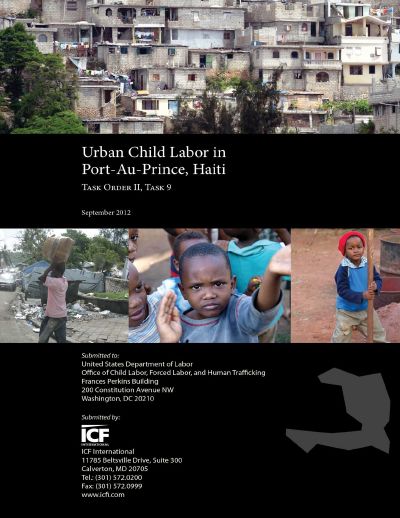
Urban Child Labor in Port-au-Prince, Haiti
- Poverty is an important factor in urban child work, and many children reported they could not feed themselves without working.
- The study found no evidence that the children interviewed were relocated to Port-au-Prince for exploitation, and the data could not conclusively show forced labor for a few children.
- Children worked mainly in petty trading, transportation assistance, washing and begging, with long hours and little income.
- Child work is spread across the four communes and concentrated where car or pedestrian traffic is heavy.
- Many child respondents had never attended school, and child workers showed a significant age-grade delay.
The report was written by Holly Howell of ICF International for the United States Department of Labor. It rests on 216 in-depth interviews with four groups of respondents: formal experts, informal experts who witness child work, child workers, and family members of child workers. Its objectives were to understand the root causes of urban child labor, the types of work and working conditions, the geography of child labor, children's lives outside work, perceptions of the situation, the effect of the earthquake, and existing programs and policies.
The study concludes that poverty is an important factor in urban child work and that many children work because they live away from their parents. It found no evidence that children were relocated to Port-au-Prince to be exploited, although the data could not settle whether a few children were in forced labor. Children worked in petty trading, transportation assistance, washing and begging, for long hours and low income, and faced risks from sun, dust, traffic, heavy loads, beatings and robbery. Many had never attended school, and child workers showed a significant age-grade delay.
How to cite
ICF International; United States Department of Labor (USDOL), 2012, Urban Child Labor in Port-au-Prince, Haiti, accessed via HaitiDocs, https://www.haitidocs.org/doc/icf-2012-urban-child-labor-port-au-prince
- Rights holder
- ICF International|United States Department of Labor (USDOL)