
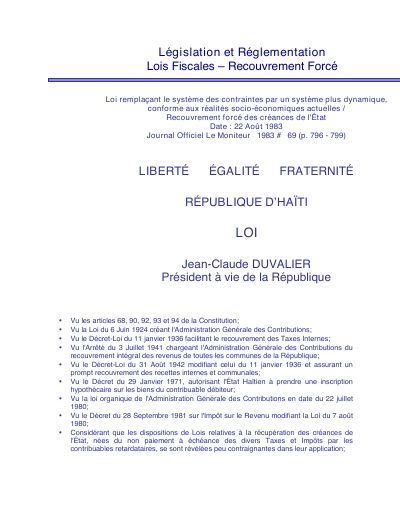
Law of 22 August 1983 on the Forced Recovery of State Claims
- The late taxpayer is given formal notice to pay in full within one clear day, on the request of the Director General of Contributions.
- The notice must state the grounds and the detailed amount of unpaid taxes with surtaxes and late interest.
- If unpaid within the following eight days, the registered notice goes to a justice of the peace for an order giving it the character of an administrative constraint.
- The visas reach back to the law of 6 June 1924 creating the Administration Générale des Contributions.
- It is the enforcement end of the tax system, on which the corpus held nothing.
The law of 22 August 1983, published in Le Moniteur No. 69 of 1983, on the forced recovery of state claims.
Article 1 provides that once the deadline set by the fiscal laws has passed, the late taxpayer is, on the request of the Director General of Contributions, given formal notice to pay the full amount due plus accessories and penalties within one clear day. Article 2 requires the notice to be signed by the Director General or a delegate and to state the grounds and the detailed amount of unpaid taxes together with surtaxes or late interest, prepared in original and copy, with service recorded on the original. Article 3 provides that if the taxpayer has not paid within the eight days following the one clear day, the registered notice is presented to the justice of the peace to obtain the order giving it the character of an administrative constraint.
Its visas run back to the law of 6 June 1924 creating the Administration Générale des Contributions, the decree-law of 11 January 1936 on the recovery of internal taxes, and the order of 3 July 1941 charging that administration with recovering the revenues of every commune.
This is the enforcement end of the tax system, and the corpus held nothing on it.
How to cite
Legislative Body of Haiti, Law of 22 August 1983 on the Forced Recovery of State Claims, https://www.mef.gouv.ht/
- Rights holder
- Government of Haiti