
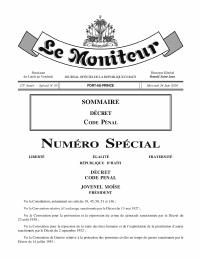
Decree Enacting the Penal Code
- The decree replaces the Penal Code in force since 1835.
- It enters into force 24 months after publication in Le Moniteur, which took place on June 24, 2020.
- The executive adopted it by decree, citing a non-functioning legislative branch.
- The code runs to 1,036 articles in seven books, with penalties set for individuals, legal persons and minors.
- Fine amounts are to be adjusted whenever official inflation measured by IHSI rises at least 10% in a fiscal year, and may not be lowered.
- A commission of at least five members named by presidential order is to oversee implementation of the penal reform.
The decree's recitals state that the Penal Code in force since 1835 no longer meets new forms of crime, that some conduct should be decriminalized, and that the executive is legislating by decree because the legislative branch is not functioning. The preamble cites more than 30 ratified conventions, on slavery, genocide, trafficking, corruption, terrorism financing and children's rights. The code has seven books: general provisions (criminal law, criminal responsibility, penalties for individuals, legal persons and minors); offenses targeting the person, including genocide, sexual assault and moral harassment; property crimes; offenses targeting the nation, the state and public trust, including terrorism; other crimes, such as eugenics, cloning and biomedical offenses; petty offenses in five classes; and transitional and final provisions. Final articles set a 24-month lead time for training magistrates and police, setting up a probation service and submitting supporting laws to Parliament. Article 1036 repeals the existing code and a list of specific laws and decrees.
How to cite
Presidency of the Republic of Haiti (PRH), 2020, Decree Enacting the Penal Code, https://archivesjuridiquesht.com/archives/21