
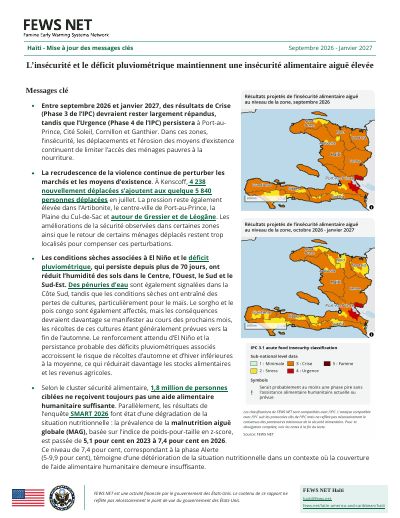
Key Message Update: Insecurity and rainfall deficits are sustaining elevated acute food insecurity
- Crisis (IPC Phase 3) widespread September 2026 to January 2027; Emergency (IPC Phase 4) in Port-au-Prince, Cité Soleil, Cornillon and Ganthier.
- In Kenscoff, 4,238 newly displaced people add to about 5,840 displaced in July.
- Rainfall deficit of more than 70 days and El Niño-related dry conditions caused crop losses, especially maize; risk of below-average fall and winter harvests.
- 8 million targeted people do not receive sufficient humanitarian food assistance (food security cluster).
- Global acute malnutrition 7.4% in 2026 (SMART), up from 5.1% in 2023; Alert phase (5 to 9.9%).
In this September 2026 Key Message Update (September 2026 to January 2027), FEWS NET expects Crisis (IPC Phase 3) outcomes to remain widespread, with Emergency (IPC Phase 4) persisting in Port-au-Prince, Cité Soleil, Cornillon and Ganthier, where insecurity, displacement and the erosion of livelihoods limit poor households' access to food. Violence continues to disrupt markets and livelihoods: in Kenscoff, 4,238 newly displaced people add to the roughly 5,840 displaced in July, and pressure remains high in Artibonite, downtown Port-au-Prince, the Plaine du Cul-de-Sac and around Gressier and Léogâne. Security improvements in some areas and the return of some displaced households remain too localized to offset these disruptions. El Niño-related dry conditions and a rainfall deficit lasting more than 70 days reduced soil moisture in Centre, Ouest, Sud and Sud-Est, water shortages are reported on the Côte Sud, and crop losses are especially marked for maize; sorghum and pigeon pea are also affected, with effects expected later because they are harvested toward late autumn.
The expected strengthening of El Niño raises the risk of below-average fall and winter harvests. According to the food security cluster, 1.8 million targeted people still do not receive sufficient humanitarian food assistance. The 2026 SMART survey reports global acute malnutrition (weight-for-height z-score) of 7.4 percent, up from 5.1 percent in 2023, which falls in the Alert phase (5 to 9.9 percent).
How to cite
Famine Early Warning Systems Network (FEWS NET), 2026, Key Message Update: Insecurity and rainfall deficits are sustaining elevated acute food insecurity, https://reliefweb.int/node/4232293
- Rights holder
- Famine Early Warning Systems Network (FEWS NET)