
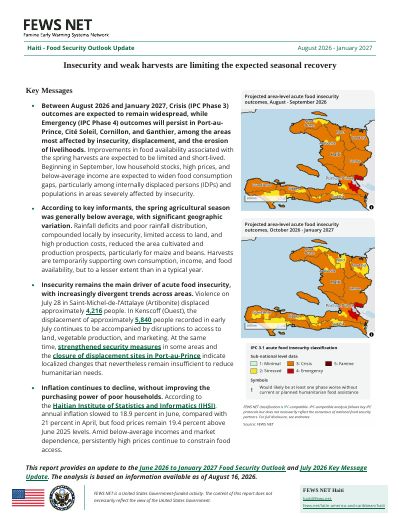
Food Security Outlook Update: Insecurity and weak harvests are limiting the expected seasonal recovery
- Crisis (IPC Phase 3) widespread August 2026 to January 2027; Emergency (IPC Phase 4) in Port-au-Prince, Cité Soleil, Cornillon and Ganthier.
- Spring harvests below average; rainfall below average for more than 70 days.
- About 1.47 million people displaced countrywide; about 4,216 displaced in Saint-Michel-de-l'Attalaye on July 28 and about 5,840 in Kenscoff in early July.
- Annual inflation 18.9% in June (21.0% in April); food prices 19.4% above June 2025.
- Forced returns 26,568 in June and 141,720 in the first half of 2026, 11% above the first half of 2025.
- About 1.84 million people received emergency food assistance by end of June.
In this August 2026 outlook update (updating the June 2026 to January 2027 outlook and the July 2026 Key Message Update, with information as of August 16, 2026), FEWS NET expects Crisis (IPC Phase 3) outcomes to remain widespread from August 2026 to January 2027, with Emergency (IPC Phase 4) in Port-au-Prince, Cité Soleil, Cornillon and Ganthier. Spring harvests were below average, particularly in Sud, Artibonite, Sud-Est, Nord-Ouest and Ouest, because rainfall stayed below average for more than 70 days; cumulative rainfall in Jérémie, Jacmel and Gonaïves was below 60 percent of the seasonal average.
Violence on July 28 in Saint-Michel-de-l'Attalaye displaced about 4,216 people (1,015 households), about 5,840 people were displaced in Kenscoff in early July, and about 1.47 million people are displaced countrywide; some displacement sites in Port-au-Prince have closed and the Gang Suppression Force is deploying in Artibonite, but FEWS NET says these changes are localized. According to IHSI, annual inflation slowed from 21.0 percent in April to 20.0 percent in May and 18.9 percent in June 2026, while food and non-alcoholic beverage prices rose 1.3 percent month on month and were 19.4 percent above June 2025. IOM recorded 26,568 forced returns in June and 141,720 in the first half of 2026, 11 percent more than in the same period of 2025.
About 1.84 million people had received emergency food assistance by the end of June, including 1.3 million who had received four cycles, but FEWS NET says the data do not allow a systematic assessment of ration size or frequency. Below-average fall and winter harvests are expected to limit stock replenishment and keep household income and food access under pressure.
How to cite
Famine Early Warning Systems Network (FEWS NET), 2026, Food Security Outlook Update: Insecurity and weak harvests are limiting the expected seasonal recovery, https://reliefweb.int/node/4230792
- Rights holder
- Famine Early Warning Systems Network (FEWS NET)