
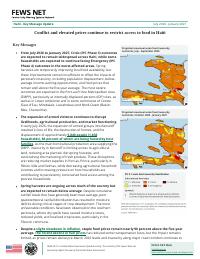
Key Message Update: Conflict and elevated prices continue to restrict access to food, July 2026 to January 2027
Summary — FEWS NET expects Crisis (IPC Phase 3) to remain widespread from July 2026 to January 2027, with Emergency (IPC Phase 4) persisting in the worst-affected areas. Spring harvests improve local food availability for a time, but not enough to offset displacement, below-average earning opportunities and food prices well above the five-year average. The most severe outcomes are expected in the Port-au-Prince metropolitan area, particularly at IDP sites, in Lower Artibonite, and in communes of Centre (Saut-d'Eau, Mirebalais, Lascahobas) and Nord-Ouest (Bassin Bleu, Chansolme). In early July 2026 armed groups expanded into Kenscoff, killing residents, destroying homes and displacing about 5,840 people in 1,836 households, 86 per cent of them into host families. Kenscoff is the main horticultural area supplying the capital.
Key Findings
- Crisis (IPC Phase 3) remains widespread from July 2026 to January 2027, with Emergency (IPC Phase 4) in the worst-affected areas.
- Armed groups expanded into Kenscoff in early July 2026, displacing about 5,840 people in 1,836 households, 86 per cent into host families.
- Kenscoff is the main horticultural area supplying the Port-au-Prince metropolitan area, so the attack constrains the capital's food supply.
- Food prices remain well above the five-year average.
- The most severe outcomes are expected at IDP sites in the metropolitan area, in Lower Artibonite, and in communes of Centre and Nord-Ouest.
Full Document Text
Extracted text from the original document for search indexing.
Haiti - Key Message Update
July 2026 - January 2027
Conflict and elevated prices continue to restrict access to food in Haïti
Key Messages
From July 2026 to January 2027, Crisis (IPC Phase 3) outcomes
are expected to remain widespread across Haiti, while some
households are expected to continue facing Emergency (IPC
Phase 4) outcomes in the worst-affected areas. Spring
harvests are temporarily improving local food availability, but
these improvements remain insufficient to offset the impacts of
persistent insecurity, including population displacement, belowaverage income-earning opportunities, and food prices that
remain well above the five-year average. The most severe
outcomes are expected in the Port-au-Prince Metropolitan Area
(ZMPP), particularly at internally displaced persons (IDP) sites, as
well as in Lower Artibonite and in some communes of Centre
(Saut-d'Eau, Mirebalais, Lascahobas) and Nord-Ouest (Bassin
Bleu, Chansolme).
The expansion of armed violence continues to disrupt
livelihoods, agricultural production, and market functioning.
In early July 2026, the expansion of armed groups into Kenscoff
resulted in loss of life, the destruction of homes, and the
displacement of approximately 5,840 people (1,836
households), 86 percent of whom are being hosted by host
families. As the main horticultural production area supplying the
ZMPP, insecurity in Kenscoff is limiting access to agricultural
land, reducing area planted, disrupting harvests, and
constraining the marketing of fresh produce. These disruptions
are reducing market supplies in Port-au-Prince, particularly in
Pétion-Ville and Delmas, while decreasing agricultural household
incomes and increasing pressure on host households are
contributing to persistently constrained food access among the
poorest households.
Spring harvests are ongoing across much of the country but
are expected to remain below average. Despite cumulative
rainfall totals that have generally been near average, poor
spatiotemporal rainfall distribution has resulted in moisture
deficits during critical stages of crop development. The most
unfavorable conditions have been observed on the southern
peninsula, where dry spells have caused moisture stress,
reduced yields, and localized crop losses, particularly in the
Tiburon commune.
Despite a slight slowdown in inflation, staple food prices remain nearly 90 percent above the five-year
average. The recent decline in fuel prices has reduced some transportation fares, but the impact remains
limited, as prices remain above pre-March 2026 levels and insecurity along major road corridors continues to
FEWS NET is a United States Government-funded activity. The content of this report does not
necessarily reflect the view of the United States Government.
FEWS NET Haiti
haiti@fews.net
fews.net/latin-america-and-caribbean/haiti
Key Message Update
July 2026 - January 2027
increase logistics and marketing costs. These factors are keeping food prices elevated and constraining
economic access to food among very poor households.
Recommended citation: FEWS NET. Haiti Key Message Update July 2026 - January 2027: Conflict and elevated prices continue
to restrict access to food in Haïti, 2026.
*
FEWS NET classification is IPC-compatible with limited exceptions. IPC-compatible analysis follows key IPC protocols but does not necessarily reflect the consensus of national food security
partners. As of IPC 3.0, the IPC no longer assesses the impact of food assistance on classification and thus no longer maps the (!). However, FEWS NET continues to produce food security
maps inclusive of the (!) as well as maps compatible with IPC 3.0/3.1, which include the mapping of food security assistance bags. In rare cases, FEWS NET classification is IPC-aligned but
not IPC-compatible. IPC-aligned analysis is evidence-based but some types of evidence required for IPC-compatibility were not available.
Key Message Update
This Key Message Update provides a high-level analysis of current acute food insecurity conditions and any changes to FEWS NET's latest projection of acute food insecurity outcomes
in the specified geography. Learn more here.
Famine Early Warning Systems Network
2
How to cite
Famine Early Warning Systems Network (FEWS NET), Key Message Update: Conflict and elevated prices continue to restrict access to food, July 2026 to January 2027, https://reliefweb.int/node/4225090