Full Description
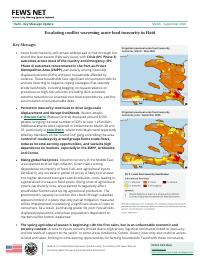
FEWS NET reports that acute food insecurity will remain widespread through the end of the February-June lean season, with Crisis (IPC Phase 3) across most of the country and Emergency (IPC Phase 4) concentrated in the Port-au-Prince metropolitan area, particularly among IDPs and poor households affected by violence, who face significant consumption deficits and severely erosive coping strategies (begging, precarious or high-risk work including illicit activity, extreme cuts to non-food spending, unsustainable debt).
Persistent insecurity continues to drive large-scale displacement: recent attacks in Boucan-Carré (Plateau Central) displaced about 4,500 people, bringing total IDPs above 1.45 million, and further attacks were reported in Artibonite on March 28-29 (Jean-Denis, attributed to the 'Grand Grif' gang). Gang control of roadways limits trade flows, reduces income-earning opportunities and sustains high market dependence, especially in the ZMPP, Artibonite and Centre. Rising global fuel prices linked to Middle East tensions are expected to drive high inflation: given Haiti's heavy dependence on imports of food, fuel and agricultural inputs (fertilizers), higher world oil prices should translate into higher domestic transport and distribution costs and a generalized rise in food prices, with input costs (notably urea) hitting smallholders and spring production; the government's capacity to cushion the shock via subsidies appears limited, likely transferring much of the cost to consumers.
The spring season is beginning with the first rains but under unfavorable conditions - limited input access on high prices and insecurity, and restricted access to land and labor in Artibonite, Centre and Ouest - so farmers may reduce cultivated area, weakening harvest prospects.
Full Document Text
Extracted text from the original document for search indexing.
Escalating conflict worsening acute food insecurity in Haiti
Key Messages
Haiti - Key Message Update March - September 2026
Acute food insecurity will remain widespread in Haiti through the
end of the lean season (February-June), with Crisis (IPC Phase 3)
outcomes across most of the country and Emergency (IPC
Phase 4) outcomes concentrated in the Port-au-Prince
Metropolitan Area (ZMPP), particularly among internally
displaced persons (IDPs) and poor households affected by
violence. These households face significant consumption deficits
and are resorting to negative coping strategies that severely
erode livelihoods, including begging, increased reliance on
precarious or high-risk activities (including illicit activities),
extreme reductions in essential non-food expenditures, and the
accumulation of unsustainable debt.
Persistent insecurity continues to drive large-scale
displacement and disrupt livelihoods. Recent attacks
in Boucan-Carré (Plateau Central) displaced around 4,500
people, bringing the total number of IDPs to over 1.45 million.
Additional attacks were reported in Artibonite on March 28 and
29, particularly in Jean-Denis, where individuals were reportedly
killed by members of the “Grand Grif” gang controlling the area.
Control of roadways by armed groups limits trade flows,
reduces income-earning opportunities, and sustains high
dependence on markets, especially in the ZMPP, Artibonite,
and Centre.
Rising global fuel prices, linked to tensions in the Middle East,
are expected to drive high inflation. Given Haiti’s strong
dependence on imports of food, fuel, and agricultural inputs
(fertilizers), any increase in global oil prices is likely to translate
into higher domestic transport and distribution costs, leading to
a generalized increase in food prices. Rising costs of agricultural
inputs, particularly urea, are expected to negatively affect
smallholder farmers and spring agricultural production. The
government’s capacity to cushion this shock through subsidies
appears limited; it is likely that only partial mitigation measures
will be implemented, transferring a significant share of costs to
consumers. As a result, purchasing power for poor households,
displaced populations, and urban populations dependent on
markets will be further weakened.
The spring agricultural season is beginning with the first rains, but in an unfavorable economic and
security context. Access to inputs remains limited due to high prices, logistical constraints linked to insecurity,
and low levels of support to the sector. In some areas (Artibonite, Centre, Ouest), insecurity also restricts access
to land and labor, limiting income-earning opportunities for farming households. Faced with these constraints,
FEWS NET is a United States Government-funded activity. The content of this report does not
necessarily reflect the view of the United States Government.
FEWS NET Haiti
haiti@fews.net
fews.net/latin-america-and-caribbean/haiti
Recommended citation: FEWS NET. Haiti Key Message Update March - September 2026: Escalating conflict worsening acute
food insecurity in Haiti, 2026.
Key Message Update
This Key Message Update provides a high-level analysis of current acute food insecurity conditions and any changes to FEWS NET's latest projection of acute food insecurity outcomes
in the specified geography. Learn more here.
farmers may reduce cultivated areas, which would negatively affect harvest prospects and maintain pressure on
food availability and access.
*
FEWS NET classification is IPC-compatible with limited exceptions. IPC-compatible analysis follows key IPC protocols but does not necessarily reflect the consensus of national food security
partners. As of IPC 3.0, the IPC no longer assesses the impact of food assistance on classification and thus no longer maps the (!). However, FEWS NET continues to produce food security
maps inclusive of the (!) as well as maps compatible with IPC 3.0/3.1, which include the mapping of food security assistance bags. In rare cases, FEWS NET classification is IPC-aligned but
not IPC-compatible. IPC-aligned analysis is evidence-based but some types of evidence required for IPC-compatibility were not available.
Key Message Update March - September 2026
Famine Early Warning Systems Network
2