
Food Security Outlook, October 2024 - May 2025: Widespread Crisis food insecurity remains, worsened by violence, food price inflation and internal displacement
- The estimate of people needing emergency food assistance holds at 2.0-2.5 million, peaking in the lean season from April 2025.
- Displaced people in ZMPP sites are in Emergency (IPC Phase 4); more than 60 percent of the internally displaced are in Port-au-Prince and Delmas communes.
- Year-on-year inflation is around 30 percent, food prices up 40 percent and rice up more than 50 percent.
- Erratic rainfall in a rain-fed system reduces production and the availability of local produce.
- Only part of the population in need is expected to receive assistance, limited by insecurity-related access constraints and insufficient funding.
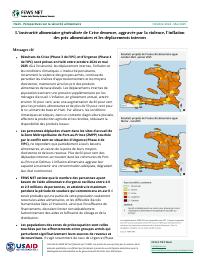
This is FEWS NET's full Food Security Outlook for October 2024 to May 2025. Crisis (IPC Phase 3) and Emergency (IPC Phase 4) outcomes are projected across the window, driven by insecurity, internal displacement, inflation and weather. Persistent insecurity, and armed group violence in particular, continues to disrupt supply chains and livelihoods and so keeps staple food prices high, while internal displacement puts additional pressure on host households. Year-on-year inflation reaches about 30 percent, with a 40 percent increase for food products and more than 50 percent for rice, Haiti's staple.
Erratic weather in a rain-fed agricultural system affects production and harvests and reduces the availability of local produce. Displaced people living in reception sites in the conflict-affected Port-au-Prince metropolitan area (ZMPP) are in Emergency (IPC Phase 4) and meet their food needs only partially, having lost their livelihoods and income; more than 60 percent of the internally displaced are in the communes of Port-au-Prince and Delmas, and food inflation degrades their ability to maintain adequate consumption and their nutritional status.
FEWS NET estimates the number of people needing emergency food assistance will range between 2.0 and 2.5 million and peak during the lean season beginning in April. It expects only part of that population to receive food aid, with humanitarian access difficulties linked to insecurity and insufficient funding considerably limiting delivery and the effectiveness of targeting and distribution. Areas of concern are those affected by clashes between armed groups that significantly disrupt income and food sources: displaced people in ZMPP camps and pockets of households scattered through the poor and very poor neighborhoods of the Port-au-Prince arrondissement and the commune of Cité Soleil are in Emergency (IPC Phase 4), while the Croix-des-Bouquets arrondissement, the lower Nord-Ouest and the wider ZMPP are in Crisis (IPC Phase 3).
How to cite
Famine Early Warning Systems Network (FEWS NET), Food Security Outlook, October 2024 - May 2025: Widespread Crisis food insecurity remains, worsened by violence, food price inflation and internal displacement, https://reliefweb.int/node/4104996