
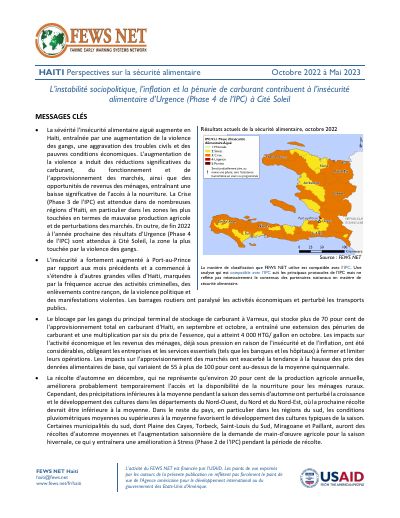
Food Security Outlook, October 2022 to May 2023: Sociopolitical instability, inflation and fuel shortages contribute to Emergency (IPC Phase 4) acute food insecurity in Cité Soleil
- Acute food insecurity is worsening in Haiti, driven by gang violence, civil unrest and poor economic conditions.
- Gang control of the Varreux fuel terminal in September and October caused fuel shortages and a sixfold rise in the gasoline price, to 4,000 HTG per gallon.
- Staple food prices ranged from 55 to more than 100 percent above the five-year average.
- Cité Soleil is expected to remain in Emergency (IPC Phase 4) until May 2023, and most of the country is in Crisis (IPC Phase 3).
- Average monthly migrant remittances fell to about 264 million dollars in January to July 2022, from 284.4 million in the same period of 2021.
- Harvests for the autumn and winter 2022-2023 seasons are expected to fall below average.
This FEWS NET outlook projects food security in Haiti from October 2022 to May 2023. It attributes rising acute food insecurity to gang violence, civil unrest and poor economic conditions. Gang control of the Varreux fuel terminal in September and October, which holds more than 70 percent of the country's fuel supply, caused shortages and a sixfold rise in the gasoline price to 4,000 HTG per gallon. Staple food prices ran 55 to more than 100 percent above the five-year average. Cité Soleil is expected to stay in Emergency (IPC Phase 4) until May 2023, and most of the country is in Crisis (IPC Phase 3). The outlook also covers below-average harvests, falling remittances, the cholera resurgence and its main assumptions for the period.
How to cite
Food Security Sector (FSS) Haiti, Food Security Outlook, October 2022 to May 2023: Sociopolitical instability, inflation and fuel shortages contribute to Emergency (IPC Phase 4) acute food insecurity in Cité Soleil, https://fscluster.org/sites/default/files/documents/ht_perspectives_sur_la_securite_alimentaire_oct_2022.pdf
- Rights holder
- Food Security Sector (FSS) Haiti